Custom Reactor Vessels Engineered Around Your Process
From atmospheric and vacuum operation to pressure reactions, heating, cooling and agitation, we design and manufacture reactor vessels around the actual process conditions—not a standard tank configuration.
A Reactor Is More Than a Mixing Tank
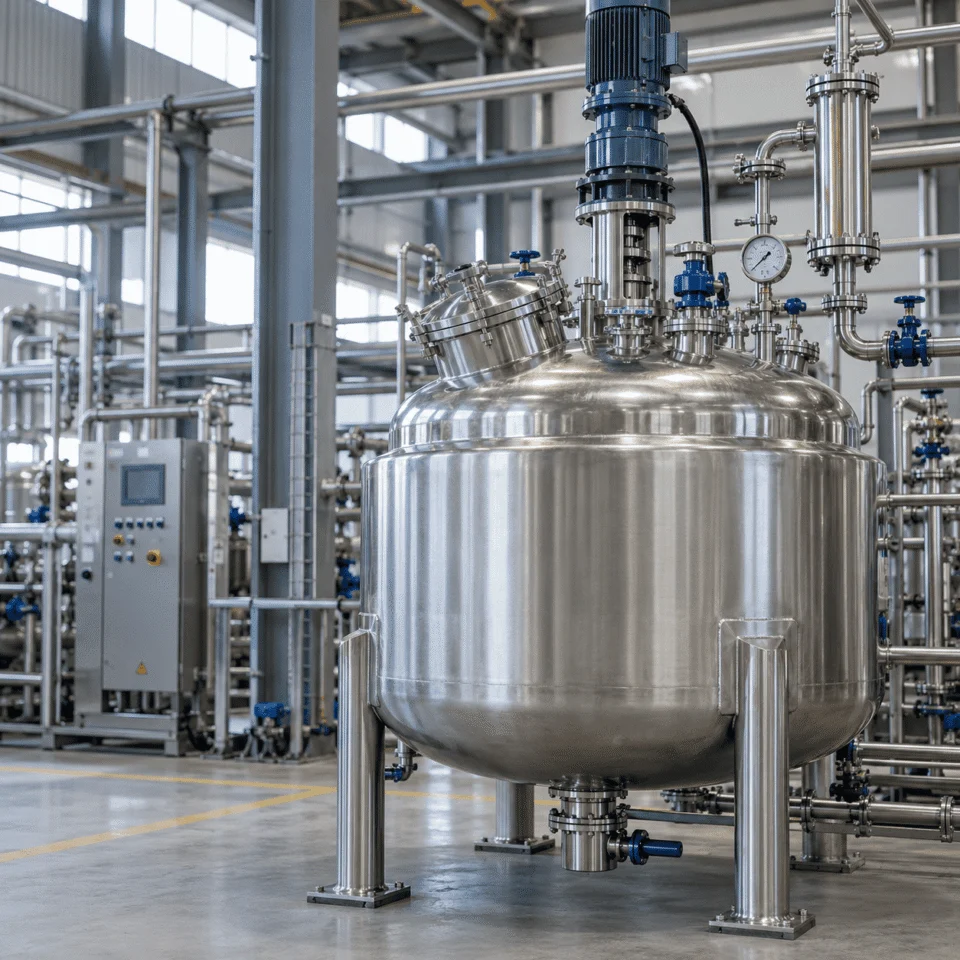
Both vessels can mix materials, but a reactor must also manage the conditions created by the reaction itself.
That changes the way the vessel, agitator, heat-transfer system, seals and safety provisions are engineered.
Primarily built to move and combine materials
Combine compatible liquids into a more uniform mixture.
Promote contact between soluble solids and the liquid phase.
Keep solids distributed through the working volume.
Reduce concentration differences throughout the vessel.
Heating or cooling may support the mixing process.
Engineered around what happens during the process
Internal pressure can become a primary mechanical design condition.
External-pressure stability must be reviewed separately from positive pressure.
Heating and cooling duty must match the actual thermal load of the process.
Vent, reflux, condensation and vapor disengagement may become part of the design.
Seals, relief devices and instrumentation must work with the process envelope.
The reactor must be reviewed as one system: vessel shell, mixing, heat transfer, sealing, instrumentation and safety provisions.
From Process Conditions to Reactor Design
Changing one process condition can change several parts of the reactor at the same time.
The vessel should be configured from the process outward—mixing, heat transfer, pressure boundary, materials and maintainability all respond to what happens inside the reactor.
Higher resistance to flow changes mixing and thermal behavior.
Suspension duty changes how the impeller and vessel bottom should work together.
Reaction heat can make cooling duty one of the primary design inputs.
External pressure creates a different mechanical design problem from internal pressure.
Material compatibility must be reviewed together with temperature and concentration.
Changeover frequency affects cleanability, access and internal geometry.
A reactor should not be selected by capacity alone. Volume, pressure, temperature, chemistry, mixing and heat transfer must be reviewed together.
Choose the Reactor Configuration Around the Process Duty
The vessel type should follow the process requirement—not the other way around.
Heating and cooling, agitation, pressure, vacuum, material compatibility and project-specific geometry can all change the final reactor configuration.

Jacketed Reactors
For reactions requiring controlled heating or cooling through an external heat-transfer surface.
Agitated Reactors
Configured around blending, suspension, dispersion, dissolution and reaction-uniformity requirements.
Stainless Steel Reactors
304, 304L, 316 and 316L configurations for corrosion-resistant and clean-process applications.
High-Pressure Reactors
For elevated-pressure reactions where vessel size, temperature, agitation and sealing must be reviewed together.
Vacuum Reactors
For reduced-pressure processing, evaporation, degassing, solvent handling and other vacuum duties.
Custom Process Reactors
Built from process data, equipment specifications, customer drawings or project-specific engineering requirements.
A stainless-steel reactor may also be jacketed, agitated, designed for vacuum and engineered for pressure service. These are design attributes, not mutually exclusive product boxes.
Mixing Is an Engineering Input
The agitator must match what happens inside the reactor—not simply a target RPM.
Viscosity, solids, shear, heat transfer and reaction behavior can all change the impeller geometry, shaft arrangement, motor torque and operating speed.

Impeller type, diameter, shaft design, speed and drive power should be reviewed as one mixing system.
Higher viscosity increases resistance to circulation and can shift the design toward lower-speed, higher-torque mixing.
Particles must remain suspended without creating unnecessary settling zones or excessive local shear.
Some reactions need gentle circulation, while dispersion and emulsification may require concentrated high shear.
Wall renewal and bulk circulation influence how effectively heat moves between the product and jacket or coil.
The process target determines how quickly concentration and temperature differences must be reduced.
Lower-viscosity circulation
General mixing and dispersion
Moderate low-speed mixing
Higher-viscosity products
Demanding bulk circulation
Dispersion and emulsification
Two reactors running at the same RPM can produce completely different mixing performance because vessel diameter, impeller diameter, viscosity, power input and flow pattern are different.
Heating & Cooling Must Match the Process Duty
Selecting a jacket is not simply choosing whether the reactor needs heating or cooling.
Required heating or cooling time, process viscosity, utility temperature, agitation and available heat-transfer area must be reviewed together.
Conventional Jacket
A general-purpose external jacket for many heating and cooling applications where a full outer heat-transfer zone is appropriate.
Dimple Jacket
A compact external heat-transfer surface that can promote utility-side turbulence while keeping the jacket profile relatively close to the vessel wall.
Half-Pipe Jacket
Often selected where higher utility-side pressure, demanding thermal duty or stronger external jacket construction is required.
Internal Coil
An internal coil can add heat-transfer area when the external jacket alone cannot provide the required thermal performance.
Steam, hot water, cooling water, chilled water, thermal oil and electric heating can all be considered according to the process and required temperature range.
Performance also depends on utility temperature, utility flow, product viscosity, agitation, fouling and the required heating or cooling time.
Material Selection Starts With the Process Fluid
The correct material is the one that matches chemistry, temperature, cleanliness and mechanical requirements.
A higher alloy grade is not automatically the better choice. Concentration, chlorides, cleaning chemicals, operating temperature and contamination requirements all affect the final selection.
Process chemistry defines the wetted-material requirement before the vessel grade is selected.
Acids, alkalis, chlorides, solvents and concentration all matter.
Material compatibility can change significantly as temperature increases.
Food, pharma and sanitary duties may require cleaner finishes and lower surface roughness.
Strength, weldability and code requirements also influence the final material choice.
Carbon Steel
Compatible chemical and industrial services where stainless steel is not required.
Corrosion allowance, coating or lining strategy may become important.
SS304 / 304L
General industrial, clean-process and many non-aggressive product-contact applications.
Chloride exposure and aggressive cleaning chemicals may limit suitability.
SS316 / 316L
Processes requiring increased corrosion resistance or higher hygiene performance.
Media concentration, chlorides and temperature still need confirmation.
Titanium
Selected highly corrosive services where conventional stainless steels may not be suitable.
Process chemistry, fabrication route and project specification must be confirmed.
Hastelloy
Demanding chemical environments requiring stronger corrosion resistance than conventional stainless steel.
The exact alloy should follow the actual process chemistry and service condition.
Industrial chemical service and sanitary product-contact service do not need the same internal finish.
For standard chemical and industrial applications.
Available for sanitary and clean-process product-contact surfaces.
Available for higher-polish or electropolished requirements.
The right material should be selected from the actual process chemistry, temperature, pressure, hygiene requirement and project specification.
Capacity, Pressure & Temperature Must Be Read Together
A reactor's size, pressure and temperature are not independent maximum ratings.
A small high-pressure reactor and a large industrial process reactor may both belong to the same product family, but they create very different mechanical design problems.
Increasing one design variable can change shell thickness, head geometry, nozzle reinforcement, support loads, agitator loads and fabrication requirements.
Smaller diameter and lower volume can support a very different pressure design approach than a large production reactor.
Large diameter and vessel weight create different fabrication, support, transport and structural considerations.
Final capability depends on the exact combination of volume, pressure, temperature, material, geometry, agitation and applicable design requirements.
Pressure, Vacuum & Temperature Form One Design Envelope
These conditions must be reviewed as one mechanical system—not as three separate specifications.
Internal pressure checks containment, vacuum checks shell stability, and temperature changes the way materials, seals, jackets and connected components behave.
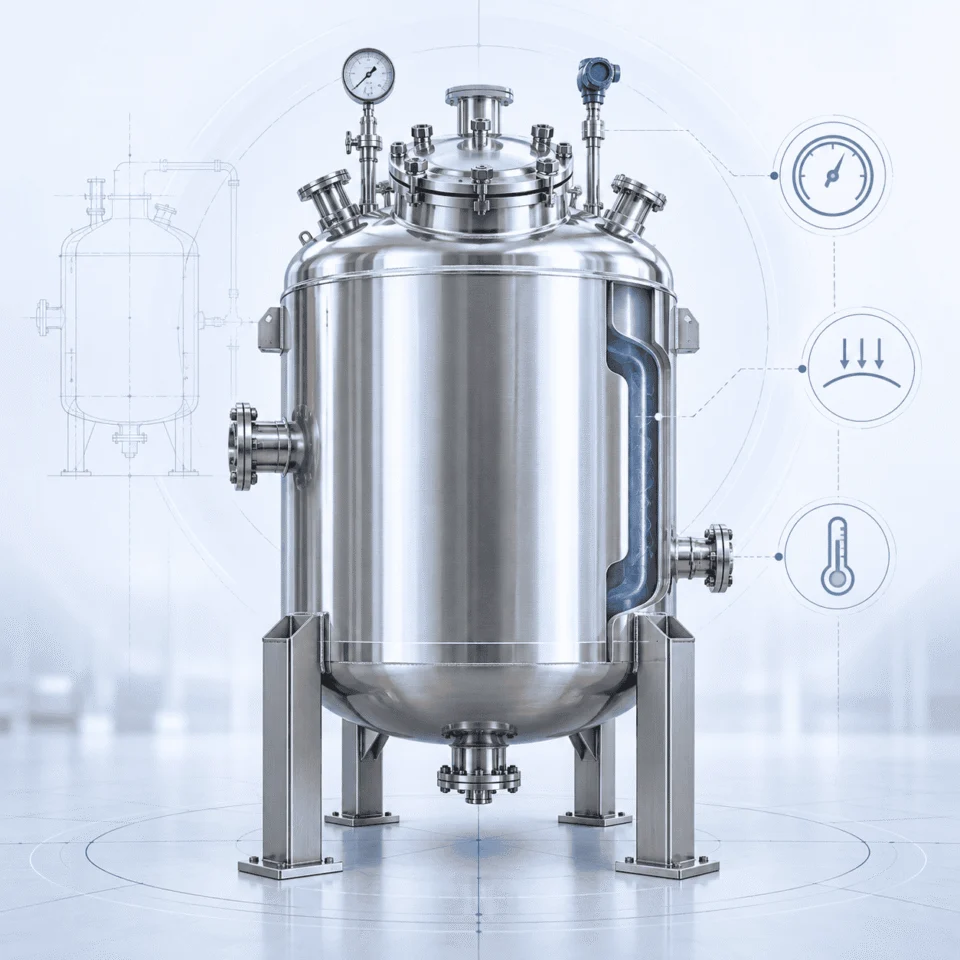
The same reactor may experience different pressure and temperature conditions on the process side and utility side.
Containment & Reinforcement
Positive internal pressure primarily drives the pressure-boundary and reinforcement checks.
Stability Against Buckling
Vacuum creates a stability problem that cannot be judged from positive-pressure capability alone.
Material & Thermal Behavior
Temperature affects material strength and how the vessel interacts with seals, gaskets and the heat-transfer system.
Higher temperature can reduce allowable stress and change the required pressure-boundary thickness.
Larger diameter can make external-pressure stability more demanding under the same vacuum condition.
The process shell and jacket may see different pressures and temperatures at the same time.
Drive, shaft, seal and nozzle loads must be considered together with the vessel design.
Internal pressure checks containment. Vacuum checks stability. Temperature affects both the material response and the connected process system.
Reactor Design Is a Balance, Not a List of Options
More is not automatically better. Every design choice changes something else in the reactor system.
Good reactor design comes from balancing process performance, mechanical loads, heat transfer, maintainability, material compatibility and cost—not from maximizing a single specification.
Increasing speed or power looks like the simplest way to improve mixing.
More surface area may help, but it is only one part of the thermal system.
Wall thickness helps, but vacuum resistance is strongly affected by geometry and unsupported length.
A more expensive alloy is not automatically the best choice for every process.
It is the reactor whose pressure boundary, mixing system, heat-transfer configuration, material and operating features work together for the actual process.
Configure the Reactor Around the Process Line
Nozzle locations, instruments, safety devices and connected equipment should follow the actual P&ID and operating sequence.
A reactor is not complete when the shell is finished. Feed, discharge, venting, sampling, measurement, relief and external process connections all have to work with the plant layout.
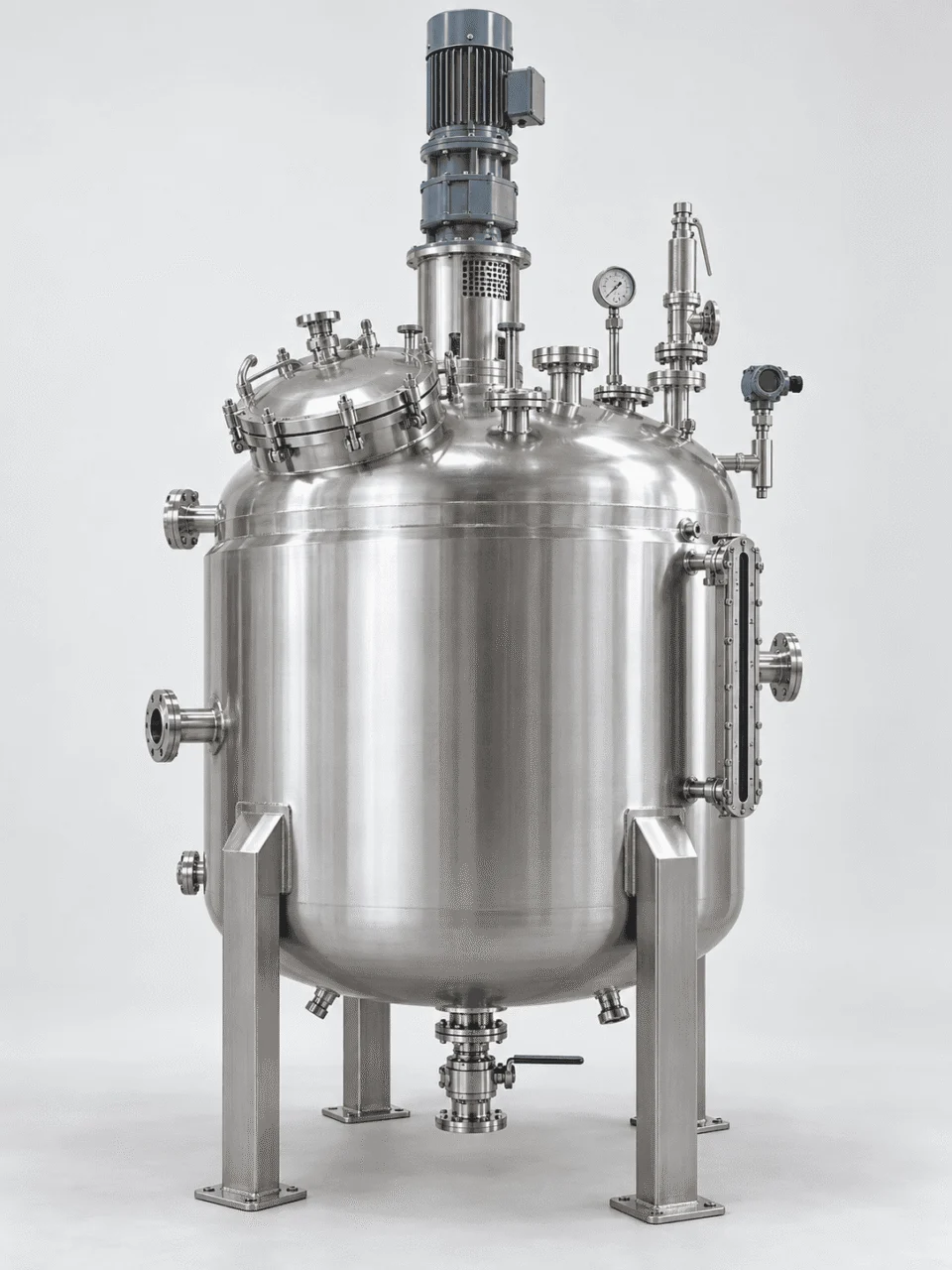
Two reactors with the same capacity may need completely different connection layouts because charging, sampling, cleaning, venting, reflux, maintenance access and surrounding piping are different.
A Reactor Must Work After It Reaches the Plant
Mechanical design should also consider how operators will use, clean, inspect and maintain the equipment.
Two reactors can have similar process specifications but behave very differently in daily operation if access, drainage, maintenance clearance and serviceability are not considered early.
The reactor has to fit into a real plant, with real operators, piping, maintenance tools and cleaning procedures.
Can the agitator be removed for maintenance?
Motor, gearbox, shaft and impeller removal may require vertical lifting space, service clearance and access around the top head.
Is the mechanical seal accessible?
Seal replacement becomes difficult when surrounding piping, platforms or instruments block the drive-end service area.
Can the vessel drain completely?
Bottom geometry, outlet elevation and valve arrangement can determine whether product remains trapped after discharge or cleaning.
Can operators inspect internal surfaces safely?
Manway size, orientation and surrounding access affect inspection, cleaning and internal maintenance after installation.
Can instruments and valves be removed without major disassembly?
Transmitters, probes, gauges and bottom valves should remain serviceable after nearby piping and platforms are installed.
Can the reactor be cleaned effectively?
Internal geometry, nozzles, dead zones and spray coverage should match the required cleaning method and product changeover frequency.
Allow vertical space for motor, gearbox, seal and shaft service.
Keep sufficient working space around access openings and removable probes.
Provide clearance for valves, actuators, piping and maintenance tools.
Platforms, pipe racks and adjacent equipment should not block service routes.
Operation and maintenance requirements should influence nozzle orientation, access, clearance, drainage and component arrangement before fabrication is finalized.
From Process Data to a Finished Reactor
A custom reactor moves through a connected engineering and manufacturing sequence—not a collection of isolated fabrication steps.
Process conditions define the mechanical design, the mechanical design defines the fabrication basis, and inspection and testing verify that the finished vessel matches the agreed project requirements.
Operating media, working volume, pressure, temperature, agitation, heat-transfer duty and material requirements are reviewed first.
Shell, heads, jacket, nozzles, supports, agitator loads and applicable project requirements are brought into one design basis.
Wetted material, jacket material, seals, gaskets, agitator components and process accessories are selected according to the agreed service conditions.
Forming, fit-up, assembly and welding are completed against the approved equipment configuration and fabrication requirements.
Visual inspection and any required NDT are defined according to the vessel design, project specification and agreed inspection scope.
Hydrostatic, pneumatic or leak testing is carried out according to the equipment specification and agreed test requirements.
Project documentation can be prepared according to the agreed scope, including drawings, material records, inspection records and test documentation.
Changes to process data, material, pressure, temperature, nozzles or agitation should be reflected in the engineering and manufacturing basis before final fabrication proceeds.
Reactor Vessels for Different Process Industries
The same reactor platform can be configured very differently depending on the industry, product behavior, hygiene requirement and operating conditions.
Use the application links to explore industry-specific requirements, or send your process data so we can review the reactor configuration around your project.
Chemical synthesis, blending, dissolution, polymer and specialty chemical processes.
Pressure-dependent reactions, additives, intermediates and process chemicals.
Controlled reactions, clean processing and sanitary reactor applications.
Temperature-controlled processing, blending and sanitary reaction duties.
Clean-process applications requiring controlled temperature and hygienic construction.
Fermentation, biological processing and temperature-controlled vessel duties.
What Should You Send Us for a Reactor Vessel Quote?
The more process information we receive, the more accurately the reactor can be configured.
Questions Buyers Often Ask Before Finalizing a Reactor
The correct answer usually depends on the process conditions, not only the vessel capacity.
These questions cover the information, pressure conditions, jacket options, agitation, materials, drawings and accessories typically reviewed before a reactor configuration is finalized.
Pressure, vacuum, temperature, mixing, heat transfer and material selection are connected decisions. If your project already has a datasheet or drawing, those documents can be used as the starting point for review.
What information is required to design a reactor vessel?
At minimum, working volume, process medium, pressure, temperature, material and basic mixing requirements are needed. Heat-transfer data, viscosity, solids content and drawings allow a more accurate configuration.
Can a reactor vessel operate under both pressure and vacuum?
Yes, when both operating conditions are included in the mechanical design. Positive-pressure capability alone does not automatically mean the reactor is suitable for full vacuum.
What jacket types are available?
Common options include conventional jackets, dimple jackets, half-pipe jackets and internal coils. The correct arrangement depends on heat-transfer duty, utility conditions and mechanical requirements.
How is the agitator selected?
Selection depends on viscosity, density, solids, shear requirement, vessel geometry, heat transfer and the actual mixing objective. RPM alone is not enough to define the mixing system.
What materials can be used?
Common materials include carbon steel, SS304/304L and SS316/316L. Titanium, Hastelloy and other project-specified materials can also be considered for demanding applications.
Can you manufacture a reactor from our drawings?
Yes. Reactors can be manufactured from customer drawings, datasheets and project specifications after technical review.
Can you supply instruments and process accessories?
Yes. Reactor configurations can include instrumentation, valves, safety devices, condensers, CIP connections, sampling systems and other project-specific components.
What sizes of reactor vessels can you manufacture?
Typical projects can range from small process reactors to large industrial vessels, with reference capacities extending from approximately 50 L to 50,000 L and above. Final capability depends on pressure, temperature, material and equipment configuration.