CHANNELVESSEL · CHEMICAL MIXING TANKS
Chemical Mixing Tanks for Industrial Blending
ChannelVessel builds each chemical mixing tank around your materials, working batch size and mixing objective. Choose single-shaft agitation, anchor mixing or a combined dispersion system, with wetted materials, sealing, heating and cooling matched to the process.
For liquid blending, powder incorporation, solids suspension and viscous batch preparation, the vessel, agitator and controls form one coordinated equipment package.
- Wetted material and seal options for the specified chemistry.
- Agitation selected for circulation, viscosity and shear requirements.
- Jacket, closed-vessel and control options to suit the operating conditions.
Match the Tank to Your Mixing Duty
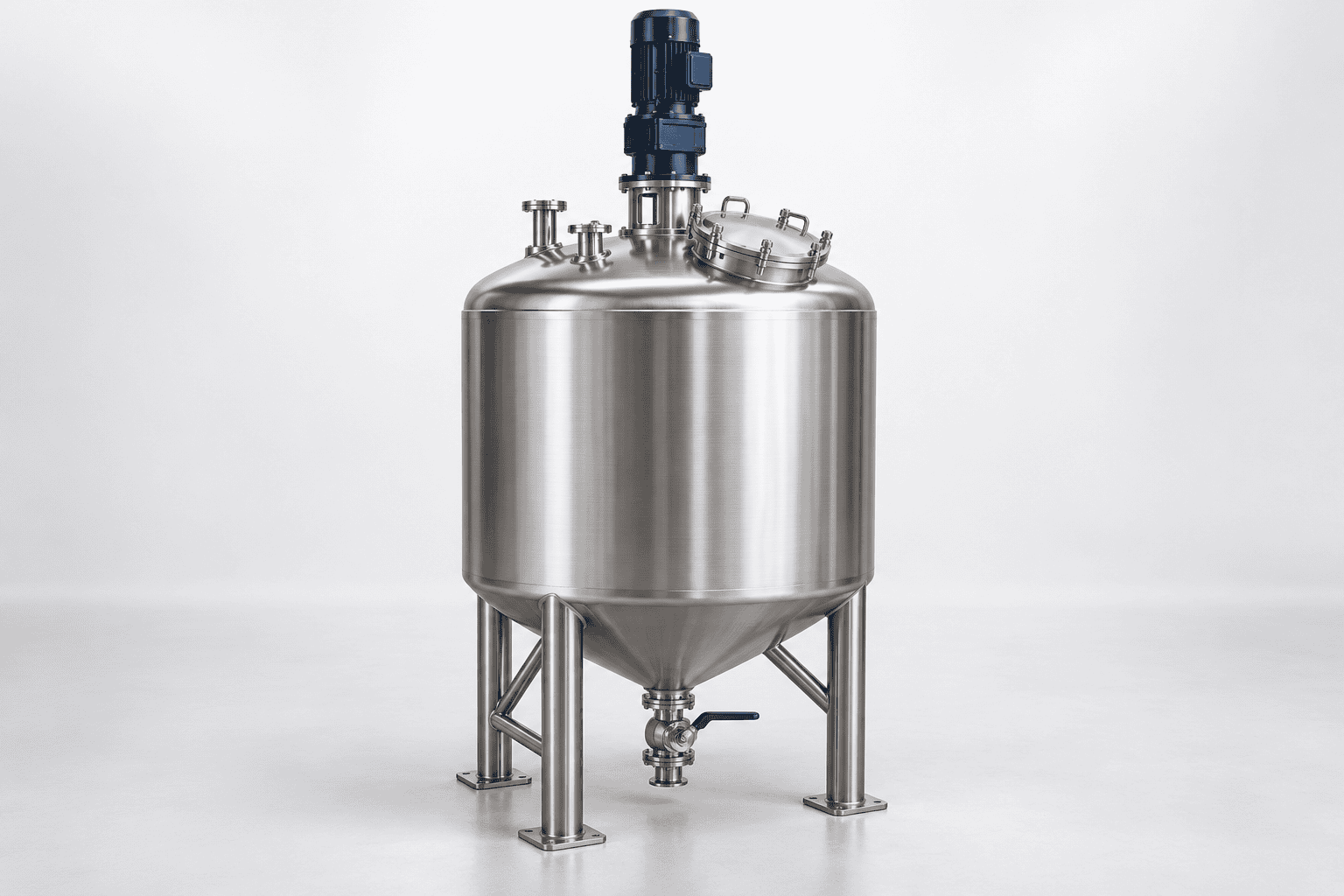
Start with the goals of the batch. Blending compatible liquids, suspending settling particles and dispersing agglomerates place different demands on the same tank volume.
| Mixing duty | Configuration to consider | What determines the selection |
|---|---|---|
| Liquid blending | Single-shaft agitation with an axial-flow or other duty-specific impeller | Liquid miscibility, density, viscosity, batch depth and required circulation |
| Powder wetting and dissolution | Agitation coordinated with the powder addition point; a disperser where agglomerates need to be broken down | Wetting behavior, solubility, addition rate, viscosity development and air entrainment |
| Solids suspension | Tank geometry and impeller arrangement selected to circulate the solids | Particle size, density difference, solids loading, settling tendency and minimum batch level |
| Viscous batch mixing | Anchor agitation, with an additional mixing device when the process also needs dispersion | Viscosity at operating temperature, changing rheology, startup torque and heat transfer |
| Dispersion and emulsification | A high-speed dispersing disc or rotor-stator homogenizer, supported by bulk circulation | Formulation, required shear, feed conditions and the agreed dispersion or emulsion target |
Applications can include compatible process solutions, water-based coating and additive dispersions, polymer preparations, adhesives and other viscous intermediates. Each application needs a material and operating-condition review before the equipment is specified.
Explore the wider Mixing Tanks range when comparing equipment for different process duties.
AGITATOR CONFIGURATIONS
Chemical Mixing Tank Configurations

Single-Shaft Batch Mixing
A top-entry drive turns a shaft fitted with a propeller, pitched-blade impeller or turbine selected for the duty. Impeller position, vessel proportions and any baffles are considered together to establish circulation through the working batch.
This arrangement provides a straightforward starting point for liquid blending and suitable dissolution or suspension duties. The required flow pattern and material properties determine the impeller and drive combination.

Anchor Mixing for Viscous Batches
An anchor agitator moves material near the vessel wall and supports bulk movement in viscous batches. Where appropriate, compatible wall scrapers can be considered for material buildup and heat-transfer requirements.
Drive selection must account for torque, including startup and changes in viscosity during processing. A separate disperser or homogenizer can be added when the formulation also requires localized high shear.
Multi-Drive Dispersion and Homogenizing
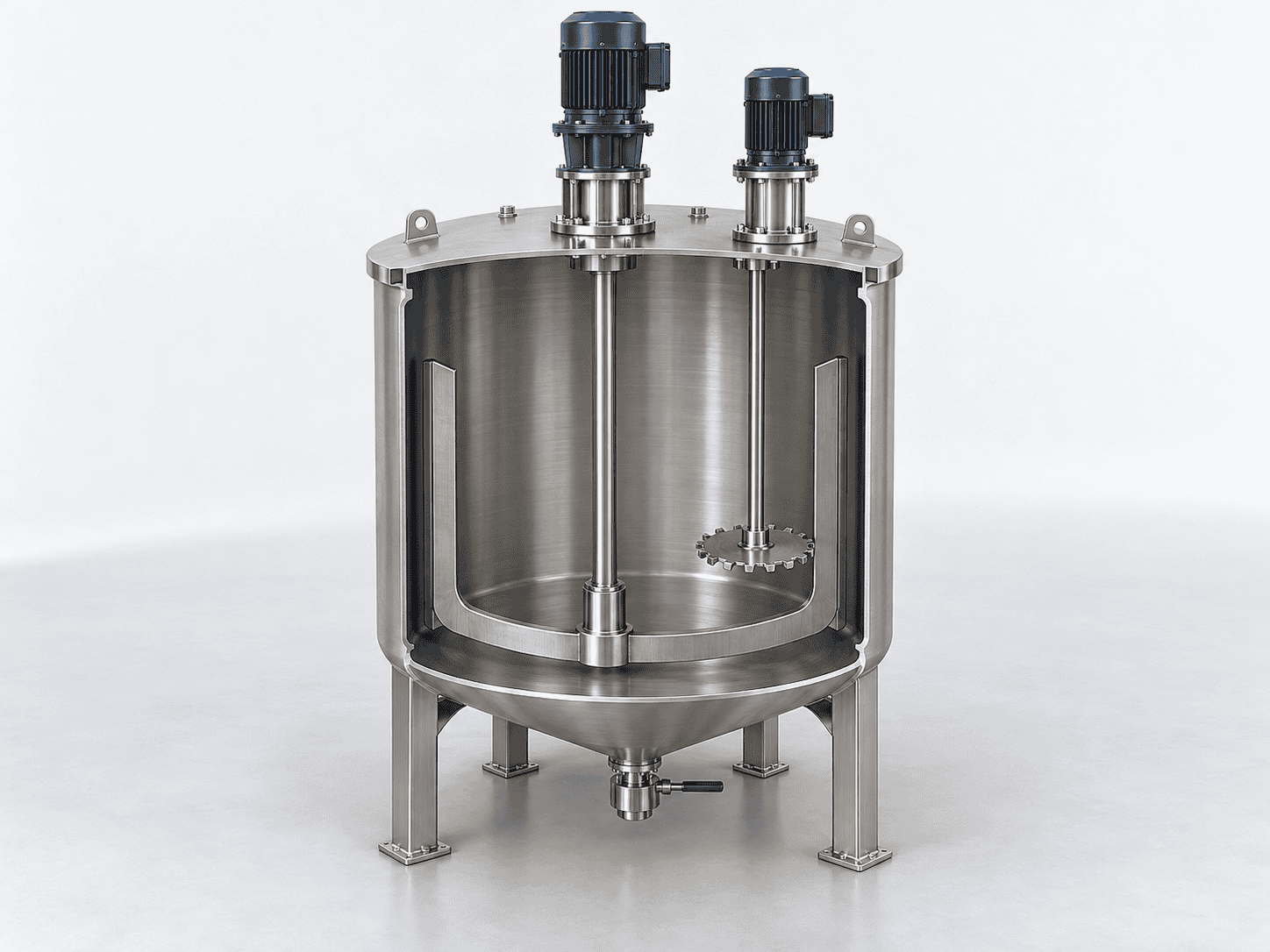
Independent drives allow bulk mixing and high-shear processing to perform different jobs. An anchor can move the batch while a high-speed disc disperses powders, or a slow agitator can support circulation through a rotor-stator homogenizer.
A dispersing disc and a rotor-stator head produce different flow and shear conditions. Selection depends on the formulation and process target; changing between them also changes the drive, circulation and maintenance requirements.
Jackets, closed covers, instrumentation and automation can be combined with these mixing arrangements. They are specified alongside the agitator architecture.
CAPACITY & DRIVE SELECTION
Chemical Mixing Tank Specifications
The following are illustrative configurations for initial discussion. The two tables describe different equipment architectures and are not interchangeable motor options for the same mixing duty. Final drive selection depends on material properties, impeller geometry and the mixing objective.
Single-Agitator Reference Configurations
These capacity and motor combinations do not establish a viscosity rating or mixing-time guarantee. Agitator speed, impeller diameter and required torque must be selected for the actual batch.
| Working volume (L) | Main agitator motor (kW) |
|---|---|
| 500 | 0.55 |
| 1,000 | 0.75 |
| 2,000 | 1.5 |
| 3,000 | 2.2 |
| 5,000 | 3.0 |
Mixing and Homogenizing Reference Configurations
These examples represent a fixed-cover vacuum mixing arrangement with a slow agitator and an external recirculating rotor-stator homogenizer.
| Working volume (L) | Slow agitator motor (kW) | Homogenizer motor (kW) |
|---|---|---|
| 500 | 4.0 | 7.5 |
| 1,000 | 5.5 | 15 |
| 2,000 | 7.5 | 18.5 |
| 3,000 | 11 | 22 |
| 5,000 | 18.5 | 37 |
Example drive-speed ranges for this arrangement are 0–60 rpm for the slow agitator and 0–3,600 rpm for the homogenizer. The operating speeds are selected for the product and process stage.
The motor values cover the listed mixing drives. Electric heating, vacuum generation, transfer pumps and thermal utilities require separate allowance when determining the electrical demand of the complete package.
Working Volume, Gross Volume and Minimum Batch
Working volume is the intended process batch. Gross volume is the vessel's total internal capacity. Free space above the working batch accommodates mixing movement, additions and any expected foam or expansion.
The minimum batch also matters: the liquid must adequately cover the impellers and support the intended circulation. Specify both the normal batch and the smallest batch required so vessel geometry, impeller position and operating levels can be checked together.
MATERIALS & SEALING
Wetted Materials and Sealing Options
Material selection covers every product-contact surface: the vessel, shaft, impellers, nozzles, valves, seal faces and elastomers. External supports and cladding can have a different material specification.

| Component or option | Selection basis |
|---|---|
| SS304 wetted construction | Consider where compatibility with the complete formulation and cleaning conditions has been established |
| SS316L wetted construction | Consider where its corrosion resistance suits the specified chemistry; assess concentration, temperature and impurities |
| Special-alloy wetted parts | Evaluate when the process requires corrosion resistance beyond the selected stainless steel grade |
| Gaskets and other elastomers | Select for the product, cleaning chemicals, temperature and exposure conditions |
| Packing or a mechanical seal | Select for the shaft arrangement, containment requirement and operating conditions |
| Double mechanical seal with a support system | Consider where the duty requires the specified seal arrangement, lubrication, cooling or barrier-fluid management |
SS316L compatibility depends on the full formulation and operating conditions. Include cleaning fluids and any seal-support medium that could contact the product in the same review.
See Stainless Steel Mixing Tanks for related construction options.
HEATING & COOLING
Heating, Cooling and Closed Operation
A jacketed chemical mixing vessel can combine agitation with heating or cooling. The thermal arrangement is selected around batch mass, material properties, starting and target temperatures, required processing time and available utilities.
| Requirement | Configuration options |
|---|---|
| Heating | A steam jacket, circulating hot-water or thermal-fluid system, or a suitably designed electric-heating arrangement |
| Cooling | A jacket connected to cooling water or a suitable chilled-fluid circuit |
| Temperature control | A product-temperature sensor, controller or PLC, and the required utility valves or circulation controls |
| Insulation | Insulated construction and outer cladding where required for the thermal duty and operating environment |
| Closed operation | A closed cover with specified charging, sampling, venting and instrument connections |
| Vacuum or pressure service | Vessel, cover, seals, connections and protective provisions designed for the agreed conditions |

The product space and jacket have separate operating and design pressure-temperature requirements. A closed cover alone does not establish a pressure or vacuum rating. The equipment specification should state both sets of conditions and identify the required design and inspection basis.
For flammable-solvent applications, the project review must also address area classification, electrical equipment, sealing, venting and any required inerting provisions. These requirements apply to the assembled package and its site interfaces.
The heating or cooling unit, circulation pump and utility-control package can be included in the quotation or provided by the site. Explore Jacketed Mixing Tanks for related temperature-control arrangements.
BATCH OPERATION
From Charging to Discharge
The equipment can support the following batch stages. Their order and overlap depend on the formulation and operating procedure.
- Charge materials. Use designated liquid and powder connections, with weighing, flow measurement or level indication where required.
- Mix or disperse. Set the agitator and any independent high-shear drive for the current batch stage.
- Heat or cool as needed. Coordinate temperature measurement, utility flow and agitation with the process requirements.
- Check the batch. Provide an appropriate sampling connection and define the required product checks separately from equipment functional checks.
- Discharge. Match the outlet, valve and any transfer pump to product viscosity, solids content and the downstream connection.
Control options range from local operation to variable-speed drives and PLC/HMI control with agreed recipe steps, alarms and interlocks. The control description should make clear which functions are automatic, which actions require an operator and which signals connect to the plant system.
Cleaning and maintenance access are considered alongside production. Outlet position, internal obstructions, cleaning connections and access to the shaft, seal and impellers affect changeover and servicing. Spray-cleaning provisions can be included where suitable; cleaning effectiveness still depends on the residue, cleaning method and vessel arrangement.
EQUIPMENT PACKAGE
What Comes with Your Mixing Tank
Define the equipment package before comparing quotations. The following provides a proposed baseline and a clear way to separate options from site responsibilities. The project quotation establishes the final supply scope.
| Proposed base package | Optional equipment and controls | Site provisions, unless included |
|---|---|---|
| Main vessel, supports, cover, access and agreed process connections | Jacket, insulation and heating or cooling equipment | Foundation, location preparation and required building access |
| Main agitator drive, shaft, selected impellers and associated guarding | Independent disperser, homogenizer or recirculation arrangement | Site electrical supply and cabling to the agreed connection point |
| Sealing arrangement for the specified duty | Vacuum equipment and seal-support system | Steam, hot water, cooling water or chilled-fluid supply |
| Agreed operating controls and instrument interfaces | Weighing, dosing, PLC/HMI and plant-system integration | Compressed air, drainage and site ventilation where required |
| Agreed technical documents and inspection records | Transfer pump, valves, skid piping and cleaning connections | Upstream and downstream pipework, installation and site connections |
For a packaged system, the supply list should also identify piping termination points, utility connections, control interfaces and any installation or commissioning services included in the order.
FABRICATION & DOCUMENTATION
Fabrication, Inspection and Project Documents
ChannelVessel manufactures chemical mixing vessels to the agreed equipment specification and supply scope. Before fabrication, the project review establishes the vessel arrangement, mixing assembly, material requirements, site interfaces and inspection plan.

| Document or inspection item | What it helps you verify |
|---|---|
| General arrangement drawing and nozzle schedule | Footprint, connection orientation, operating access and maintenance clearance |
| Material records and agreed traceability | The specified material grades and product-contact scope |
| Welding and inspection plan | Required welding records, inspection stages and any specified examination |
| Pressure or leak testing, where applicable | The agreed test scope and acceptance requirements for the relevant equipment |
| Factory acceptance testing, where specified | Agreed functional checks, such as drive rotation, controls and interlocks |
| Electrical drawings and operation and maintenance documents | Power and signal interfaces, operating instructions and service requirements |
The required records, inspection points and test scope are defined for the project. A functional factory test and a formulation-specific mixing trial have different purposes; any product-performance acceptance test needs its own materials, method and acceptance criteria.
BUYING QUESTIONS
Chemical Mixing Tank FAQs
What materials are available for a chemical mixing tank?
Options include SS304, SS316L and suitable special alloys for the specified wetted parts. Selection depends on the chemical composition, concentration, operating temperature, impurities and cleaning fluids. Include gaskets, seal faces and valves in the compatibility review. External structural parts can use a different material from the surfaces that contact the batch.
How do I choose the working volume?
Start with the normal process batch and the smallest batch you need to run. The vessel then needs enough gross capacity for that working volume, mixing movement, additions and expected foam or expansion. Minimum liquid level must suit the impeller arrangement. A tank's stated total capacity should therefore be checked against its actual usable batch range.
How is agitator power selected?
Agitator power is selected from the mixing duty, material properties, impeller type and size, speed and vessel geometry. Viscosity changes and startup conditions also affect torque and drive selection. Capacity alone is insufficient. Where a separate disperser or homogenizer is fitted, its motor rating and process role must be considered separately from the main agitator.
Do I need a disperser or a homogenizer?
A high-speed dispersing disc is a candidate when powder incorporation and agglomerate breakdown are central to the process. A rotor-stator homogenizer is considered where localized high shear is required for the formulation's dispersion or emulsification target. Both depend on effective circulation and feed conditions. Product trials may be needed to establish the required result and suitable operating settings.
Can the tank be heated and cooled?
Yes. Jacketed construction can be configured for heating and cooling using suitable site utilities or a dedicated thermal system. The available utility temperature and flow, batch properties and desired processing time determine the thermal design. The jacket, insulation, control valves, circulation equipment and thermal unit should each be identified in the supply scope.
Can you supply a sealed, vacuum or pressure-rated design?
Closed, vacuum and pressure-service arrangements can be considered for the specified project. Each requires a suitable vessel, cover, seal, connection and protection arrangement. Provide the operating and design conditions for the product space and jacket separately, together with the applicable design requirements. A lid or shaft seal by itself does not make a tank pressure-rated.
How are the tank and agitator cleaned and maintained?
The cleaning method depends on the formulation, residue and vessel internals. Options include access for manual cleaning and suitable spray-cleaning connections. The design review should cover drainage, accessible surfaces and removal or servicing of the seal, shaft and impellers. Required lifting space and maintenance clearance should be shown on the arrangement drawing; cleaning results need evaluation for the intended process.
What affects the price of a chemical mixing tank?
Price depends on working volume, wetted material, vessel geometry, agitator type and drive requirements. A jacket, vacuum or pressure design, separate high-shear drive, seal-support system, automation and packaged piping also change the scope. Inspection, documentation and delivery requirements matter as well. Compare quotations using the same process conditions and equipment list to understand cost differences.
PROJECT REQUIREMENTS
Get a Chemical Mixing Tank Proposal
Send your process requirements or an existing drawing. We can develop a proposal covering vessel construction, agitation, temperature control, instrumentation and the agreed equipment package.
- Chemistry: product name, composition, concentration, relevant hazards and cleaning fluids.
- Batch size: normal working volume, maximum intended batch and minimum batch.
- Material properties: viscosity at the relevant temperature, density, solids loading and particle information where applicable.
- Operating conditions: process temperatures, heating or cooling needs, and operating and design pressure or vacuum for the vessel and jacket.
- Mixing objective: blending, dissolution, suspension, dispersion or emulsification, with the required result and any existing process constraints.
- Project interfaces: drawings, available utilities, power supply, connection and space requirements, quantity and destination.
If you are replacing an existing tank, send the current arrangement and describe the processing or maintenance issue you want to resolve.