ChannelVessel Intelligent Equipment Co., Ltd. Contact Us
CUSTOM CHEMICAL STORAGE SOLUTIONS

Chemical Storage Tanks

Custom Metal Storage Tanks Engineered Around Your Chemical and Process

ChannelVessel manufactures custom chemical storage tanks for industrial storage and process applications. Material, geometry, corrosion protection, connections and accessories are configured around the chemical being stored and the conditions under which the tank will actually operate.

0.5–200 m³ Typical Custom Capacity
304 / 316L / CS Material Options
Vertical / Horizontal Tank Configuration
Custom Engineered Lining · Jacket · Agitation

Atmospheric storage as standard; pressure or vacuum service can be engineered where required.
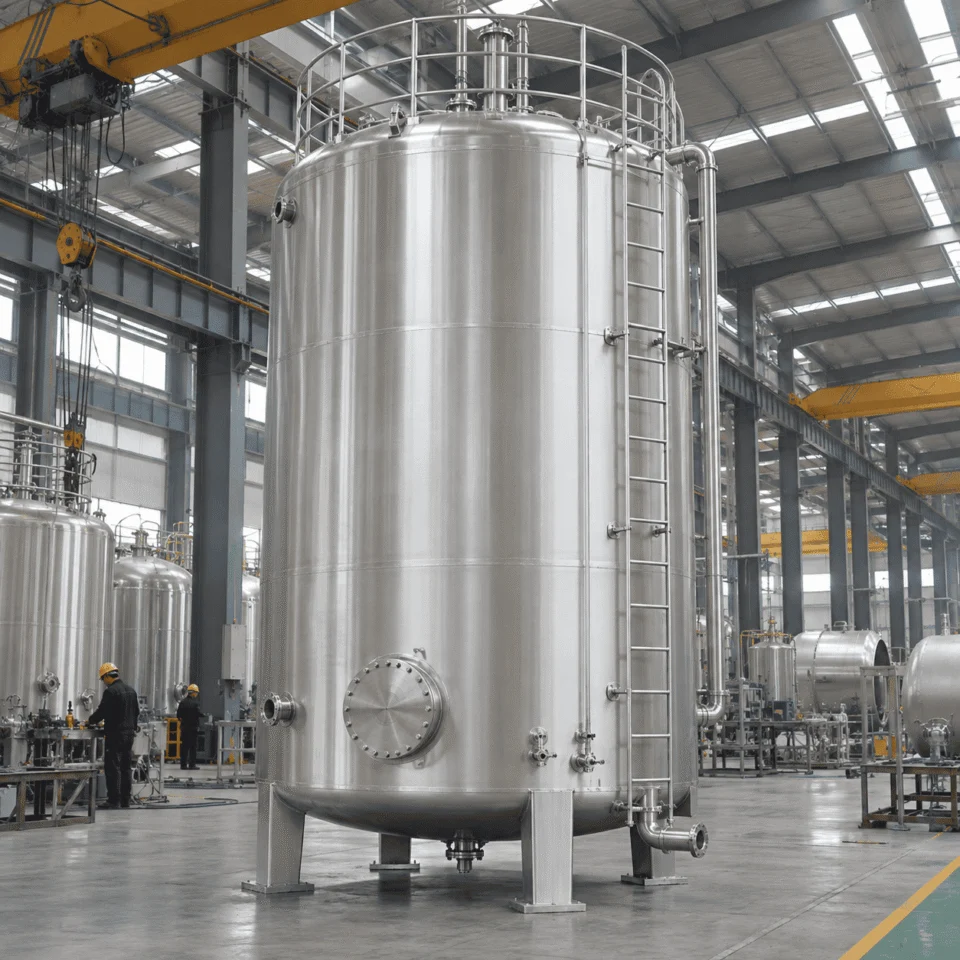
Custom chemical storage tank manufactured by ChannelVessel
ENGINEERED AROUND Chemical · Temperature · Process
AVAILABLE OPTIONS Lined · Jacketed · Insulated
LAYOUT Bulk storage / floor-space efficient

Vertical Chemical Storage Tanks

A practical choice for bulk chemical storage where efficient use of floor space matters. Bottom geometry, access and nozzle arrangement can be configured around drainage and process requirements.

Flat / Sloped / Cone Bottom Indoor / Outdoor
LAYOUT Low-profile installation

Horizontal Chemical Storage Tanks

Suitable where installation height is restricted or where a lower-profile arrangement works better with the process layout.

Saddle Supported Custom Nozzles
MATERIAL Clean / corrosion-resistant service

Stainless Steel Chemical Storage Tanks

SS304, SS304L, SS316 and SS316L are available where stainless steel is compatible with the chemical and operating conditions.

SS304 / SS316L Pickling / Passivation
MATERIAL Economical structural base

Carbon Steel Chemical Storage Tanks

A cost-effective structural solution for compatible chemical service. Corrosion allowance, internal coating or lining can be incorporated when required by the application.

Carbon Steel Optional Internal Protection
PROTECTION For more demanding chemical exposure

Lined & Coated Chemical Tanks

Where direct contact with the base metal is not appropriate, a chemical-resistant lining or coating system can be evaluated around the medium, concentration and operating temperature.

PTFE / PFA / ETFE Options Project-Specific Selection
PROCESS Temperature & product control

Jacketed, Insulated & Agitated Tanks

Heating or cooling jackets, internal coils, insulation and agitator connections can be incorporated where required.

Jacket / Coil Insulation / Agitation
CHEMICAL SERVICE ENVELOPE

Chemical + Process Data → Tank Design Basis

A chemical storage tank should be defined around the complete service envelope—not only the stored liquid. Material compatibility, temperature, vapor behavior, corrosion risk and operating conditions all influence the final tank configuration.

Chemical Medium Stored product, composition and concentration
Operating Temperature Normal, minimum and maximum service temperature
Corrosion Behavior Compatibility, corrosion allowance and surface requirements
Tank Capacity Working volume, total volume and available installation space
DESIGN INPUT
Chemical storage tank engineering design basis
PROCESS DATA Tank Design Basis

Geometry · Material · Connections · Venting · Thermal Control · Agitation

Pressure / Vacuum Atmospheric, low-pressure or vacuum service requirements
Venting & Vapor Breathing, vapor control, emissions and safe vent arrangement
Thermal Requirements Heating, cooling, insulation, jacket or internal coil needs
Connections & Agitation Nozzles, drains, instruments, mixers and process interfaces
ENGINEERING REVIEW
Normal Condition Routine operating data
Full Design Envelope Startup, shutdown, upset and cleaning conditions included
MATERIAL & CONSTRUCTION OPTIONS

Choose the Right Tank Construction for Your Chemical Service

The right tank material depends on more than the product name alone. Chemical concentration, operating temperature, cleaning method, corrosion behavior and service life expectations all affect the final construction choice.

ChannelVessel matches the service conditions with the appropriate tank material, internal finish and auxiliary construction options.

GENERAL SERVICE

304 Stainless Steel

Explore Stainless Steel →

A practical choice for many general industrial liquids, water-based chemicals and non-aggressive cleaning media where chloride exposure and corrosion severity are limited.

Mild chemical storage Water-based solutions General plant service
PROTECTED CARBON STEEL

Carbon Steel + Lining / Coating

Explore Carbon Steel →

A cost-effective route for suitable services where carbon steel is compatible with the process or where an appropriate internal protection system can be engineered for the stored chemical.

Cost-sensitive projects Compatible process media Lined or coated service
CUSTOM CONSTRUCTION

When storage duty becomes part of the process

More complex chemical services may require thermal control, agitation, specialized nozzles, instruments or reinforced support arrangements. These features should be selected from the actual process duty rather than added as generic options.
Thermal Control Insulation, heat tracing, jackets or internal coils
Mixing & Agitation Agitators selected around viscosity and process duty
Process Connections Custom nozzles, drains, instruments and transfer interfaces
Support & Installation Legs, skirts, platforms and site-specific support arrangements
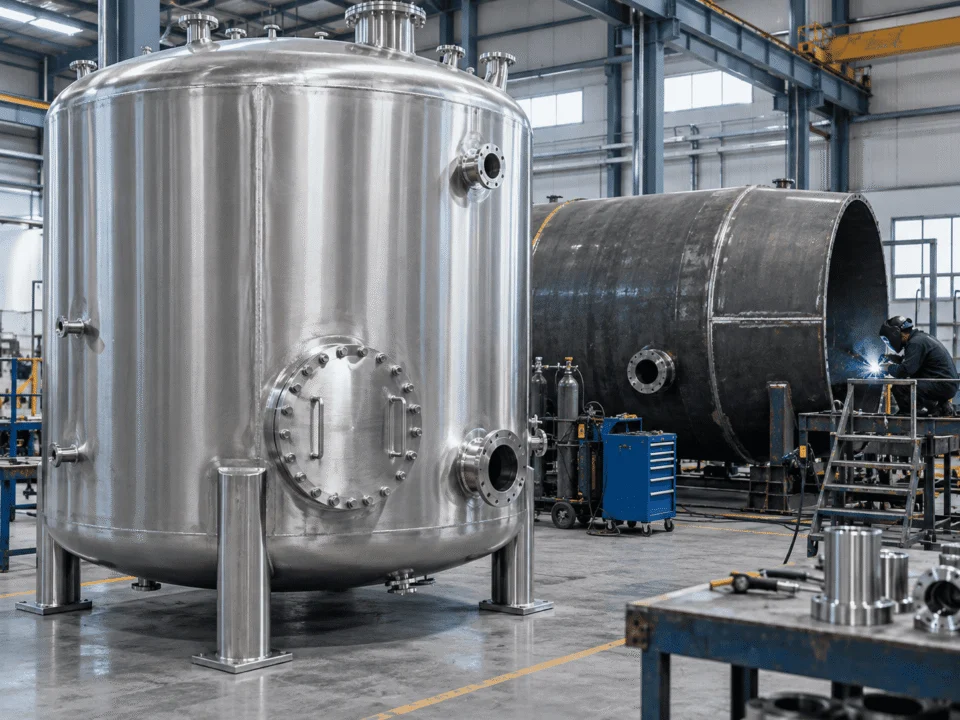
Chemical storage tank material and fabrication detail
FROM MATERIAL TO COMPLETE CONFIGURATION The final tank specification is built around the chemical, the process and the operating environment.
TANK GEOMETRY & CAPACITY PLANNING

Capacity Is Only the Starting Point

Useful tank sizing starts with working volume, but the final geometry also depends on headspace, installation envelope, loading method, drainage, mixing requirements and access for inspection or maintenance.

VOLUME LOGIC From required storage volume to usable tank capacity
PROCESS REQUIREMENT Working Volume

Actual liquid volume required during normal operation.

OPERATING MARGIN Headspace / Freeboard

Allows for filling control, vapor space, thermal expansion and process movement.

FINAL SELECTION Total Tank Volume

Nominal vessel size selected after the complete service envelope is reviewed.

CHECK Batch size
CHECK Daily consumption
CHECK Fill frequency
CHECK Reserve volume
GEOMETRY DECISIONS Shape the tank around the process and the site
V
Vertical Tank

Common where floor space is limited and height is available. Suitable for many stationary chemical storage duties.

H
Horizontal Tank

Useful where height is restricted, where a low center of gravity is preferred or where process layout favors horizontal installation.

B
Bottom Configuration

Flat, dished, sloped or cone-bottom arrangements can be selected around drainage, solids behavior and cleaning requirements.

R
Roof / Top Configuration

Top geometry is coordinated with venting, nozzles, manways, agitators, instruments and maintenance access.

INSTALLATION ENVELOPE Site conditions can change the tank before fabrication starts
Available Floor Area

Tank diameter and support footprint must fit the actual installation space.

Available Height

Ceiling height, platform elevation and lifting access can limit overall tank height.

Transport Route

Door openings, container limits and site access may determine whether the tank ships complete or in sections.

Maintenance Access

Manways, valves, instruments and removable internals require usable service clearance.

CONNECTIONS, VENTING & TRANSFER INTERFACES

Design the Tank Around How Product Actually Moves

A chemical storage tank is not complete until the fill, discharge, venting, overflow, drainage and instrumentation interfaces are coordinated with the real operating sequence.

INLET Fill Connection

Top or side entry selected around transfer route, splash control and product characteristics.

TANK INTERFACE Nozzle Layout

Connection size, elevation and orientation are coordinated before fabrication begins.

OUTLET Discharge Connection

Bottom, side or low-point outlet arrangement selected for transfer, drainage and pump suction.

↑
VAPOR PATH Vent / Breather

Normal breathing and process venting are reviewed against filling, emptying and vapor behavior.

↗
LEVEL PROTECTION Overflow

Overflow routing can be added where process control or operating practice requires a defined high-level path.

↓
LOW POINT Drain / Cleanout

Low-point drainage supports product recovery, flushing, cleaning and maintenance access.

◎
MEASUREMENT Instrumentation

Level, temperature, pressure or other process instruments are positioned around the actual control philosophy.

NOZZLE REGISTER Typical interfaces to confirm before fabrication
Connection Design Check Typical Input
Fill Entry location and transfer route Pipe size / elevation / orientation
Discharge Drainability and pump suction Bottom or side outlet / size
Vent Breathing and vapor path Flow condition / vent device
Manway Inspection and maintenance access Location / opening size
Instrument Level, temperature or pressure monitoring Type / connection size / elevation
ENGINEERING REVIEW

Venting should be checked against the actual operating sequence

Filling and emptying can create pressure or vacuum demand even on tanks that normally operate near atmospheric pressure. Venting, blanketing and vapor handling should therefore be reviewed as part of the complete operating case.

Filling Rate
Emptying Rate
Vapor Behavior
Blanketing Need
THERMAL CONTROL & MIXING OPTIONS

Control Temperature and Product Condition Inside the Tank

Some chemicals can be stored in a simple vessel. Others require controlled temperature, insulation, circulation or agitation to prevent freezing, crystallization, settling, phase separation or excessive viscosity.

WHEN EXTRA CONTROL IS NEEDED Process behavior drives the configuration
High Viscosity

Product becomes difficult to pump or transfer as temperature decreases.

Freezing / Crystallization

The stored chemical may solidify, crystallize or form deposits below a critical temperature.

Settling / Separation

Suspended solids or multi-phase liquids may separate during storage.

Temperature-Sensitive Service

Product quality or process stability depends on maintaining a controlled temperature window.

KEY INPUT Tell us the required storage temperature and product viscosity.
CONFIGURATION OPTIONS Match the hardware to the actual storage duty
H
Heating Jacket External thermal surface

Used where tank-wall heating is suitable for maintaining or increasing product temperature. Jacket type and coverage depend on heat duty, tank geometry and utility conditions.

Typical use Viscosity control · Heat maintenance
C
Internal Coil Direct internal heat-transfer surface

Internal coils can provide heating or cooling where the process requires a dedicated heat-transfer surface inside the tank. Coil geometry should consider cleaning and product compatibility.

Typical use Heating · Cooling · Temperature recovery
I
Insulation / Heat Tracing Reduce heat loss from storage

Insulation helps stabilize product temperature and reduce energy loss, while heat tracing can support piping, nozzles or tank surfaces where localized heat maintenance is required.

Typical use Heat retention · Freeze protection
M
Mixing & Agitation Maintain uniform product condition

Agitator selection depends on viscosity, tank diameter, liquid level, solids behavior and the required mixing objective. Mounting and nozzle layout should be coordinated early in the tank design.

Typical use Suspension · Blending · Homogeneity
SELECTION PATH Define the duty before selecting the hardware
PRODUCT Chemical + viscosity
→
TEMPERATURE Storage range
→
PROCESS DUTY Heat / cool / mix
→
CONFIGURATION Final tank arrangement
FABRICATION, WELDING & INSPECTION

Build Quality Into the Tank Before Final Inspection

Reliable chemical storage tanks depend on controlled material handling, accurate fabrication, qualified welding, appropriate inspection and documented final checks—not only the appearance of the finished vessel.

SHOP FABRICATION
Chemical storage tank fabrication welding and inspection
QUALITY STARTS BEFORE WELDING Material identity, dimensions and fit-up should be controlled before permanent joints are completed.
QUALITY GATES From material receipt to final release
MATERIAL CONTROL

Material Identification & Traceability

Plate, pipe, flange and fitting materials are checked against the project specification before fabrication begins. Where required, heat-number or material traceability can be maintained through production.

FABRICATION CONTROL

Forming, Fit-Up & Dimensional Checks

Shell alignment, nozzle location, support geometry and component fit-up are reviewed before final welding so that dimensional errors do not carry into later assembly stages.

WELDING CONTROL

Qualified Welding & Joint Execution

Welding procedures, joint preparation, sequence and welder qualification should match the project requirements and the selected material. Stainless-steel fabrication also requires contamination control and suitable finishing practices.

INSPECTION & RELEASE

Inspection, Testing & Final Documentation

Visual inspection, dimensional review, leak or pressure testing and additional NDT can be applied according to the tank design, service conditions and project specification before shipment release.

INSPECTION SCOPE Testing is selected according to service and project requirements

Not every chemical tank needs the same inspection package. The correct scope depends on design basis, material, joint details, operating condition and the agreed quality plan.

VT
Visual Inspection Weld appearance, fabrication condition and general workmanship
PT / MT
Surface Examination Applied where surface-breaking indications need to be checked
RT / UT
Volumetric Examination Used where internal weld examination is required by the project
TEST
Leak / Pressure Testing Hydrostatic, pneumatic or other agreed testing method where applicable
FINAL RELEASE PACKAGE Documentation can be aligned with the project quality plan
Material Records
Welding Records
Inspection Reports
Test Records
Final Drawings
CHEMICAL SERVICE MATRIX

Different Chemicals Create Different Storage Priorities

Chemical name alone is not enough to define a tank. Concentration, temperature, impurities, vapor behavior, viscosity and cleaning practice can change the material and configuration required for the same product family.

Service Group
Typical Design Concern
Engineering Focus
Possible Tank Response
Acids Selected mineral / organic acid services
Corrosion severity

Compatibility can change significantly with concentration and temperature.

Material selection

Review alloy, lining or coating suitability against the actual service envelope.

Material review Venting Corrosion allowance
Alkalis Caustic and alkaline chemical storage
Temperature-dependent compatibility

Material performance may change as concentration and temperature increase.

Heat and material control

Review storage temperature, transfer temperature and cleaning conditions together.

Thermal review Material review Insulation
Solvents Selected organic liquid storage duties
Vapor and flammability behavior

Storage arrangement can depend on vapor generation, transfer method and site controls.

Venting and containment

Review vent path, blanketing requirement, grounding and project safety requirements.

Vent system Blanketing Closed transfer
Additives & Intermediates Process chemicals, blends and formulated liquids
Settling or viscosity

Some products separate, settle or become difficult to transfer during storage.

Product condition control

Mixing, heating or circulation can be considered where the process requires uniformity.

Agitation Heating Recirculation
Process Water & Utility Liquids Plant utility and treatment-related storage
Cleanliness and operating simplicity

Storage may prioritize durability, drainage, inspection access and straightforward maintenance.

Lifecycle efficiency

Balance material cost, corrosion resistance and maintenance expectations.

Simple geometry Drainability Easy access
Specialty Chemicals Project-specific or proprietary process media
Incomplete or sensitive process data

Specialty services often require closer review of product behavior and operating limits.

Custom engineering review

Configuration is developed from the actual process description, data sheet or customer specification.

Custom material Custom internals Project QA plan
COMPATIBILITY REVIEW Material selection should always be checked against the actual chemical service.
01 Chemical name
02 Concentration
03 Temperature
04 Impurities
05 Cleaning method
PROJECT WORKFLOW

From RFQ to Fabrication, Inspection and Delivery

A clear project path reduces redesign, quotation gaps and late-stage changes. Each stage should close the right technical questions before the tank moves forward.

START WITH THE RIGHT INPUTS What we need before engineering begins
Chemical Service Product, concentration, impurities
Capacity Working volume and total volume
Operating Conditions Temperature, pressure, vacuum
Site Envelope Diameter, height, access limits
Connections Nozzles, venting, instruments
Special Functions Heating, cooling, mixing, insulation
RFQ REVIEW
Technical Requirement Review

We check the chemical service, operating conditions, tank capacity, site limits and requested configuration for missing or conflicting inputs.

OUTPUT Clarified design basis
ENGINEERING
Tank Configuration & Material Selection

Geometry, material, nozzle layout, supports, venting and optional process functions are developed around the agreed service conditions.

OUTPUT Technical proposal
DRAWING APPROVAL
Confirm Layout Before Fabrication

Major dimensions, nozzle positions, supports, manways and process interfaces are reviewed so fabrication can proceed from an approved configuration.

OUTPUT Approved drawing
FABRICATION
Controlled Shop Production

Material preparation, forming, fit-up, welding, nozzle installation, supports and finishing are completed according to the released production documents.

OUTPUT Fabricated tank
QA / QC
Inspection, Testing & Final Release

Dimensional checks, visual inspection, agreed NDT and leak or pressure testing are completed before final release and shipment preparation.

OUTPUT Inspection records
DELIVERY
Packing, Documentation & Shipment

The tank is prepared for transport with the agreed release documents, packing method and shipment arrangement based on project and destination requirements.

OUTPUT Ready for site installation
PROJECT HANDOFF Each stage should close the right questions before the next one starts.
Before Engineering Confirm process inputs
Before Fabrication Approve tank layout
Before Shipment Complete inspection release
CHEMICAL STORAGE TANK FAQ

Questions Buyers Usually Need Answered Before Ordering

These are the practical questions that usually determine material, tank geometry, process configuration, inspection scope and quotation accuracy.

QUICK DECISION GUIDE

A better quotation starts with better process information

If your project is still at an early stage, the most useful information is the chemical service, concentration, temperature, working volume, installation space and any heating, mixing or venting requirements.

Chemical + concentration
Working capacity
Operating temperature
Pressure / vacuum condition
Site size limits
Special process functions
How do I choose between 304 and 316L stainless steel?

The choice depends on the actual chemical composition, concentration, temperature, chloride exposure, cleaning method and required service life. 316L is often considered where corrosion resistance requirements are higher, but the final selection should be checked against the real service conditions rather than selected only by tank type.

How should chemical storage tank capacity be specified?

Start with the required working volume, then allow for headspace, filling control, thermal expansion, process movement and reserve capacity where needed. The nominal tank volume is normally larger than the usable working volume.

Can a chemical storage tank operate under pressure or vacuum?

Yes, but pressure or vacuum service changes the design basis significantly. Atmospheric storage, low-pressure service and full pressure-vessel duty should not be treated as the same condition. The design pressure, vacuum condition, temperature and operating cycles should be confirmed before engineering.

How is tank venting determined?

Venting should be reviewed against filling rate, emptying rate, vapor behavior, thermal breathing and any blanketing or vapor-control requirement. Even a tank that normally operates near atmospheric pressure can experience pressure or vacuum demand during transfer.

When does a chemical tank need heating or insulation?

Heating or insulation may be needed when the product becomes too viscous, can freeze or crystallize, requires a controlled storage temperature, or loses process performance when temperature changes. Jackets, internal coils, heat tracing and insulation are selected around the actual duty.

When should an agitator be added to the tank?

Agitation can be required when solids settle, phases separate, blending is needed or product uniformity must be maintained. Agitator type and mounting should be coordinated with viscosity, tank diameter, liquid level, internals and nozzle layout.

What inspection or testing can be provided?

The inspection scope can include visual examination, dimensional checks, surface or volumetric NDT where required, and leak or pressure testing according to the tank design and project specification. The final scope should be agreed before fabrication.

What information is needed for an accurate quotation?

Please provide the chemical name, concentration, working volume, operating temperature, pressure or vacuum condition, preferred material if known, installation limits, nozzle requirements and any heating, cooling, mixing or insulation needs. A process data sheet or preliminary drawing is also useful when available.

READY FOR ENGINEERING REVIEW?

Send Your Chemical Storage Tank Requirements

Share the chemical service, required capacity and operating conditions. We can review the application and prepare a tank configuration around your actual process requirements.

ENGINEERING REVIEW Preliminary requirements are enough to start.

If some details are still unknown, send the information you already have and we can help identify the missing design inputs.

RFQ INPUTS Include these details if available
Chemical Service

Product name, concentration and important impurities

Required Capacity

Working volume or total tank volume

Operating Conditions

Temperature, pressure, vacuum and transfer conditions

Material Requirement

304, 316L, carbon steel or project-specified material

Tank Configuration

Vertical / horizontal, nozzles, venting and installation limits

Optional Process Functions

Heating, cooling, insulation, mixing or special internals

CHEMICAL STORAGE TANKS Engineered around the actual service condition.
Material selection Custom fabrication Inspection & testing Project documentation
Scroll to Top
DRAWING & FILE REVIEW

Send Your Drawings

Upload your drawings, datasheets or existing specifications. Our engineering team will review the files and respond with technical feedback.

Engineering Review

Drawings, specifications and process requirements

Confidential File Handling

Project files are used only for technical review and quotation

Faster Technical Feedback

Clearer inputs help us respond more accurately and efficiently

DRAWING & FILE REVIEW

Send Your Drawings

Upload your drawings, datasheets or specifications. Our engineering team will review your files and provide technical feedback.

Contact Form Demo (#3)
Project Protected NDA available
12h Response
ASME / PED
AFTER SUBMISSION
01 Review
→
02 Confirm
→
03 Quote
TECHNICAL QUOTATION

Get a
Technical Quote

Tell us what you need. Our engineering team will review your requirements and respond within 12 hours.

Engineered for Your Application

From concept to certified manufacturing

Global Compliance

ASME, PED and other international standards

Expert Support

Direct access to our engineering team

TECHNICAL QUOTATION

Get a Technical Quote

Tell us what you need. Our engineering team will review your requirements and respond within 12 hours.

Contact Form Demo
Project Protected NDA available
12h Response
ASME / PED
AFTER SUBMISSION
01 Review
→
02 Confirm
→
03 Quote