Custom Sanitary Storage Tanks for Hygienic Processing
Engineered for cleanability, drainability and product protection, with SS304 / SS316L construction, sanitary fittings, polished product-contact surfaces, CIP options and project-specific configurations.
For food, beverage, dairy, pharmaceutical, brewing, purified water and other hygienic liquid-storage applications.
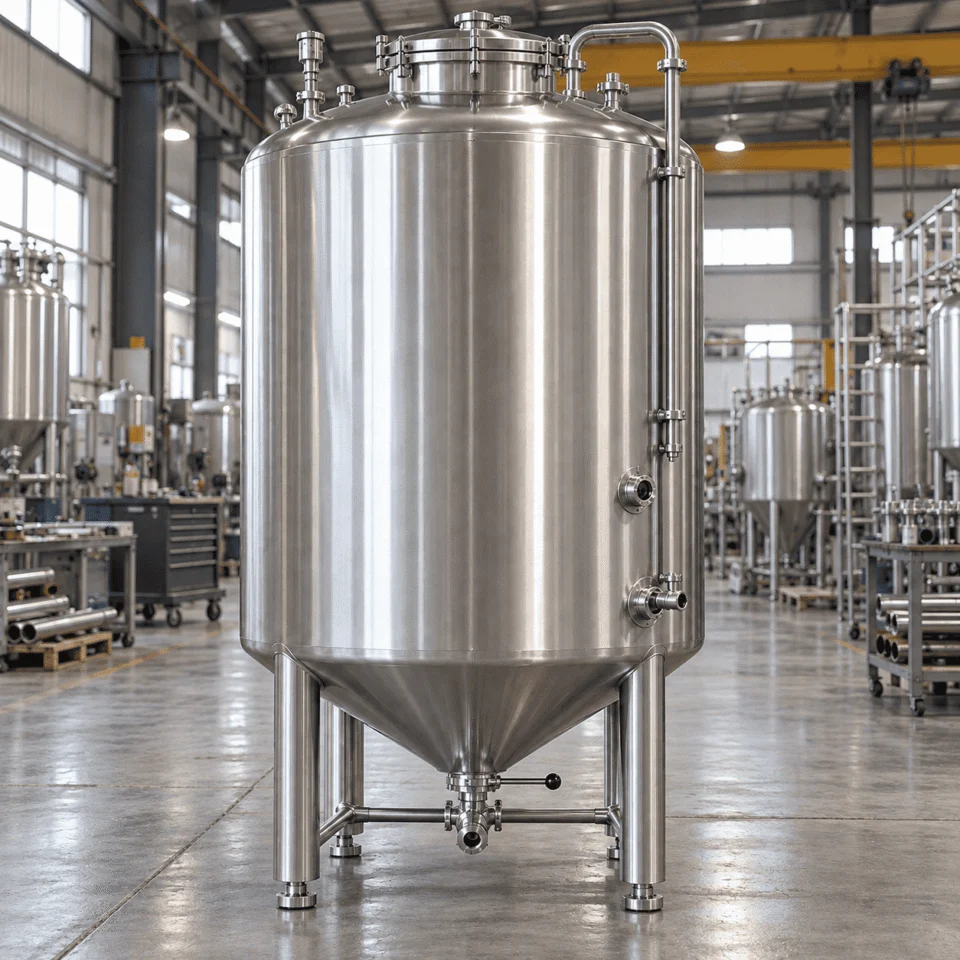
Sanitary Storage Tank Specifications & Options
Start with the process conditions, not a fixed catalog model. Capacity, material, surface finish, cleaning method, bottom geometry, connections and instrumentation can all be configured around the liquid you store and how the tank will be operated.
Do not specify a sanitary tank by capacity alone. The stored product, cleaning chemistry, operating temperature, filling and discharge method, pressure or vacuum condition and installation space should be reviewed together.
What Makes a Storage Tank Sanitary?
Stainless steel alone does not make a tank sanitary. A sanitary storage tank is designed so every product-contact area can be cleaned, drained, inspected, and protected from contamination.
The sanitary result comes from the complete tank system — surface finish, weld execution, geometry, cleaning coverage, and hygienic connections working together.
Internal Surface Finish
Product-contact surfaces should be smooth, consistent, and free from defects that can trap residue. Surface finish should be specified together with the process, cleaning method, and hygiene requirement.
Product-Contact Welds
Sanitary welds must minimize crevices, pits, undercut, and rough transitions. Where required, welds are blended and finished so the welded area does not become a contamination or cleaning risk.
Drainability
Bottom geometry, outlet position, nozzle orientation, and internal transitions should support complete drainage. A sanitary tank should avoid unnecessary hold-up areas and stagnant product zones.
CIP Cleaning Coverage
Adding a spray ball alone does not guarantee full cleaning. Cleaning device position, spray coverage, return flow, internal obstructions, and tank geometry must be considered together.
Hygienic Connections
Manways, nozzles, instruments, vents, valves, and product connections should be selected and positioned to reduce dead zones, simplify cleaning, and maintain a hygienic product path.
316L, a low Ra value, or a CIP spray device does not individually make a tank sanitary. Sanitary performance depends on how material, finish, welds, geometry, drainage, cleaning, and connections are integrated into one design.
Design the Tank Around the Cleaning Cycle
Cleaning should not be treated as an accessory added after the tank geometry is fixed. The cleaning method, temperature change, drain rate, venting, and sterilization requirements can all influence the final sanitary tank design.
Cleaning Solution In
Define cleaning chemistry, concentration, temperature, and available flow before selecting the cleaning device.
Spray / Cleaning Device
Device type and location should match tank diameter, geometry, internals, and required cleaning coverage.
Reach Every Product Zone
Agitators, coils, probes, baffles, and nozzles can create shadow areas that need to be reviewed during design.
Remove Cleaning Liquid
Bottom geometry, outlet position, and return flow should support complete drainage without unnecessary hold-up.
Vent and Protect the Tank
Filling, draining, heating, cooling, and vapor condensation can change internal pressure faster than expected.
Cleaning Inputs We Need
CIP Can Create a Vacuum Risk
A tank that operates near atmospheric pressure during production can still experience vacuum during cleaning, draining, or rapid cooling.
Do not assume a tank is protected simply because its normal operating condition is atmospheric.
Not every sanitary storage tank requires SIP. Where steam sterilization is specified, the tank, venting arrangement, seals, instruments, and condensate path should be reviewed for the complete sterilization cycle rather than production conditions alone.
304 or 316L? Choose by Service Condition, Not by Habit
Both 304 and 316L stainless steel are widely used for sanitary storage tanks. The right choice depends on the stored product, chloride exposure, temperature, cleaning chemistry, hygiene requirements, and corrosion allowance — not simply on choosing the higher grade.
Suitable for Many General Sanitary Duties
304 is often appropriate where the product and cleaning environment are relatively mild and chloride exposure is limited.
Water-based products, many food and beverage duties, and general sanitary storage with moderate corrosion demand.
Good cleanability, broad availability, practical fabrication, and lower material cost than 316L.
Chlorides, acidic ingredients, hot cleaning chemicals, long contact time, and outdoor or coastal exposure.
Preferred When Corrosion Margin Matters More
316L is commonly selected when the process requires improved resistance to chloride-containing media, aggressive cleaning, or tighter sanitary expectations.
Many pharmaceutical, dairy, beverage, cosmetic, and higher-purity duties where corrosion resistance is more demanding.
Molybdenum improves resistance to certain localized corrosion mechanisms compared with 304.
316L is not automatically immune to chloride attack. Actual concentration, temperature, pH, cleaning cycle, and exposure time still matter.
What We Check Before Confirming the Material
Product composition, pH, salt content, solvents, acids, sugars, proteins, and other ingredients can change corrosion behavior.
Caustic, acid, sanitizer, hot water, steam, concentration, and cleaning frequency should be considered together.
Corrosion behavior can change significantly between ambient storage, hot product holding, and elevated-temperature CIP or SIP cycles.
Material grade and surface finish should be specified together because hygiene, residue release, and cleanability depend on both.
Do not specify 316L only because it sounds “more sanitary.” Sanitary performance depends on the whole design: material, surface finish, weld quality, drainage, cleaning coverage, and process compatibility.
Sanitary Storage Tanks Across Hygienic Industries
Each industry creates different demands for cleanability, drainage, temperature control, surface finish, venting, and documentation. We configure the tank around the actual process rather than using one standard sanitary layout for every application.
 FOOD & BEVERAGE
Food & Beverage
Clean transfer, repeatable CIP and low product hold-up.
 DAIRY
Dairy
Frequent cleaning, hygienic fittings and temperature control.
 BREWING & FERMENTATION
Brewing & Fermentation
Process transfer, vent strategy and thermal control working together.
 PHARMACEUTICAL
Pharmaceutical
Controlled finish, hygienic interfaces and stronger documentation.
 COSMETICS & PERSONAL CARE
Cosmetics & Personal Care
Viscosity, residue behavior, heating and batch-cleaning requirements.
Product chemistry and cleaning conditions should be confirmed before the final material, surface finish, nozzle arrangement, venting and thermal-control configuration are fixed.
What to Verify Before the Tank Leaves the Factory
A sanitary tank should not be accepted only because the exterior looks clean. Before shipment, the buyer should verify the product-contact construction, process interfaces, cleaning arrangement, and the design basis agreed during engineering.
Product-contact material and any specified non-contact material should match the approved requirement.
Material recordsOverall size, working volume, support arrangement, access clearance, and installation constraints should match the approved drawing.
Approved drawingInlet, outlet, vent, CIP, instruments, manway, drain, and utility connections should be in the agreed positions and directions.
Nozzle scheduleSpecified product-contact finish should be consistent across the tank interior, welded areas, transitions, and accessible fittings.
Finish requirementWeld profile, blending, pits, undercut, crevices, and rough transitions should be reviewed from a sanitary-cleanability perspective.
Visual inspectionBottom geometry and outlet arrangement should support the intended drainage path without obvious unnecessary liquid hold-up.
Drain reviewCleaning device type, position, access, internal obstructions, and return path should match the agreed cleaning concept.
CIP layoutOperating, cleaning, draining, heating, cooling, venting, and any vacuum condition should be consistent with the final design basis.
Design basisDo Not Treat Visual Appearance as Final Acceptance
The tank should be checked against the approved engineering basis, not only against how polished or clean it looks at the end of fabrication.
What to Send for a More Accurate Sanitary Tank Proposal
You do not need a complete specification before contacting us. But the more process information we receive at the beginning, the faster we can review material, cleaning, connections, thermal requirements, and the correct tank configuration.
Six Items That Help Us Review the Tank Correctly
Product name, composition, pH, chloride content or any known corrosive ingredients.
Required working volume, total volume preference, and any height or diameter limitation.
Cleaning method, chemicals, temperature, flow condition, and whether steam sterilization is required.
Storage temperature, heating or cooling need, pressure, vacuum, drain rate, and venting condition.
Inlet, outlet, manway, level, temperature, vent, CIP, drain, and other process connections.
Required material grade, internal finish, inspection, testing, drawing, and documentation expectations.
No Complete Datasheet Yet?
Send the information you already know. We can use it to identify the missing engineering inputs and clarify what still needs to be confirmed before fabrication.
Before You Specify a Sanitary Storage Tank
Is 316L always required for a sanitary storage tank?
No. 304 can be suitable for many sanitary duties. Material selection should consider the stored product, chlorides, pH, temperature, cleaning chemistry, contact time, and project hygiene requirements.
Does a sanitary tank always need CIP?
No. Cleaning strategy depends on the process. Some tanks use manual cleaning, while others require CIP or CIP with SIP. The cleaning method should be confirmed before the final internal geometry is fixed.
Can an atmospheric tank experience vacuum during cleaning?
Yes. Rapid draining, cooling, or vapor condensation after a hot cleaning cycle can create internal vacuum. Venting and vacuum protection should therefore be reviewed against the real operating and cleaning sequence.
What surface finish should I specify?
The required finish depends on the product, hygiene expectation, cleanability target, and project standard. Surface finish should be specified together with weld treatment and the complete product-contact construction.
Can heating, cooling or agitation be added?
Yes. Jackets, insulation, coils, agitators, instruments, and custom nozzles can be integrated when required by the process. These features should be defined early because they affect cleaning, geometry, support, and fabrication.
What should I inspect before shipment?
Check the agreed material, dimensions, nozzle orientation, internal finish, product-contact welds, drainability, cleaning arrangement, and the pressure or vacuum design basis against the approved project requirements.
Send Us the Process Conditions — We’ll Review the Tank Around the Application
Capacity, medium, temperature, cleaning method, material preference, connections, and any drawing you already have are enough to start the discussion.