Brewing & Fermentation Process Equipment
Engineered stainless steel vessels and process equipment for breweries, fermented beverages and industrial fermentation systems.
From ingredient preparation and mixing to temperature control, fermentation, conditioning and storage, ChannelVessel manufactures equipment around your actual batch size, operating temperature, pressure conditions, agitation requirements and sanitary needs.

From Preparation to Controlled Fermentation
Brewing and fermentation projects are not defined by the fermentation vessel alone. Mixing, heat transfer, fermentation, conditioning and storage all influence how the equipment should be configured and connected.
Preparation
Raw materials, water and other process ingredients are prepared according to the required batch formulation and production sequence.
Mixing / Mashing
Agitated vessels support ingredient blending, hydration, extraction or mashing while helping maintain more uniform process conditions.
Heating & Cooling
Jackets and heat exchangers manage product temperature before, during and after fermentation, depending on the process profile.
Fermentation
The fermentation vessel must match working volume, temperature profile, pressure conditions, gas release, cleaning method and process connections.
Conditioning
After fermentation, the product may require controlled cooling, holding or maturation before downstream transfer.
Storage / Transfer
Sanitary storage tanks and connected piping support buffer storage, product transfer and the next production or packaging stage.
The equipment configuration depends on the actual process sequence rather than on a single standard tank design. Defining each stage early helps determine vessel type, heat-transfer requirements, agitation, instrumentation and process connections.
Process Equipment for Brewing & Fermentation
A brewing or fermentation line rarely depends on one vessel alone. The equipment combination should reflect the actual process sequence, thermal requirements, batch handling, cleaning needs and level of integration required for the project.

Fermentation Vessels
Designed around batch volume, fermentation temperature, pressure conditions, gas release, cleaning method and required process connections. This is the core vessel in many brewing and fermentation projects, but it must still be defined by the actual process rather than by a generic tank size.
Selection focus: Working volume · Temperature profile · Pressure · Gas release · Cleaning
Explore this equipment →
Mixing & Process Tanks
Used for ingredient preparation, blending, mashing and intermediate processing where agitation and more uniform product conditions are required. These tanks help connect upstream preparation with downstream fermentation or transfer steps.
Selection focus: Batch size · Agitation · Viscosity · Temperature · Product contact
Explore this equipment →
Jacketed Vessels
Used where the process requires controlled heating or cooling through the vessel wall before, during or after fermentation. The vessel configuration depends on the thermal duty, utility conditions and the required level of process control.
Selection focus: Heating/cooling duty · Jacket type · Utility · Temperature · Pressure
Explore this equipment →
Sanitary Storage Tanks
Used for buffer storage, conditioning or finished-product holding before transfer, downstream processing or packaging. The design should reflect sanitary handling, drainability and the role of the tank within the full process sequence.
Selection focus: Hold time · Sanitary design · Surface finish · Capacity · Connections
Explore this equipment →
Heat Exchangers & Process Coolers
Support controlled temperature changes in wort, fermented product or other process streams when vessel jackets alone are not the preferred heat-transfer solution. They are often selected to improve thermal efficiency and process responsiveness.
Selection focus: Inlet/outlet temperature · Product type · Flow rate · Utility · Thermal load
Explore this equipment →
Integrated Process Skids
Combine pumps, valves, heat exchangers, instrumentation and piping into a coordinated process module when the project requires more than standalone vessels. This approach can simplify installation, integration and site execution.
Selection focus: Scope of integration · Controls · Utilities · Footprint · Piping layout
Explore this equipment →What Defines the Right Vessel for Your Process?
A fermentation or brewing project is more than a tank size. The vessel and connected equipment should be designed around your actual process conditions, product characteristics, cleaning requirements and the level of integration needed for the project.
Working Volume
Defines batch capacity, total vessel volume and required headspace.
Agitation
Depends on viscosity, shear sensitivity and the required mixing result.
Heating / Cooling
Jacket type, utility and heat duty determine the thermal design. Jacketed vessels→
Product / Medium
Composition, corrosion and solids influence materials and internal design.
Material
Select contact materials around product, corrosion and hygiene needs. Material guide→
Instrumentation
Temperature, pressure and level points should match monitoring needs.
Temperature Profile
Define heating, fermentation, cooling and holding temperatures.
Internal Finish & Hygiene
Surface finish, drainability and cleaning requirements affect construction.
Cleaning Method
CIP or manual cleaning affects spray devices, nozzles and internal details.
Pressure / Vacuum
Define whether operation is atmospheric, pressurized, vacuum or combined. Design basics→
Connections
Define inlet, outlet, sampling, gas, cleaning and instrument connections.
Controls
Specify standalone instruments or integration into a complete control system.
Better Information.
A More Suitable Solution.
Providing these conditions at the RFQ stage allows the vessel and connected equipment to be engineered around the real process rather than a generic tank specification.
Hygienic Fabrication & Project Delivery
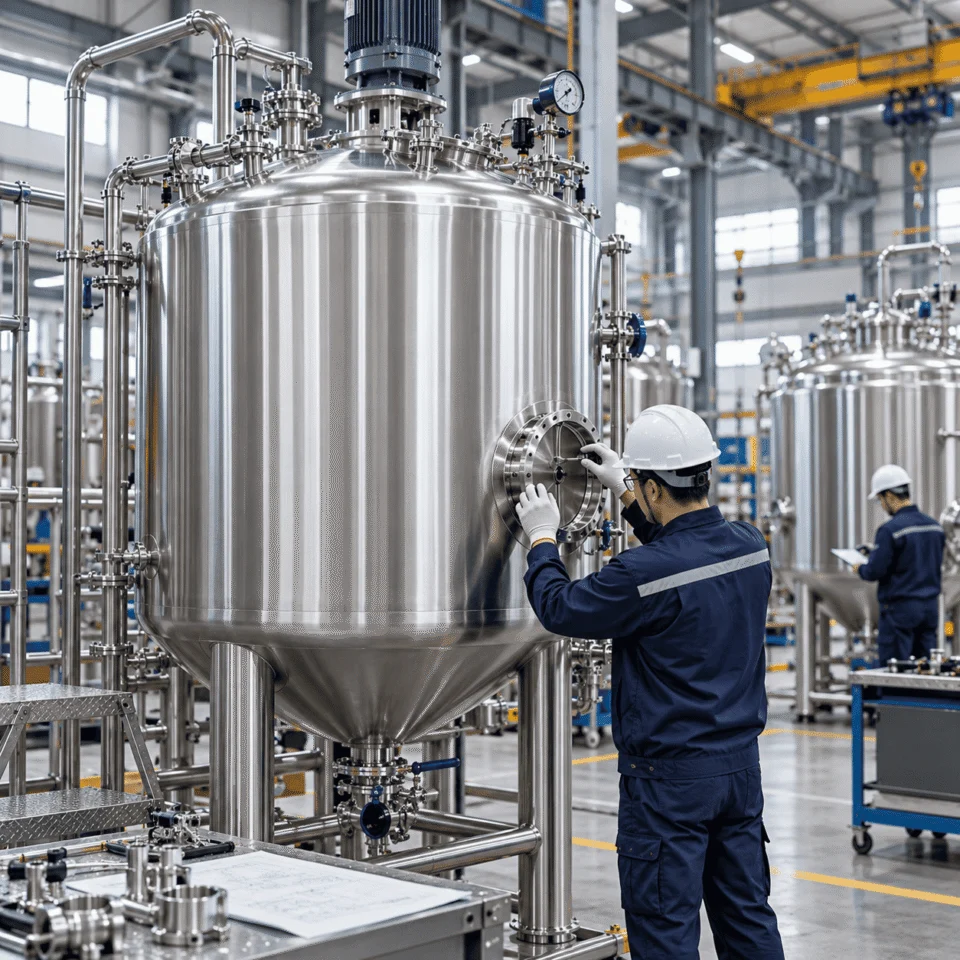
Once the process requirements are defined and the equipment is selected, we carry out detailed design, fabrication, inspection and delivery according to the approved specifications. Our goal is to deliver reliable, sanitary and well-documented equipment that fits your process and installation requirements.
Process & Design Review
Review the confirmed batch volume, product, temperature, pressure, agitation, utilities, cleaning method and plant interfaces before fabrication begins.
Drawing Approval
Confirm vessel dimensions, nozzle orientation, agitator arrangement, jacket details, instrumentation and connected equipment before production.
Fabrication & Welding
Forming, welding, machining and assembly are carried out according to the approved design and applicable project requirements. Learn more about our fabrication and welding capabilities →
Hygienic Details & Surface Requirements
Product-contact surfaces, drainage, sanitary connections, cleaning devices and specified surface requirements are completed according to the actual process.
Inspection & Testing
Required dimensional checks, weld inspection, pressure or leak testing and other agreed inspections are completed according to the approved design basis and project scope. See more about our inspection and testing →
Documentation & Delivery
Prepare the agreed drawings, inspection records and project documents, then protect the equipment for transportation and installation.
Built to Your Process.
Ready for Real-World Operation.
The goal is not simply to fabricate a stainless steel vessel, but to deliver equipment that matches the approved process conditions, interfaces and installation requirements.
Brewing & Fermentation Equipment FAQ
Every brewing and fermentation project has different process conditions, sanitary requirements and levels of integration. The answers below cover several of the questions buyers commonly need to clarify before requesting a quotation.
Please provide the required working volume, product or medium, operating temperature, pressure conditions, agitation requirements, preferred material, cleaning method, process connections, heating or cooling requirements and required instrumentation. Existing drawings, process flow information and plant interface details are also useful when available.
Yes. Jacketed vessels can be engineered when the process requires controlled heating or cooling. The suitable configuration depends on the required temperature profile, heating or cooling medium, heat-transfer duty, operating conditions and the level of temperature control required by the process.
Material selection should be based on the product, corrosion conditions, hygiene requirements, cleaning method, operating temperature and required surface condition. Stainless steel is commonly used for brewing and fermentation equipment, but the final material specification should match the actual project requirements.
Pressure-rated fermentation vessels can be engineered when the project requires defined operating or design pressure. The required pressure, temperature, working volume, material and applicable project requirements should be confirmed before detailed design and fabrication.
Yes. Depending on the project scope, vessels can be integrated with mixers, pumps, valves, heat exchangers, instrumentation, piping and controls as a coordinated process system or skid. The level of integration should be defined around the process flow, plant layout, utilities and installation requirements.
Yes. Existing drawings can be reviewed together with your process conditions, equipment requirements and plant interfaces. After the design scope and technical details are confirmed, the approved drawings can be used as the basis for detailed engineering, fabrication and project documentation.