Start With the Evaporation Duty, Not the Equipment Type
An evaporator is selected to achieve a separation task, not simply to match a tank size. Identify what enters the system, what must remain in the concentrate and what quality is required from the recovered vapor or condensate.
Define What Enters the System
Provide the composition, flow range, temperature and solids content. Identify solvents, suspended particles and components that may become more difficult to handle as concentration increases.
Define the Required Product Condition
State the required final concentration and whether the discharge must remain pumpable. Specify product-quality limits and whether crystal formation is acceptable or must be avoided.
Define What Happens to the Recovered Stream
Clarify whether the objective is water recovery, solvent collection or simply liquid-volume reduction. Set the intended use and required quality before selecting the separation and condensation arrangement.
Calculate Evaporation Duty Before Sizing the Equipment
Feed capacity and evaporation capacity describe different quantities. Specify the incoming liquid, concentrated product and solvent removed separately so that every supplier is pricing the same process duty.
Worked Example: Concentrating an Aqueous Feed
| Feed flow | 5,000 kg/h |
| Feed nonvolatile solids | 10 wt% |
| Target nonvolatile solids | 50 wt% |
| Nonvolatile solids retained | 500 kg/h |
| Concentrate flow | 1,000 kg/h |
| Water evaporation rate | 4,000 kg/h |
The Same Feed Produces a Different Duty at a Different Target
Match the Evaporator Configuration to the Feed
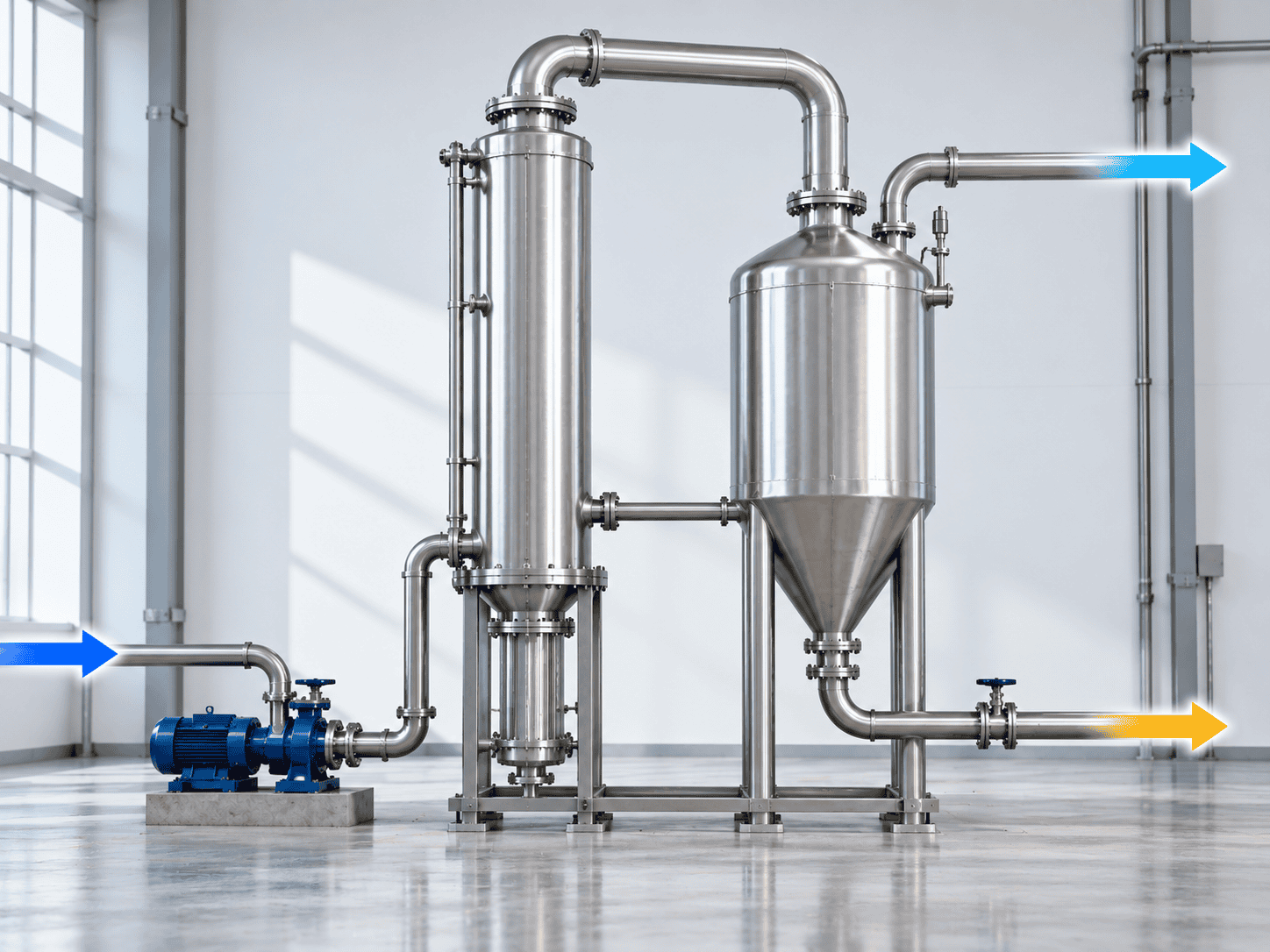
Select the liquid-handling arrangement around the most demanding expected concentrate, not only the incoming feed. Falling-film and forced-circulation systems solve different operating problems, and neither is automatically the better choice for every liquid.
| Feed condition | Falling film | Forced circulation | Confirm before selection |
|---|---|---|---|
| Heat-sensitive liquid | Often a candidate | Requires review | Maximum temperature, exposure time and product stability |
| Low viscosity, low solids | Often well suited | Possible | Distribution, wetting, fouling tendency and turndown |
| Increasing final viscosity | Needs evaluation | Often considered | Viscosity at the actual final concentration and temperature |
| Scaling or precipitation | Use caution | Often evaluated | Solubility limits, deposit behavior and cleaning strategy |
| Suspended solids or crystals | Needs evaluation | Often preferred | Particle loading, crystal size, passage size and pump suitability |
| Shear-sensitive product | Can be attractive | Check recirculation | Allowable shear, pump selection and product degradation limits |
Configuration, pressure and heat recovery describe different things
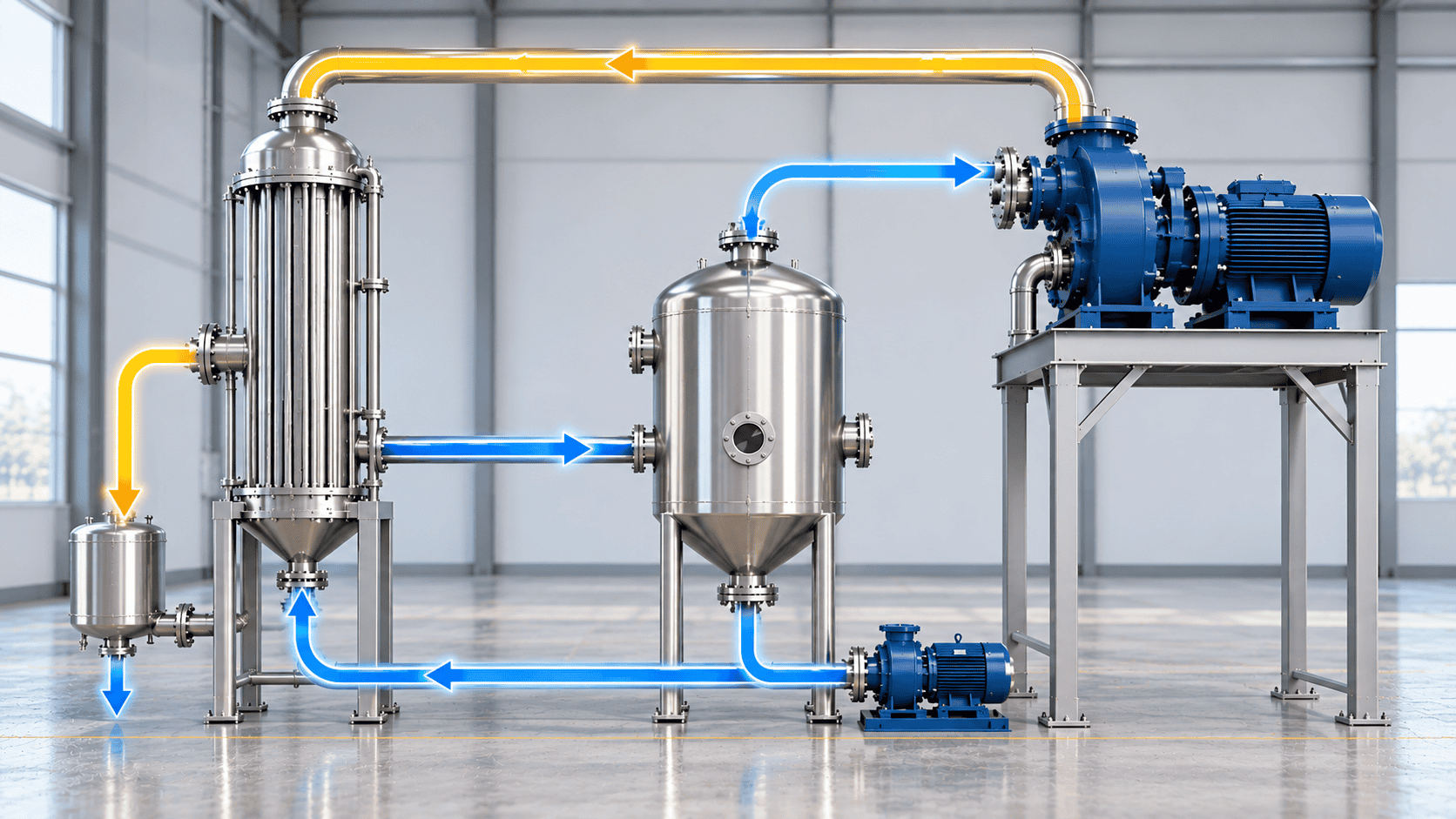
Falling film and forced circulation describe how liquid moves through the evaporator. Vacuum describes operating pressure. Multiple effects, TVR and MVR describe how heat or vapor is reused.
Heat-transfer hardware still has to match the duty
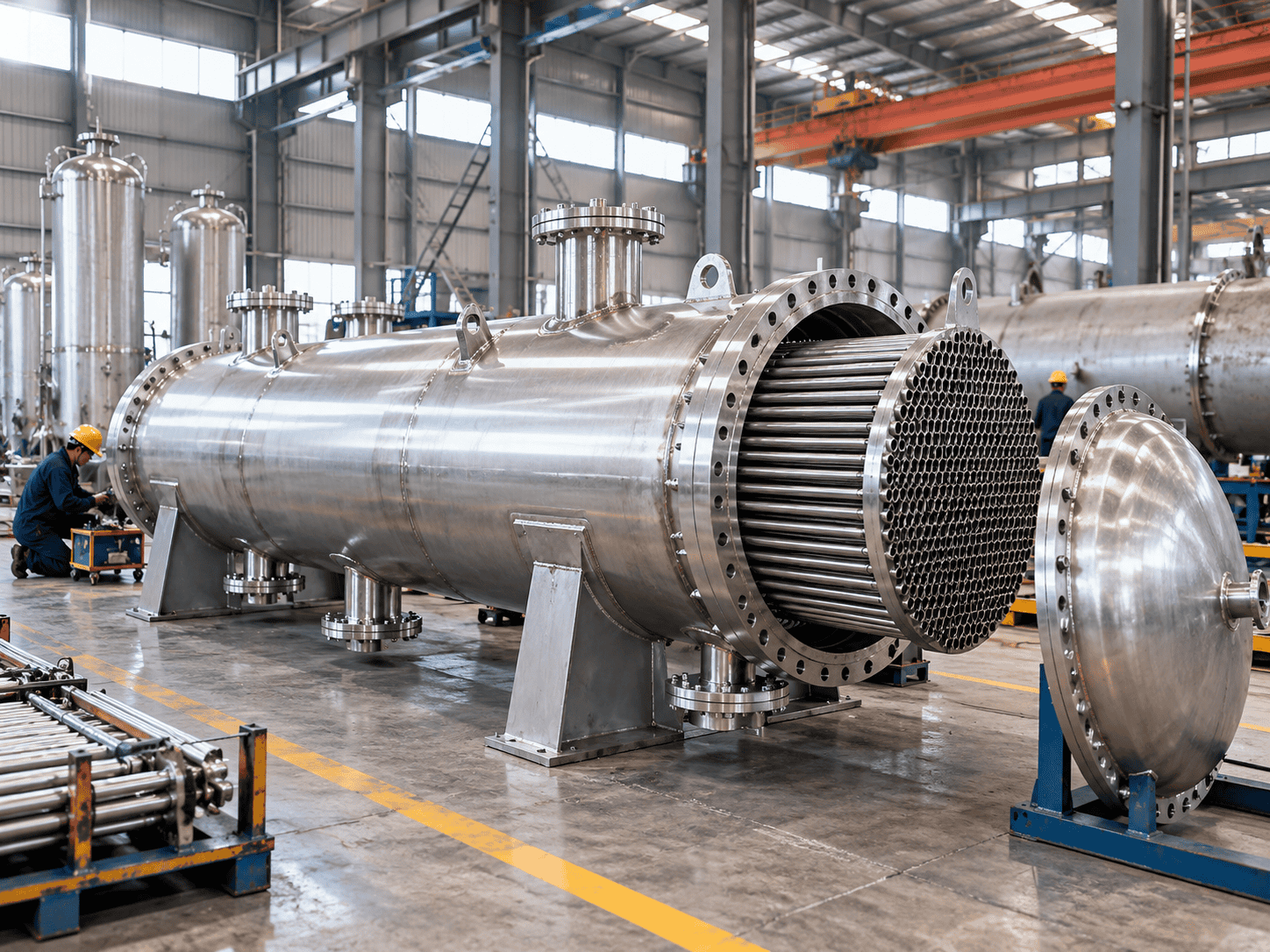
Heating-surface geometry, allowable pressure drop and cleanability should be reviewed together with the liquid-handling arrangement.
Explore Shell & Tube Heat ExchangersVacuum Lowers Boiling Temperature—Not the Need for Heat
Lower absolute pressure reduces the boiling temperature of water, which can help when the process liquid is temperature-sensitive. It does not remove the latent heat required for evaporation, and lower-temperature vapor also occupies more volume per kilogram.
Pure Water Saturation Reference
| Temperature | Saturation pressure | Latent heat | Saturated vapor volume |
|---|---|---|---|
| 40°C | 7.385 kPa(a) | 2,406.0 kJ/kg | 19.515 m³/kg |
| 60°C | 19.946 kPa(a) | 2,357.7 kJ/kg | 7.667 m³/kg |
| 80°C | 47.414 kPa(a) | 2,308.0 kJ/kg | 3.405 m³/kg |
| 100°C | 101.42 kPa(a) | 2,256.4 kJ/kg | 1.672 m³/kg |
Account for Boiling-Point Elevation and Heat-Transfer Losses
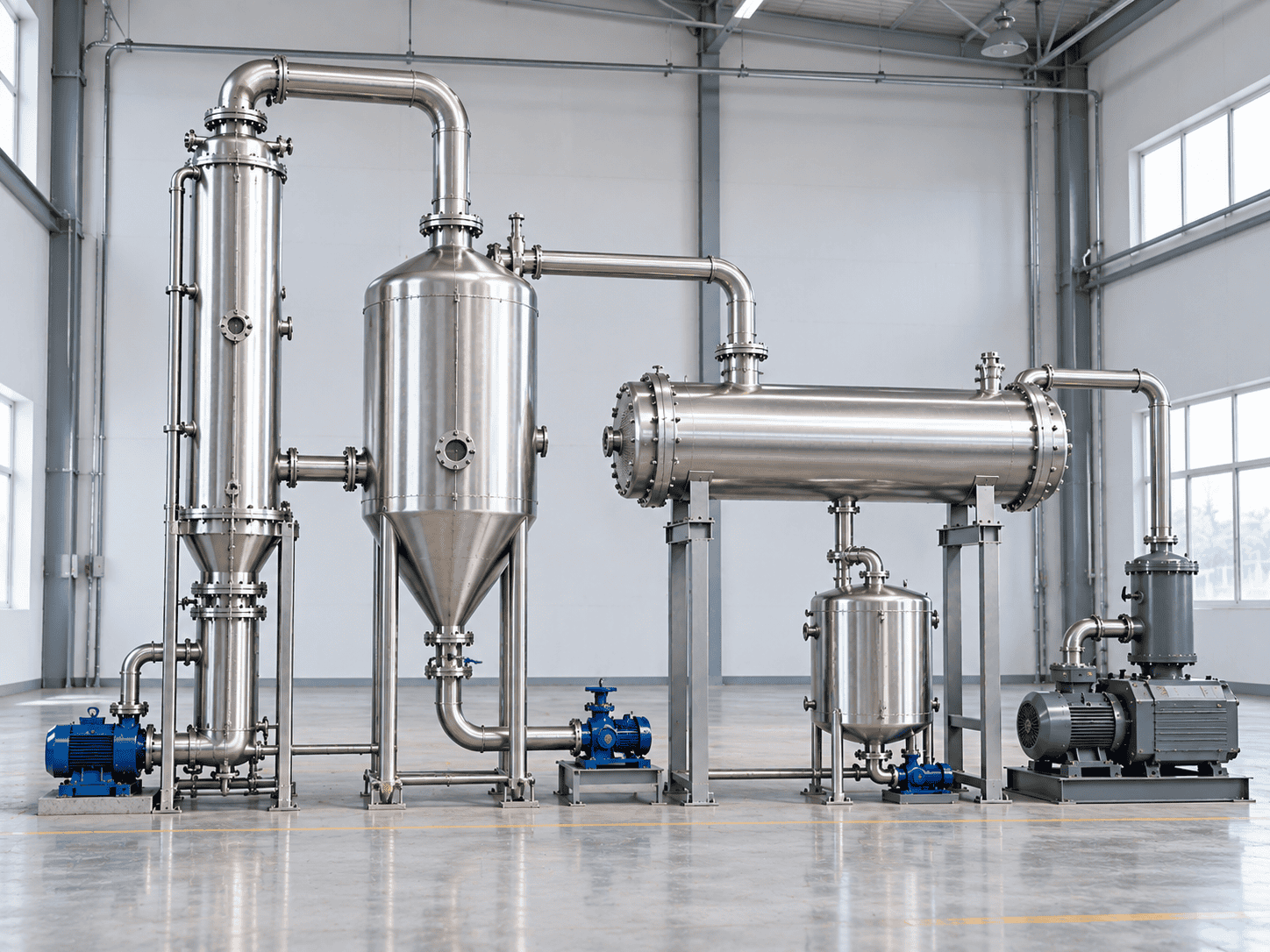
A process solution can boil above the saturation temperature of pure water at the same pressure. As concentration rises, boiling-point elevation, viscosity and fouling can reduce the effective temperature difference or the overall heat-transfer coefficient used to size the evaporator.
The heating-steam temperature is not the complete driving force
The designer should consider the actual boiling temperature of the concentrated liquid, pressure losses through the system and the temperature profile across the selected effect or heating surface.
A Smaller Effective ΔT Can Require More Surface Area
Assume the required heat duty and overall heat-transfer coefficient stay unchanged. If the effective temperature difference falls from 20 K to 15 K, the theoretical area rises in inverse proportion.
Compare Heating Concepts on the Same Evaporation Basis
Compare utilities per tonne of water evaporated, not per tonne of feed. Also confirm whether the published number includes pumps, vacuum equipment, compressors, cooling systems and start-up or supplementary heating.
Published Engineering Reference Values
| Heating concept | Steam reference | Electricity reference |
|---|---|---|
| Conventional single effect | ≈1.00 t steam / t water evaporated | Auxiliary loads depend on package scope |
| Double effect | ≈0.50 t/t | Auxiliary loads depend on package scope |
| Triple effect | ≈0.33 t/t | Auxiliary loads depend on package scope |
| Four effects | ≈0.25 t/t | Auxiliary loads depend on package scope |
| TVR reference arrangement | ≈0.50 t/t, design-dependent | Usually not the primary energy input |
| MVR reference arrangement | Low supplementary steam demand, condition-dependent | ≈30–50 kWh/t water evaporated |
Choose for the Site, Not the Label
Custom Evaporator Options Start With the Process Data
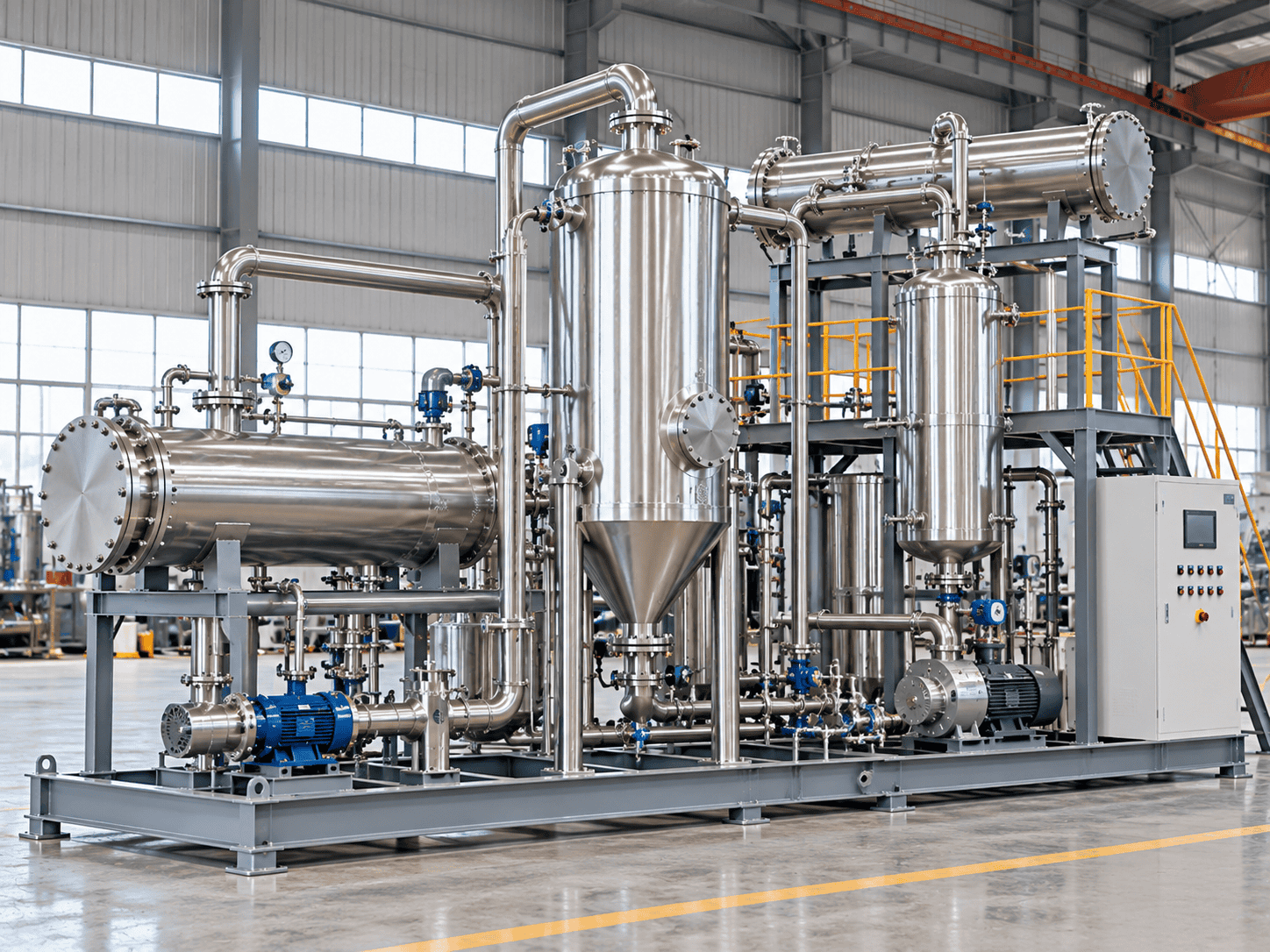
ChannelVessel can configure the evaporator around the agreed process duty, materials, utility conditions and package scope. The options below define what can be evaluated during project engineering; they are not automatically included in every quotation.
Define What Is Included Before Comparing Evaporator Quotations
One quotation may cover the core evaporation equipment only, while another includes vacuum equipment, condensers, pumps, controls and package integration. Compare the equipment list and connection points before comparing the total price.
Define the heater, separator and circulation arrangement
Identify condensation, vacuum and material-handling equipment
Mark every project item as included, optional or by others
Plan for Fouling, Foaming, Carryover and Cleaning
Initial evaporation capacity is only part of the design problem. The equipment should also be reviewed for what happens after hours or days of concentration, when deposits, foam, entrainment or cleaning requirements begin to affect performance.
Fouling and Scaling
Foaming
Liquid Carryover and Condensate Quality
Cleaning and Maintenance Access
Design for the Actual Concentrate, Pressure and Project Basis
Material compatibility and mechanical design should follow the real process conditions, not only the incoming feed. Concentration changes chemistry, vacuum creates external-pressure loads and the purchase specification determines what manufacturing and inspection records are required.
Select for the concentrated liquid and cleaning conditions
Check pressure, vacuum and thermal loads separately
State the required records before fabrication starts
Compare Evaporator Quotations on the Same Technical Basis
Different equipment designs can both be technically acceptable, but their prices are only comparable when the process basis, utility boundary, equipment scope and performance test conditions are defined on the same basis.
Normalize the Technical Scope Before Comparing Price
| Comparison item | What should be stated | Why it matters |
|---|---|---|
| Process basis | Feed composition, flow, feed temperature, feed concentration, target concentration and required evaporation rate | Confirms the same duty |
| Thermal basis | Operating pressure, boiling temperature, effective ΔT, heat-transfer assumptions and fouling allowance | Explains sizing differences |
| Equipment basis | Configuration, materials, number of effects, heating surface, pumps, condenser, vacuum system and included instruments | Prevents scope mismatch |
| Utility basis | Steam conditions, electrical boundary, cooling demand, compressed air and all auxiliary loads included in the stated consumption | Makes OPEX comparable |
| Delivery basis | Controls, piping, structure, insulation, documentation, commissioning, site work and clearly stated exclusions | Defines the real package price |
| Acceptance basis | Test feed, steady-state definition, duration, sampling method, evaporation rate, concentration target and utility measurement method | Defines what “meets performance” means |
Evaporation Duties Across Process Industries
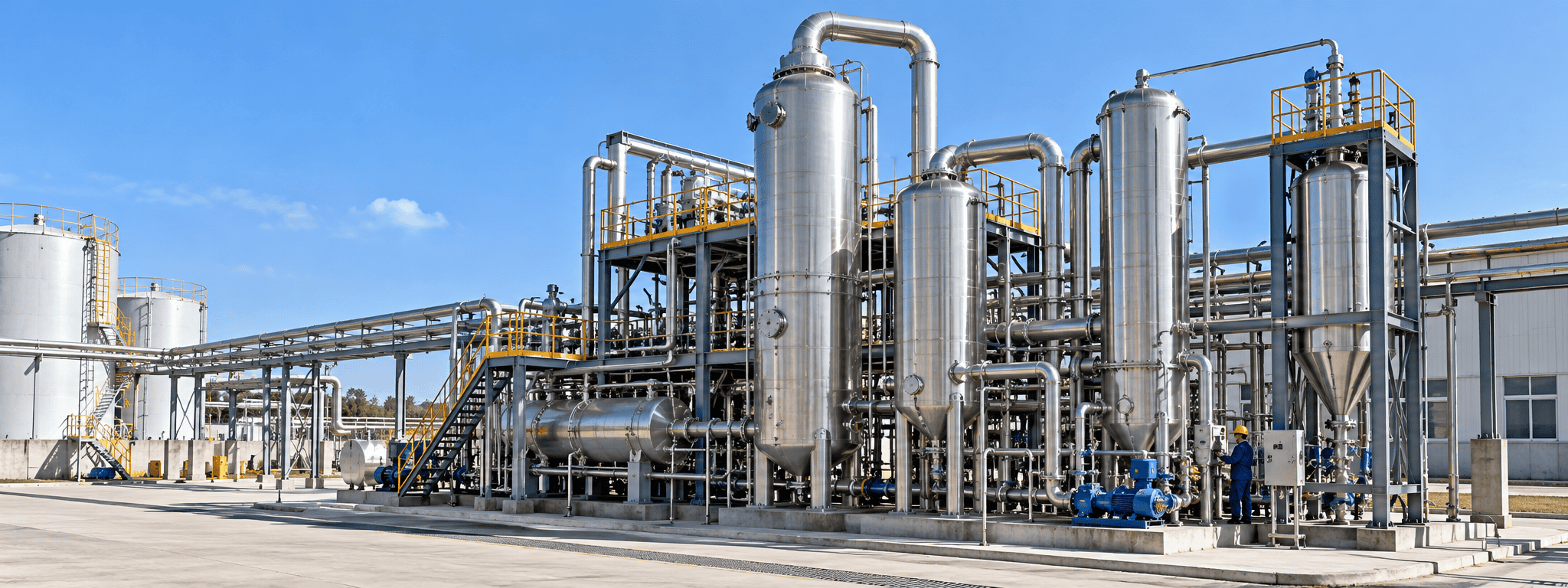
Industry names help describe the application, but the actual evaporator design still depends on feed chemistry, solids behavior, temperature limits, target concentration and the required quality of the recovered stream.
Concentrate process solutions or prepare streams for recovery
Review corrosion, boiling-point elevation, precipitation, solvent behavior and the handling of the final concentrate.
Chemical IndustryReduce liquid volume and manage concentrated residuals
Review scaling, salts, volatile contaminants, condensate quality and the disposal or downstream treatment route for the remaining concentrate.
Water TreatmentConcentrate suitable liquid ingredients or extracts
Review heat sensitivity, residence time, product quality, hygienic design requirements and cleaning conditions.
Food & Beverage IndustryEvaluate defined concentration and recovery duties
Confirm compatibility, containment, cleanability, documentation and any process-specific quality requirements before equipment selection.
Pharmaceutical IndustryConcentrate milk- or whey-based process streams
Consider thermal exposure, deposits, product quality, cleaning frequency and the behavior of the stream as solids increase.
Dairy IndustryEvaluate fermentation-derived liquids and by-product streams
Review solids, foaming, thermal stability, volatile components and the required quality of recovered water or solvent.
Brewing & Fermentation