Custom Pressure Vessels Engineered Around Your Process
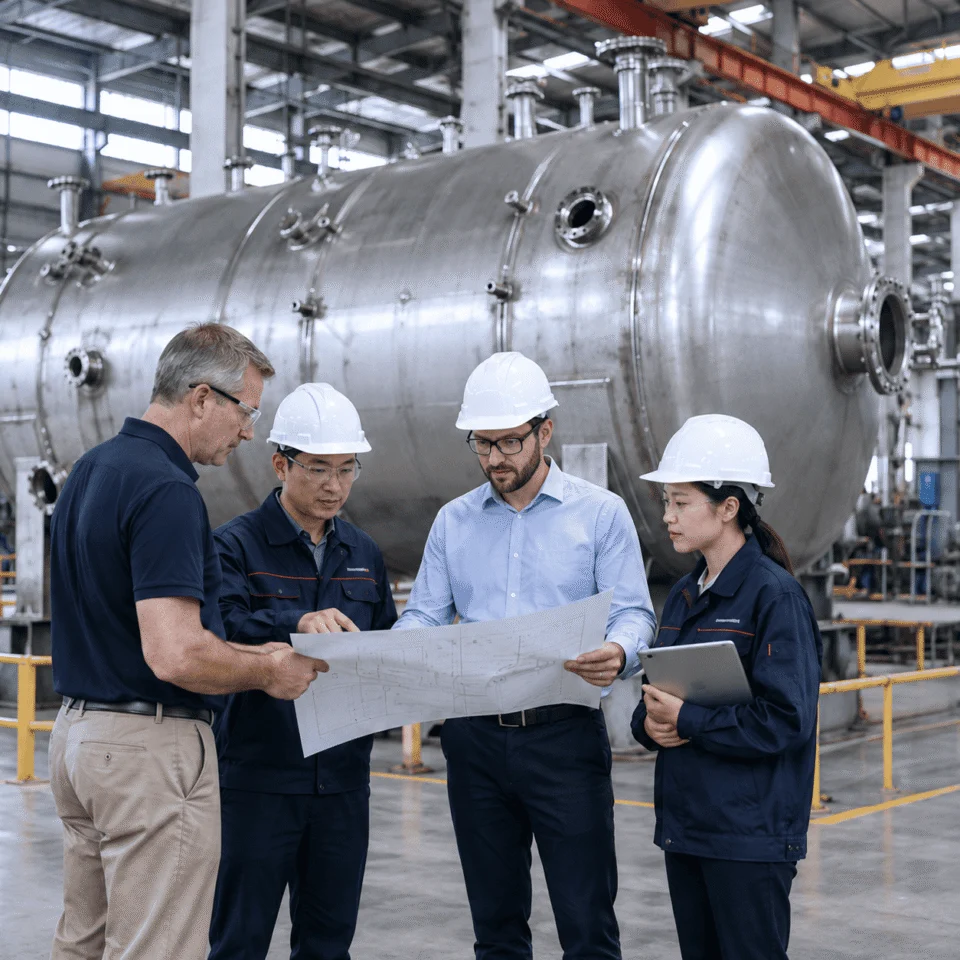
ChannelVessel designs and manufactures custom pressure vessels from customer drawings, datasheets or process requirements. Dimensions, materials, design conditions, nozzle arrangements, internals and fabrication requirements can be engineered around your project.
Start with a finished drawing, a datasheet, or simply your process conditions.

From Process Conditions to Vessel Design
We take your process inputs and systematically transform them into a safe, reliable, and buildable pressure vessel design — engineered to perform.
Process Medium
Composition, phase, corrosivity, toxicity, contaminants
Pressure & Temperature
Operating pressure range, design pressure, operating temperature range
Required Capacity
Vessel volume, flow rate, residence time
Thermal Duty
Heat input / removal, heat exchange requirements, insulation
Site & Process Interfaces
Nozzle specifications, tie-ins, codes & standards, site conditions
ENGINEERING
INPUT REVIEW
Three Ways to Start Your Custom Vessel Project
Begin your project in the way that works best for you. Whether you have a completed drawing, a vessel datasheet, or just core process conditions, our team will take it from there.
Start With a Finished Drawing
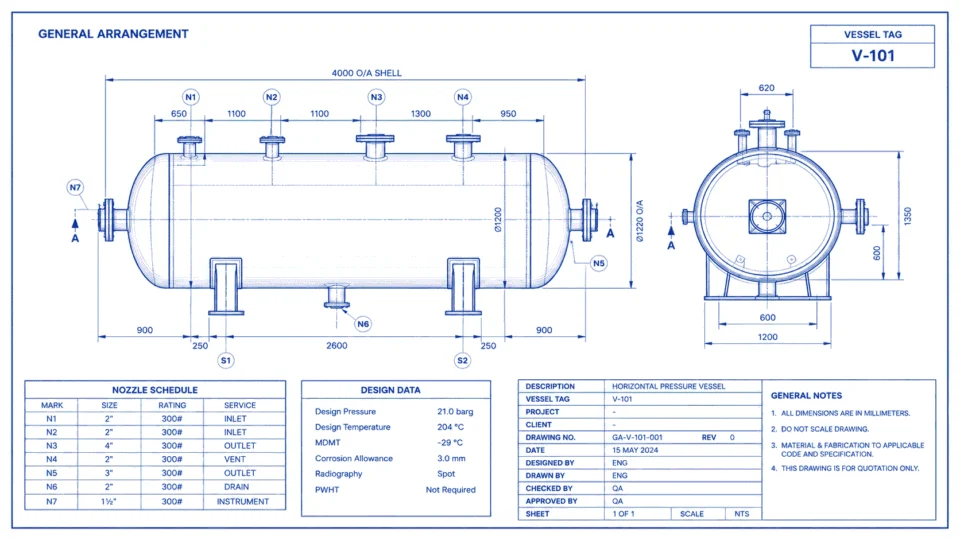
Send us your completed drawing package and we’ll review the details, clarify any open items, and provide a fast, accurate quotation before moving to fabrication.
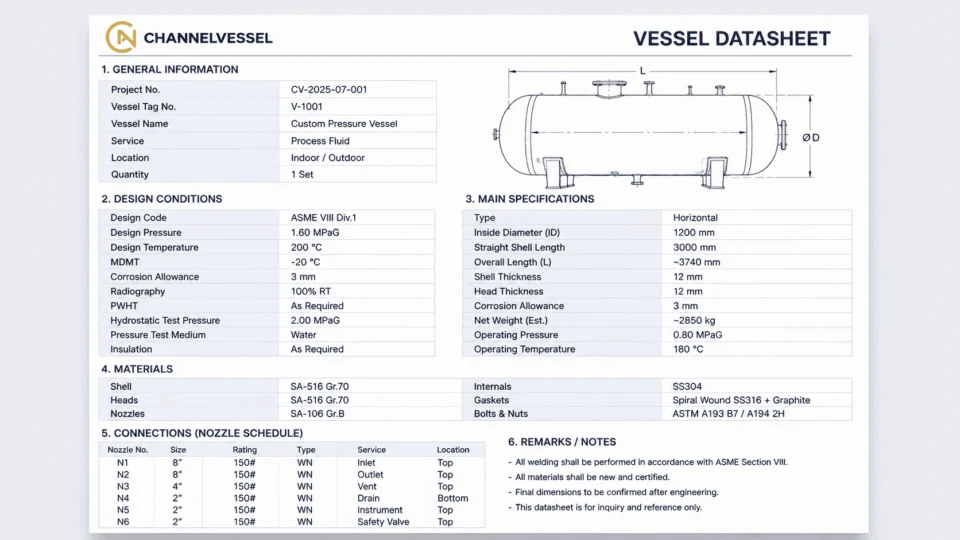
Start With a Vessel Datasheet
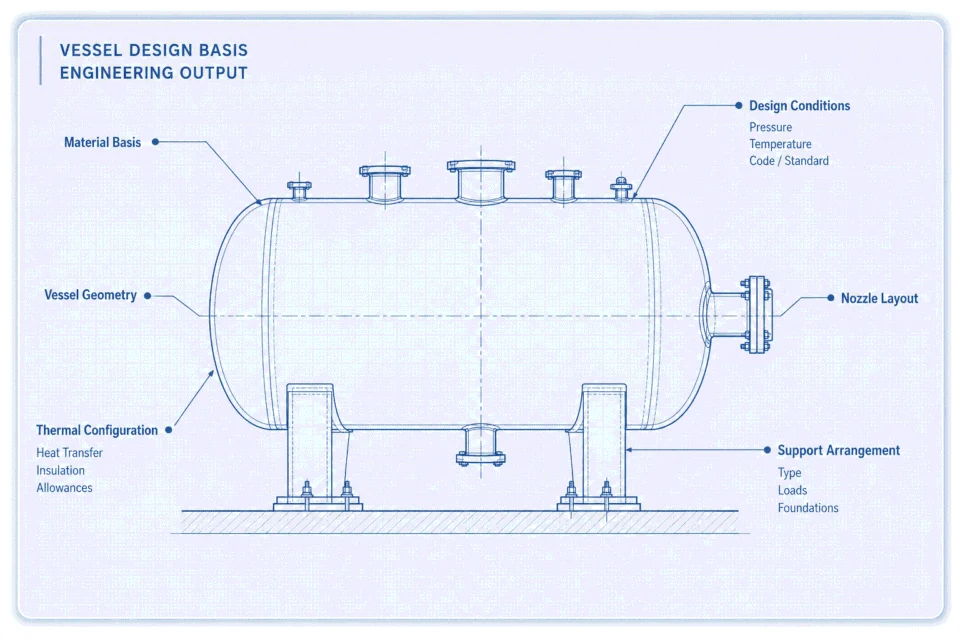
Provide your vessel datasheet and we’ll use it to establish the mechanical design basis, verify requirements, and develop a reliable scope for your project.
Start With Your Process Conditions
Share your key process inputs and constraints. We’ll help define the right vessel concept, sizing, and configuration to meet your performance and site requirements.

Engineering Review Before Manufacturing
Before any material is cut or fabrication begins, our engineering team conducts a comprehensive review of the vessel design against approved process data, project specifications, and manufacturing requirements to ensure buildability, code compliance, and trouble-free installation.
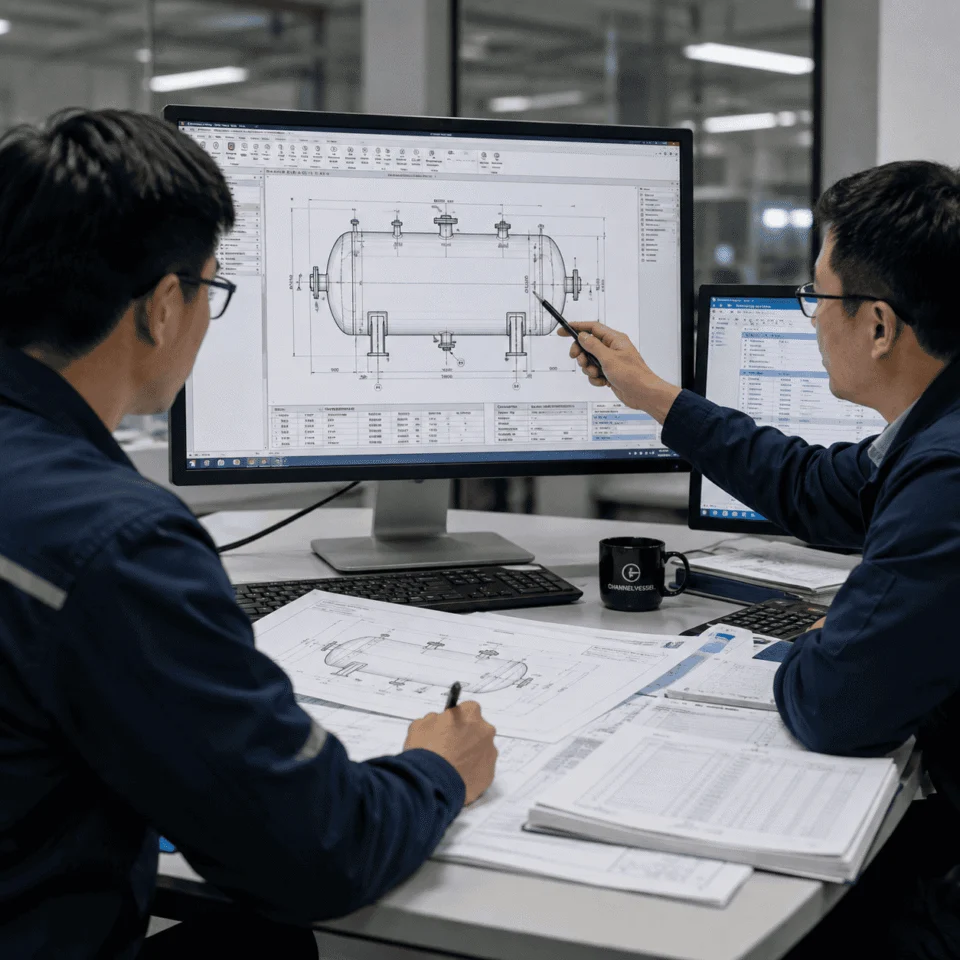
Each critical aspect of the vessel design is reviewed and verified for accuracy and completeness.
1. Design Conditions Review
Pressure, temperature, vacuum, corrosion allowance, and code basis.
2. Material & Corrosion Review
Material suitability for process media, temperature, and corrosion risk.
3. Vessel Geometry & Mechanical Configuration
Diameter, shell length, head type, orientation, and support basis.
4. Nozzle, Manway & Interface Review
Nozzle sizes, ratings, orientations, elevations, and tie-in points.
5. Internals & Functional Features
Coils, baffles, demisters, or process internals required by duty.
6. Fabrication & Inspection Requirements
Welding, NDT, testing, documentation, and inspection requirements.
Connections, Internals & External Components
A custom pressure vessel is more than a shell and two heads. Connections, process internals and external features must be coordinated with process duty, piping, installation, maintenance and fabrication requirements.
01. CONNECTIONS
& ACCESS
Connections and access points must match the process requirements and integrate seamlessly with the piping and instrument system.
Nozzles
Process and utility connections in required sizes and ratings.
Manways
Inspection and maintenance access openings.
Instrument Ports
Connections for pressure, level, temperature and other instruments.
Vent / Drain
Venting, draining and flushing connections.
Flange Rating
ASME Class, PN or custom rating as required.
Orientation & Elevation
Nozzle direction and elevation to fit site layout and piping design.
02. PROCESS
INTERNALS
Internals are selected to achieve process performance while ensuring reliability, maintainability and fabrication feasibility.

Baffles
Direct flow and improve separation efficiency.
Coils
Heating or cooling coils for process control.
Demisters
Remove entrained liquid for clean vapor.
Dip Pipes
Guide inlet flow and reduce turbulence.
Internal Supports
Support internals and maintain alignment.
03. EXTERNAL &
INSTALLATION
COMPONENTS
External components are designed for safe lifting, transportation, installation and long-term operation.
Saddles
Support the vessel and distribute weight to the foundation.
Legs
Alternative support solution for specific installations.
Lifting Lugs
For safe lifting and positioning during handling.
Platforms
Provide safe access to nozzles and instrumentation.
Ladders
Access to platform or elevated components.
Insulation Supports
Support insulation systems and cladding.
Nameplate Brackets
& Earthing Lugs
Nameplate, earthing and other auxiliary attachments.
From Approved Design to Fabrication
Once the drawing package and material basis are approved, fabrication proceeds through controlled material preparation, forming, welding, assembly and dimensional verification. Each stage is executed against the released design so critical dimensions and interfaces remain aligned with the project.

Shell Forming
Plate rolling and geometry preparation to match the approved design.

Controlled Welding
Shell, head and nozzle welding performed according to approved procedures.

Fit-Up & Assembly
Nozzles, supports and components positioned and assembled to the approved drawing.

Dimensional Verification
Critical dimensions, elevations and interfaces checked before final inspection.
Inspection, Testing & Documentation Before Delivery
After fabrication is complete, the vessel moves through final inspection, testing and documentation review. The objective is to verify material traceability, weld quality, dimensions, pressure integrity and project records before the equipment is released for shipment.

Verify Material & Weld Quality
Material identification & traceability
MTC, heat numbers and main pressure-retaining materials verified.
Weld inspection & NDT
Visual, PT, MT, UT and RT performed according to project and code requirements.

Prove Pressure Integrity
Hydrostatic pressure testing
Test pressure in accordance with the approved design and applicable requirements.
Leak testing (where applicable)
Leak and tightness verified to ensure dependable pressure boundary performance.
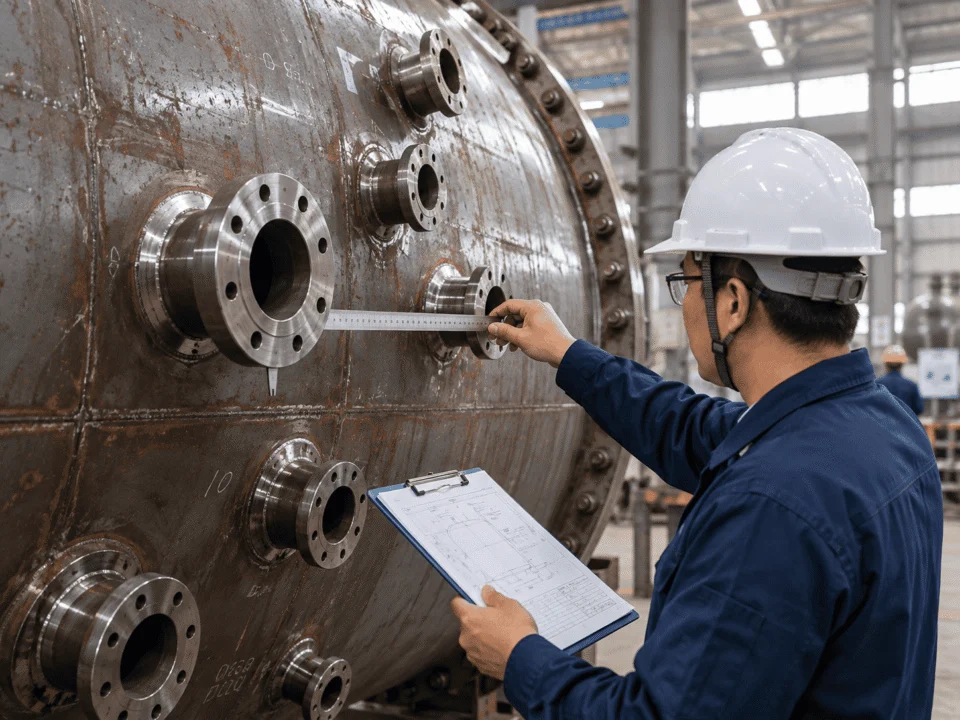
Confirm Final Condition
Dimensional & interface inspection
Overall dimensions, nozzle orientation, elevations and critical interfaces verified.
Surface & final condition check
Surface finish, cleanliness, coatings, nameplate and attachments verified.
FINAL DOCUMENTATION PACKAGE
Drawings
Certificates
Reports
Records
Records
Certificates
SHIPMENT
The vessel is released for shipment together with the documentation required by the approved project scope.
Inspection and testing are performed in accordance with the applicable code, approved design and project requirements.
Custom Pressure Vessels for Different Process Duties
Custom pressure vessels are defined by what they need to do inside the process. Working volume, pressure, temperature, materials, internals, connections and installation requirements are coordinated around the actual duty rather than a fixed vessel configuration.
Process & Buffer Vessels
Used for intermediate storage, buffer service, surge control and process stabilization. Designed to match your specific working volume, pressure and process requirements.
Explore Chemical Applications →Gas & Liquid Receiving Service
Designed for gas receiving, liquid receiving, knock-out service and condensate collection. Custom nozzles, internals and interfaces can be configured to fit your process.
Explore Petrochemical Applications →Heating & Cooling Duties
Can be designed with jackets, internal coils or other heat-transfer arrangements to meet your heating or cooling process requirements.
Explore Jacketed Pressure Vessels →
Vacuum & Pressure Cycling
Engineered for vacuum service, pressure service or combined pressure/vacuum conditions, with design and configuration tailored to your operating envelope.
Explore Vacuum Vessels →Clean & Corrosion-Sensitive Processes
Suitable for pharmaceutical, food & beverage, fine chemical and other corrosive or high-purity processes. Material, surface finish and internal configuration can be customized for your application.
Explore Pharmaceutical Applications →Project-Specific Equipment Packages
Manufactured as individual vessels or as part of a larger skid, EPC package, plant retrofit or customer-designed equipment scope.
Explore Process Skids →Custom Pressure Vessels for Different Industries
Different industries place different demands on pressure vessel materials, operating conditions, surface requirements, interfaces and inspection scope. We adapt the vessel design around the requirements of the process and the environment in which it will operate.

Chemical
- Material compatibility for aggressive process media
- Corrosion allowance and thermal-cycle requirements
- Reliable interfaces with complex process systems
Petrochemical
- Pressure and temperature envelope for hydrocarbon service
- Project-specific material, nozzle and inspection requirements
- Accurate integration with existing plant piping and supports

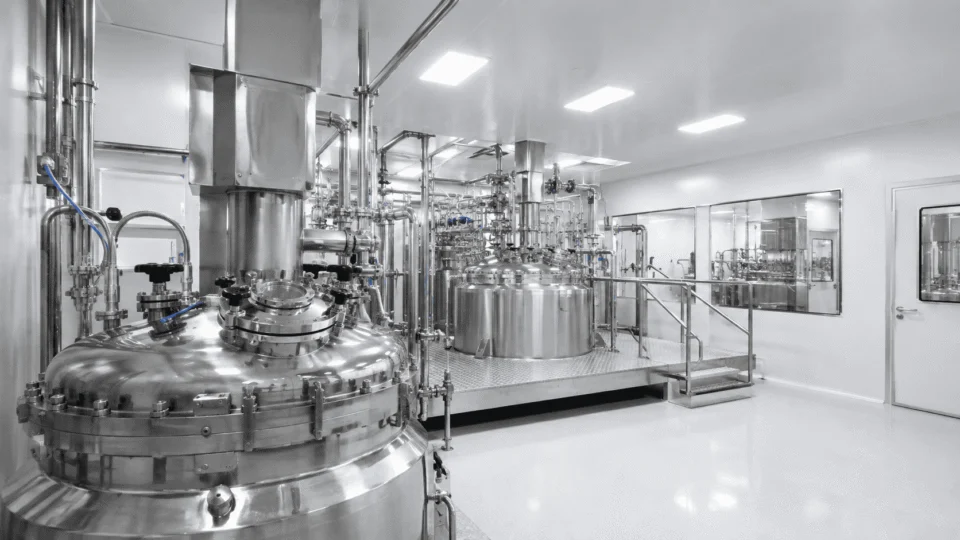
Pharmaceutical
- Material and product-contact surfaces selected for clean service
- Internal geometry, drainage and surface condition coordinated for cleanability
- Project documentation and inspection aligned with pharmaceutical requirements
Food & Beverage
- Clean product-contact configuration for food processing duty
- Heating or cooling interfaces matched to process requirements
- Cleaning access, drainage and surface condition considered in the design

Manufacturing Envelope & Project Requirements
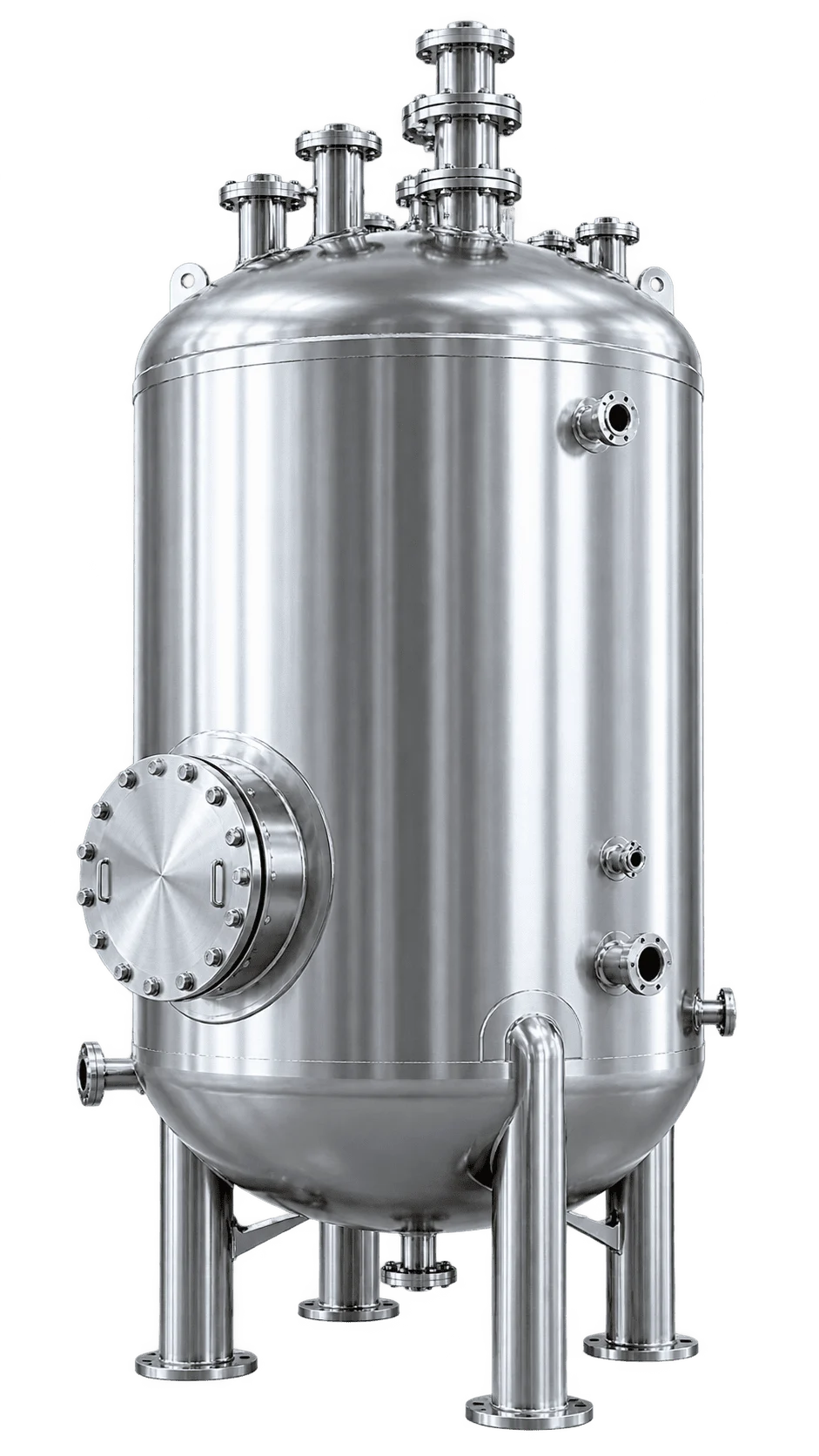
Before detailed engineering begins, the vessel must fit both the manufacturing envelope and the requirements of the actual process. Key operating conditions, dimensions, materials, interfaces and inspection requirements are defined before the project is released for fabrication.
MANUFACTURING ENVELOPE
Our manufacturing capability covers a wide range of sizes, pressures, temperatures and key configurations to meet different industry requirements.
Design Pressure
Full Vacuum to
10 MPaVessel Diameter
300–5,000 mmOrientation
Vertical /Horizontal
Design Temperature
−45°C to400°C
Materials
Carbon Steel
SS304
SS316L
Project-Specified
Configurations
Jacketed / Internals /
Multiple Nozzles /
Custom Supports
PROJECT FIT
THE ENVELOPE?
Capability Check
Leads to
Engineering Review
PROJECT DEFINITION CHECKLIST
To ensure accurate design and quotation, the following key information should be defined before the project is released for engineering.
Process Medium
Medium, phase, corrosiveness, special process requirements
Operating & Design Conditions
Operating pressure, design pressure, temperature, vacuum
Required Capacity
Working volume, total volume, process residence requirement
Material Requirement
Carbon steel, SS304, SS316L or customer specification
Connections & Installation
Nozzle sizes and ratings, orientation, support, installation space
Inspection & Documentation
Applicable code, NDT, testing, documentation, third-party inspection if required
Once the above information is defined, our engineering team can proceed with detailed design, quotation and project scheduling.
Contact our team to discuss your project requirements.
Have a Custom Pressure Vessel Project to Define?
Send us your drawing, datasheet or process conditions. Our engineering team can review the project requirements, identify the information still needed and help define the next step toward quotation and fabrication.
Drawing
Send an existing vessel or fabrication drawing.
Datasheet
Share your vessel or process datasheet.
Process Conditions
Start from your operating requirements — medium, pressure, temperature, capacity and installation conditions.