Custom Distillation Columns for Industrial Separation
Engineered tray, packed and hybrid distillation columns for chemical, petrochemical, pharmaceutical and process applications. Designed around your separation duty, operating conditions, internals and project requirements.
Start With the Separation Duty — Not the Column Size
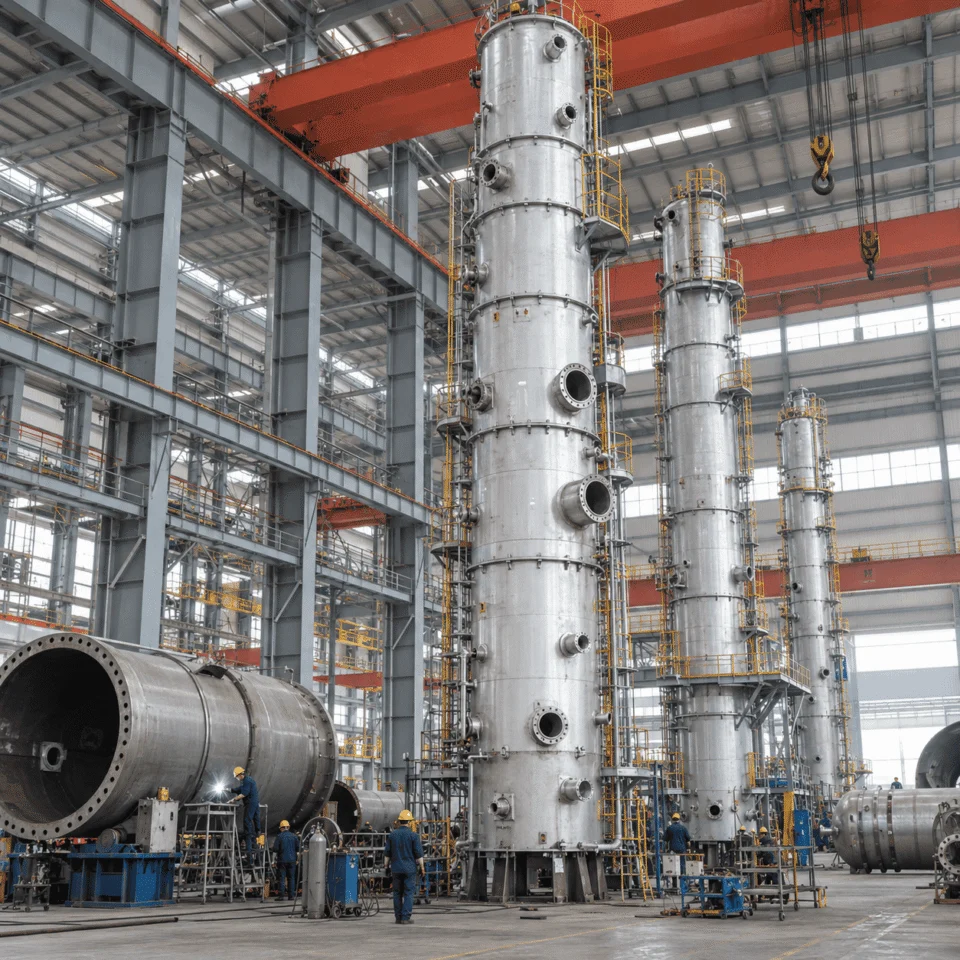
A reliable distillation column starts with the process duty. Diameter, height, internals and material selection should follow the feed, separation target and operating window—not the other way around.
What must be separated, at what rate, and under what conditions?
This is the basis for hydraulic sizing, stage requirements, internals selection and the final mechanical design.
Process requirements define the hydraulic envelope; the hydraulic envelope defines the column geometry; the mechanical design then turns that geometry into a fabricable pressure vessel. See our pressure vessel design basics for the mechanical-design side of this process.
Tray or Packed? Choose by Operating Condition
The right internal configuration is not chosen by habit or initial cost alone. Pressure drop, fouling tendency, turndown, liquid load, maintenance access and product sensitivity all affect the decision.
Can be used, but cumulative tray pressure drop must be checked carefully.
Structured packing is frequently selected when minimizing pressure drop is a priority.
Open tray designs can provide better access for inspection and cleaning.
Dense structured packing and distributors can be sensitive to fouling or solids accumulation.
Valve trays can provide a broad operating window when correctly sized.
Very low liquid rates can create poor wetting or distribution problems.
Tray decks, downcomers and access can become difficult in compact shells.
Packing can simplify the internal arrangement in smaller-diameter columns.
Tray systems are widely used where high liquid rates must be handled predictably.
Packing type, bed geometry and distributor design must be matched to the liquid load.
Suitable in many services, but total pressure drop and liquid holdup should be evaluated.
Lower pressure drop and lower liquid holdup can be advantageous in sensitive service.
Individual tray areas can often be inspected through planned manway locations.
Packing may need partial or full removal to inspect supports, collectors or lower beds.
Tray performance still requires correct liquid flow paths, downcomers and leveling.
Distributor quality, leveling and redistribution can directly affect effective mass transfer area.
Tray vs. packing is a hydraulic and process decision, not a universal rule. Final selection should be checked against vapor and liquid loads, allowable pressure drop, operating range, fouling behavior and maintenance requirements.
Where Separation Performance Is Won or Lost
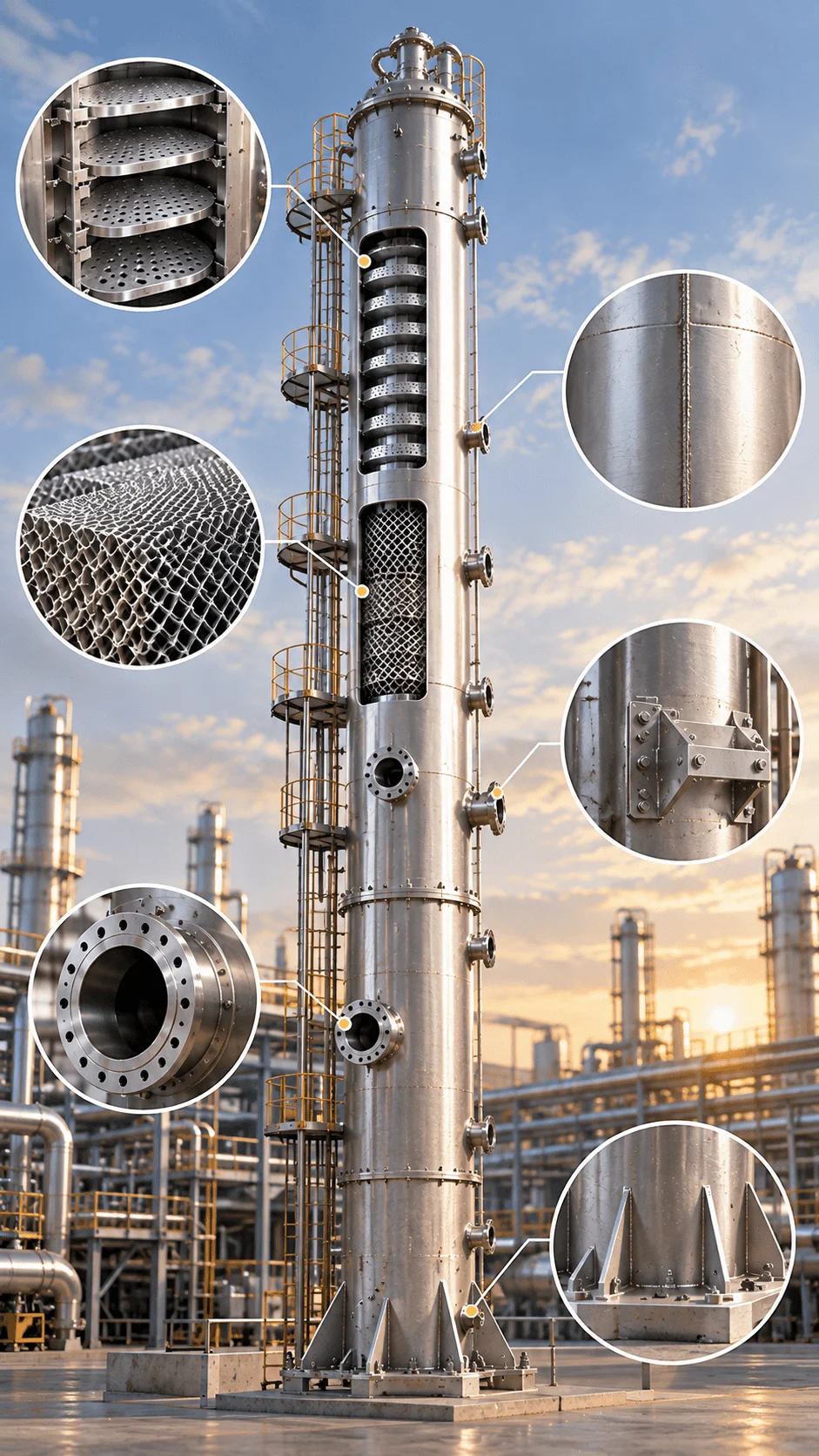
Column internals do more than fill space inside the shell. Their geometry, elevation and distribution quality directly affect vapor-liquid contact, pressure drop, flooding margin, entrainment and product consistency.
Feed Distributor
Introduces the feed without creating excessive local vapor or liquid loading. Poor feed entry can disturb nearby trays or packing and reduce effective separation area.
Liquid Distributor
Spreads liquid evenly across the packing cross-section. Good packing cannot perform properly if the liquid distribution above it is uneven.
Redistributor
Re-collects and redistributes liquid after a packing bed or at selected elevations to limit channeling and progressive maldistribution.
Tray & Downcomer System
Controls vapor-liquid contact from stage to stage. Tray spacing, active area and downcomer capacity all influence weeping, entrainment and flooding behavior.
Support Grid & Hold-Down
Carries packing weight while preserving open flow area. The support arrangement must resist operating loads without creating unnecessary pressure drop.
Demister / Entrainment Control
Reduces liquid carryover in the overhead vapor where required. Selection depends on vapor velocity, droplet loading and allowable pressure drop.
Internals should be reviewed together with shell diameter, vapor and liquid loads, pressure drop allowance, turndown and maintenance access. A column shell can be mechanically sound and still underperform if the internal arrangement is wrong.
Flooding Is Only One Failure Mode
A distillation column must remain stable across its expected operating range, not only at the design point. Hydraulic checks should consider flooding together with weeping, entrainment, pressure drop, downcomer backup, maldistribution and process-specific foaming behavior.
The Numbers That Actually Change the Column
Column diameter, height, internals and material should follow the process duty and hydraulic limits. The most useful project data is not a long specification list—it is the set of parameters that directly changes sizing, operating margin and mechanical design.
Material Selection Is a Process Decision
The right material depends on the chemistry, temperature, corrosion mechanism, contamination limits and fabrication route—not simply on choosing a “higher grade” stainless steel.
Extra thickness may extend life against predictable general corrosion, but it does not solve every localized corrosion, cracking or contamination mechanism.
Fabricating a Tall Column Is Different From Fabricating a Tank
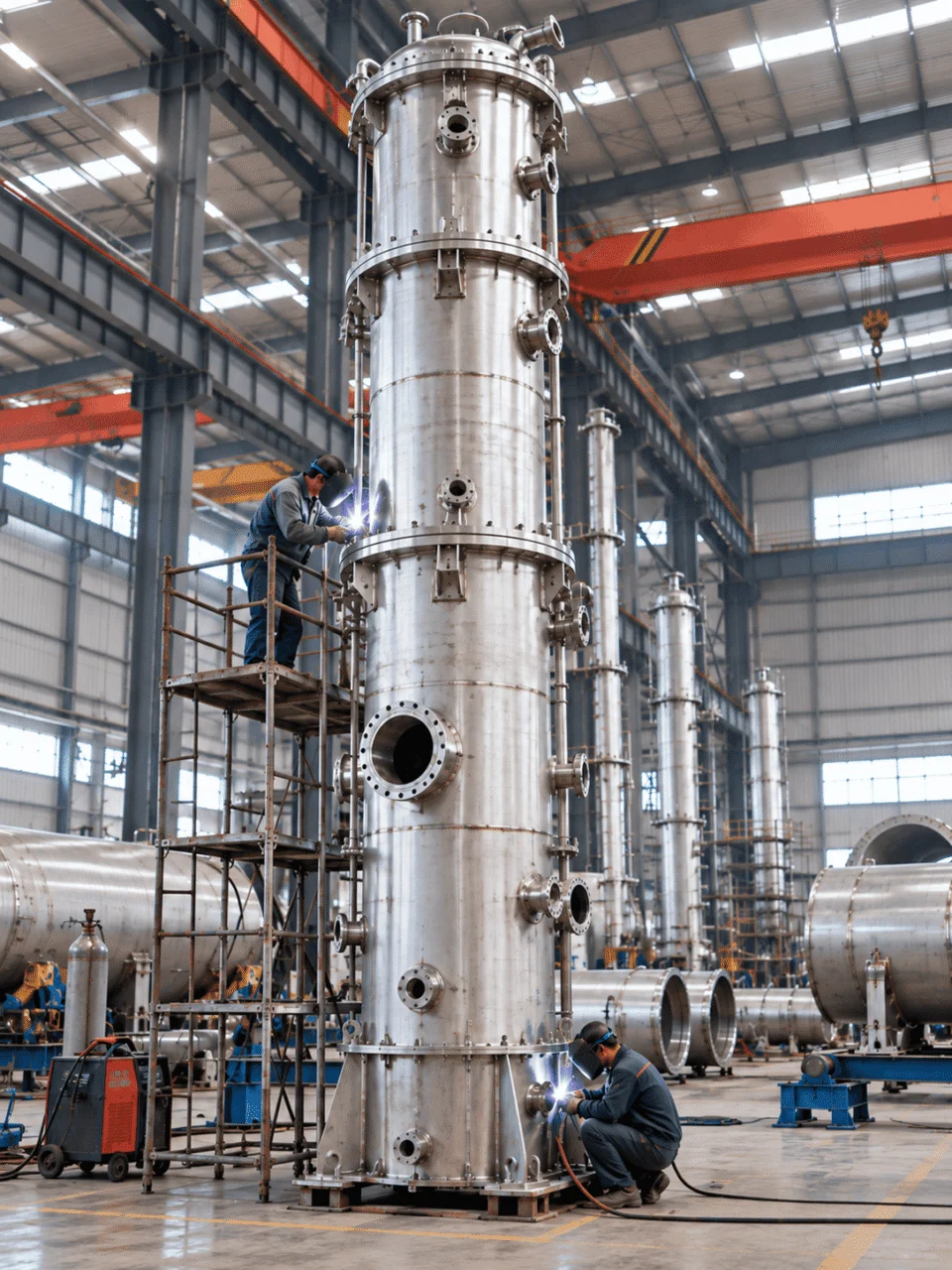
A tall distillation column adds alignment, distortion, internal-elevation, lifting and transport challenges that do not appear in the same way on a simple storage vessel.
Roundness & Straightness
Shell courses must remain within project tolerances so trays, packing supports and other internals fit correctly along the full tower height.
Verticality
Cumulative alignment error becomes more important as tower height increases, affecting support loading, internal elevation and final site installation.
Support Ring Elevation
Tray support rings, packing supports and distributor supports need controlled elevations and levelness so process internals are installed as designed.
Nozzle Orientation & Flange Alignment
Nozzle orientation affects piping fit-up, platforms, instruments and field assembly. Errors are much harder to correct after a tall column reaches site.
Distortion Control
Weld sequencing, shell-course fit-up and heat input must be controlled to limit ovality, local distortion and misalignment during fabrication.
Lifting & Sectional Fabrication
Lifting lugs, temporary supports, transport length, shipping weight and field-joint strategy should be considered before finalizing the mechanical design.
The result may be difficult tray installation, misaligned nozzles, uneven internals, field-fit problems or extra correction work during erection.
Transport Can Change the Column Design
A tall distillation column should not be mechanically finalized before the shipping route, lifting limits and site-assembly strategy are understood. For large towers, logistics can directly influence section length, joint location, support details and the sequence of internal installation.
Check workshop handling, crane capacity, shell length and shipping preparation.
Road clearance, turning radius, bridge limits, port handling and carrier limits all matter.
Confirm lift weight, lift height, laydown area, field joints and internal installation sequence.
Single Piece or Sectional Fabrication?
The correct answer depends on the complete logistics chain—not only the tower height.
Useful when dimensions, weight and route permit complete shop fabrication and testing.
Useful when route, crane or handling limits make a complete tower impractical to move.
Requires careful flange design, bolt access, alignment control and sealing strategy.
Requires site welding, inspection access, dimensional control and suitable erection planning.
If the completed column cannot move through the planned route or cannot be lifted at site, redesign, rework or field modification may be required after manufacturing has already started.
Inspection Should Verify More Than Weld Quality
A distillation column must be checked as a pressure boundary, a tall geometric structure and a platform for precision internals. Weld quality is only one part of final acceptance.
Verify the Vessel Can Safely Contain the Process
Verify the Tower Matches the Mechanical Design
Verify the Separation Hardware Is Installed as Designed
Verify the Records Match the Delivered Equipment
Once trays, packing or internal supports become inaccessible, correcting elevation, alignment or installation errors can be far more difficult and expensive.
What to Send Us Before Requesting a Quote
The more complete the project data, the faster the column can be reviewed for process duty, mechanical design, internals, fabrication and logistics. You do not need every item below to start—but these are the inputs that most directly affect the quotation.
Have a Datasheet or Drawing?
Send the files you already have. A GA drawing, process datasheet, mechanical datasheet, internals drawing or even a marked-up sketch can be enough to start the technical review.
Applications by Separation Challenge
Distillation columns are better matched to the separation problem than to an industry label. The same process sector may require very different column pressure, internals, materials and heat-integration strategies.
Reduce Pressure Drop Without Giving Up Separation Performance
Vacuum service is often driven by boiling-point reduction, thermal sensitivity or the need to protect product quality. Pressure drop across trays, packing, distributors and overhead equipment becomes part of the core process design.
Packing and internals should be reviewed against the full vacuum pressure budget.
Low-pressure systems can still underperform if liquid distribution is uneven.
Useful where heat-sensitive components or solvent systems must be separated gently.
Recover Reusable Solvent While Controlling Product Losses
Solvent-recovery columns may be designed around purity targets, recovery rate, energy use, corrosion behavior and the relationship between the column, condenser, reboiler and receiver system.
Stage count, reflux and heat duty should reflect the required recovery target.
Material and gasket choices should match the complete solvent system.
Often integrated with reactors, receivers and storage equipment.
Balance Capacity, Pressure Drop and Operating Flexibility
Hydrocarbon fractionation can require large vapor loads, wide turndown and careful control of tray or packing hydraulics. Mechanical height and shipping strategy can also become major project constraints.
Column diameter and internals must accommodate expected vapor and liquid traffic.
Peak loads should be checked rather than relying only on nominal throughput.
Often part of larger fractionation and heat-integration systems.
When the Separation Is Difficult, Stage Efficiency Matters More
Close-boiling systems may require more theoretical stages, greater transfer area, tighter control of reflux and better-performing internals. Small hydraulic or distribution problems can have a larger impact on final purity.
Tray efficiency or packing performance should support the required separation difficulty.
Maldistribution, entrainment and poor tray hydraulics reduce effective separation.
Useful where relatively small volatility differences drive a taller or more efficient column.
The Material System Must Match the Process Chemistry
Corrosive service changes more than the shell material. Internals, weld procedures, cladding, surface treatment, nozzles and associated equipment may all need to follow the same corrosion strategy.
Review process chemistry, temperature and expected corrosion mechanism together.
Corrosion allowance alone does not solve pitting, cracking or crevice attack.
May involve stainless, duplex, clad or higher-alloy construction by project.
Protect Product Quality From the Shell to the Internals
High-purity service may place additional emphasis on material traceability, surface finish, weld treatment, cleanability, internal drainage and avoiding contamination from product-contact surfaces.
Material, finishing and fabrication details can affect final product purity.
Internal arrangement and finish should support the required cleanliness level.
Often paired with tighter documentation and surface-treatment requirements.
Common Distillation Column Procurement Mistakes
Most purchasing problems do not start with fabrication. They start earlier—when process conditions, internals, inspection, transport or operating limits are left undefined in the RFQ.
Questions That Affect the Final Column Design
Distillation column questions are rarely isolated. Internals, hydraulics, materials, transport and inspection often influence one another, so the answer should explain what changes in the actual project.
Tray or packed column—which should I choose?
The choice depends on pressure drop, fouling tendency, turndown, diameter, liquid load, maintenance strategy and separation duty. Packed columns are often attractive for vacuum and low-pressure-drop service, while tray columns can be advantageous in fouling service, high liquid load and applications where inspection or maintenance access is important.
Confirm the full hydraulic operating window before final selection.
Planning a Distillation Column Project?
Share your process conditions, datasheet, GA drawing or internals requirements. We can review the separation duty, mechanical design, materials, fabrication and shipping strategy together.
Incomplete project data is fine. Send what you already have and we can define the next technical inputs from there.