Dairy Processing Equipment Built Around Your Process
From milk receiving and ingredient mixing to heating, cooling, process holding and storage, ChannelVessel manufactures stainless steel process equipment configured around the actual requirements of dairy production.
Tell us the product, capacity, temperature, mixing duty and connection requirements. We can help define the vessel and process equipment configuration before fabrication begins.
Process Equipment for Different Dairy Products
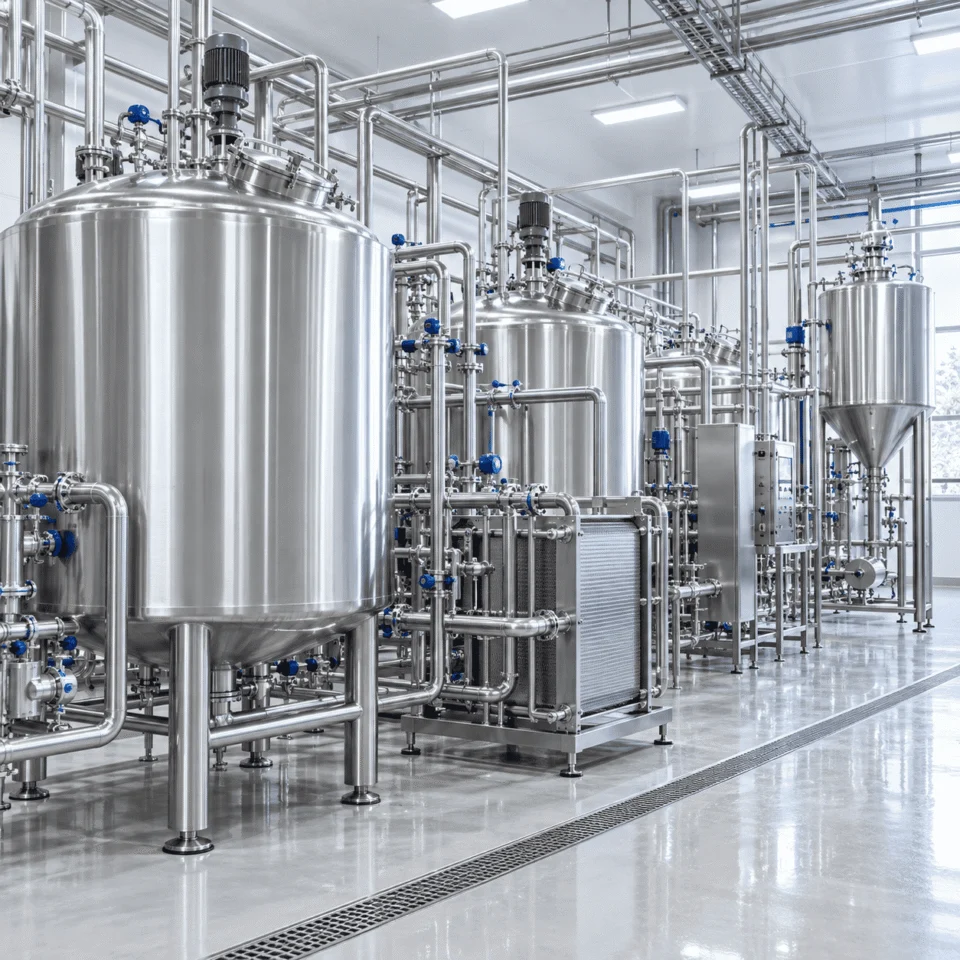
Equipment configuration changes with the dairy product being processed. Viscosity, mixing sensitivity, ingredient addition, temperature profile and storage conditions can all affect vessel design and process equipment selection. ChannelVessel provides stainless steel process equipment that can be tailored to your specific dairy products and production goals.

Fresh Milk
Fresh milk applications typically require reliable receiving, buffering and intermediate storage, with equipment configured around product temperature, capacity and downstream process requirements.
Yogurt & Cultured Dairy
Yogurt and cultured dairy products may require controlled ingredient mixing, temperature management and intermediate holding while avoiding unnecessary product handling.
Cream
Higher-viscosity dairy products such as cream can place different demands on agitation, product transfer and temperature control compared with low-viscosity milk. Equipment can be designed to ensure gentle and efficient processing.
Milk-Based Beverages
Milk-based beverages may combine milk with sugar, powders, flavors, stabilizers or other ingredients, making mixing performance and ingredient addition important parts of equipment selection.
Milk Powder Preparation
Mixing vessels can be configured for applications where milk powder or other powdered ingredients need to be incorporated into a liquid phase before downstream processing.
Dairy Ingredients & Formulations
For specialized dairy ingredients or formulated products, vessel configuration can be reviewed around batch size, viscosity, temperature profile, mixing duty and connections to existing equipment.
Custom Process EquipmentWhat Matters When Specifying Dairy Process Equipment
Selecting dairy process equipment by tank volume alone is rarely enough. Product characteristics, operating temperature, mixing duty, cleaning requirements and connections to upstream and downstream equipment can all change the final vessel configuration. The more complete the process data, the more accurate and efficient the equipment design and quotation.
Same Volume,
Different Equipment
Two dairy vessels with the same nominal volume can require very different configurations. A low-viscosity milk buffer tank may need a different agitator, outlet arrangement and thermal design from a vessel handling a higher-viscosity formulated dairy product.
The more complete the process data, the easier it is to define the right vessel before fabrication begins.

Key Information to Provide
The following parameters help us understand your process and recommend the most suitable equipment configuration.
Product or Medium
Define whether the equipment will handle fresh milk, cream, yogurt base, dairy beverages, reconstituted milk or another formulation.
Working Volume
Specify the required working or usable volume rather than only the nominal vessel capacity.
Operating Temperature
Provide the normal operating temperature, maximum temperature and any required heating, cooling or temperature-holding conditions.
Pressure or Vacuum
Indicate whether the vessel operates at atmospheric pressure, under pressure or under vacuum.
Mixing Requirement
Explain what the agitator needs to achieve, such as ingredient incorporation, blending, maintaining uniformity or handling a higher-viscosity product.
Heating & Cooling Duty
Define whether the vessel requires heating, cooling or temperature maintenance, together with the available utility conditions where known.
Connections & Instrumentation
Confirm inlet and outlet sizes, process connections, instrumentation points and interfaces with existing upstream or downstream equipment.
Cleaning Requirements
Describe the intended cleaning method, internal accessibility and any project-specific requirements for sanitary connections or cleaning devices.
Sanitary Construction and Process Temperature Control
Dairy process equipment must be designed around product contact, cleaning, and temperature conditions—not simply fabricated as a general-purpose tank. Surface condition, connections, drainage, agitation, and thermal control all affect daily dairy production.
Sanitary-Oriented Construction
Product-Contact Surfaces
Stainless steel product-contact surfaces with appropriate finish for dairy service.
Smooth Internal Geometry
Transitions and internal geometry designed to minimize product hold-up and support effective cleaning.
Sanitary Connections
Industry-standard sanitary fittings and connections to match plant requirements.
Drainability
Vessel and nozzle design supports complete drainage and minimizes residual product.
Cleaning Access
Manways, inspection ports, and internal access designed for safe and effective cleaning.
Project-Specific Cleaning Configuration
CIP-oriented arrangements can be incorporated when required by the project.
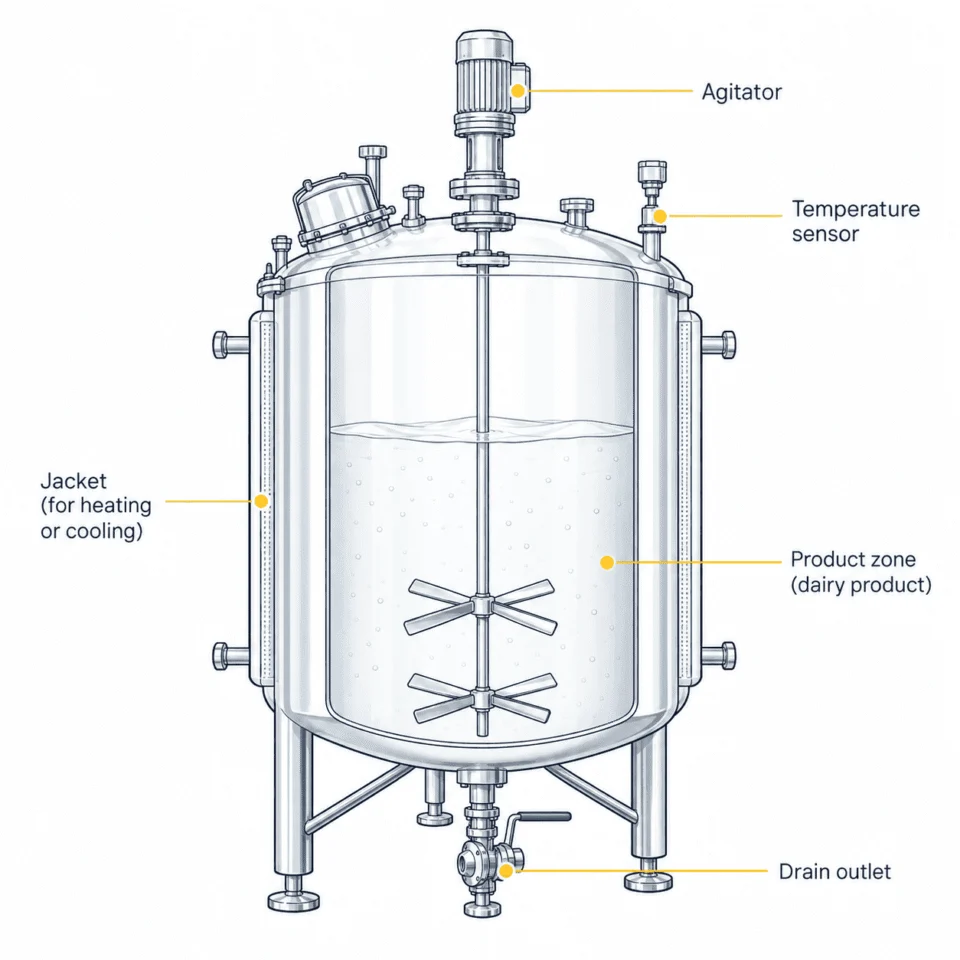
Sanitary design is not one specification
Cleaning method, product viscosity, operating temperature, connection type, and plant layout can all change the appropriate vessel configuration.
Heating, Cooling & Temperature Holding
Jacketed Heating or Cooling
Dimple or full jacket construction for efficient and uniform heat transfer.
Utility Conditions
Designed to match available plant utilities such as steam, hot water, chilled water, or glycol.
Insulation
External insulation can be applied to improve energy efficiency and maintain stable product temperatures.
Temperature Measurement
Temperature sensors and thermowells can be provided in locations suitable for process control.
Agitation During Temperature Control
Proper agitation helps maintain uniform temperature and product consistency during heating, cooling, or holding.