Mixing Tanks for Industrial Blending & Batch Processing
ChannelVessel supplies custom mixing tanks for liquid blending, batch preparation and process-specific mixing. Start with your product and required working batch size, then configure agitation, product-contact materials, heating or cooling, and plant connections around your process.
Whether you need a standalone blending tank or a mixing vessel integrated with transfer equipment and controls, share the production task—not just a tank capacity—to start your equipment selection.
Define normal production volume and smaller batches before choosing the vessel.
Match the mixing action to blending, dispersion, emulsification or viscous-product handling.
Coordinate the tank with your temperature-control requirements, available utilities and production line.
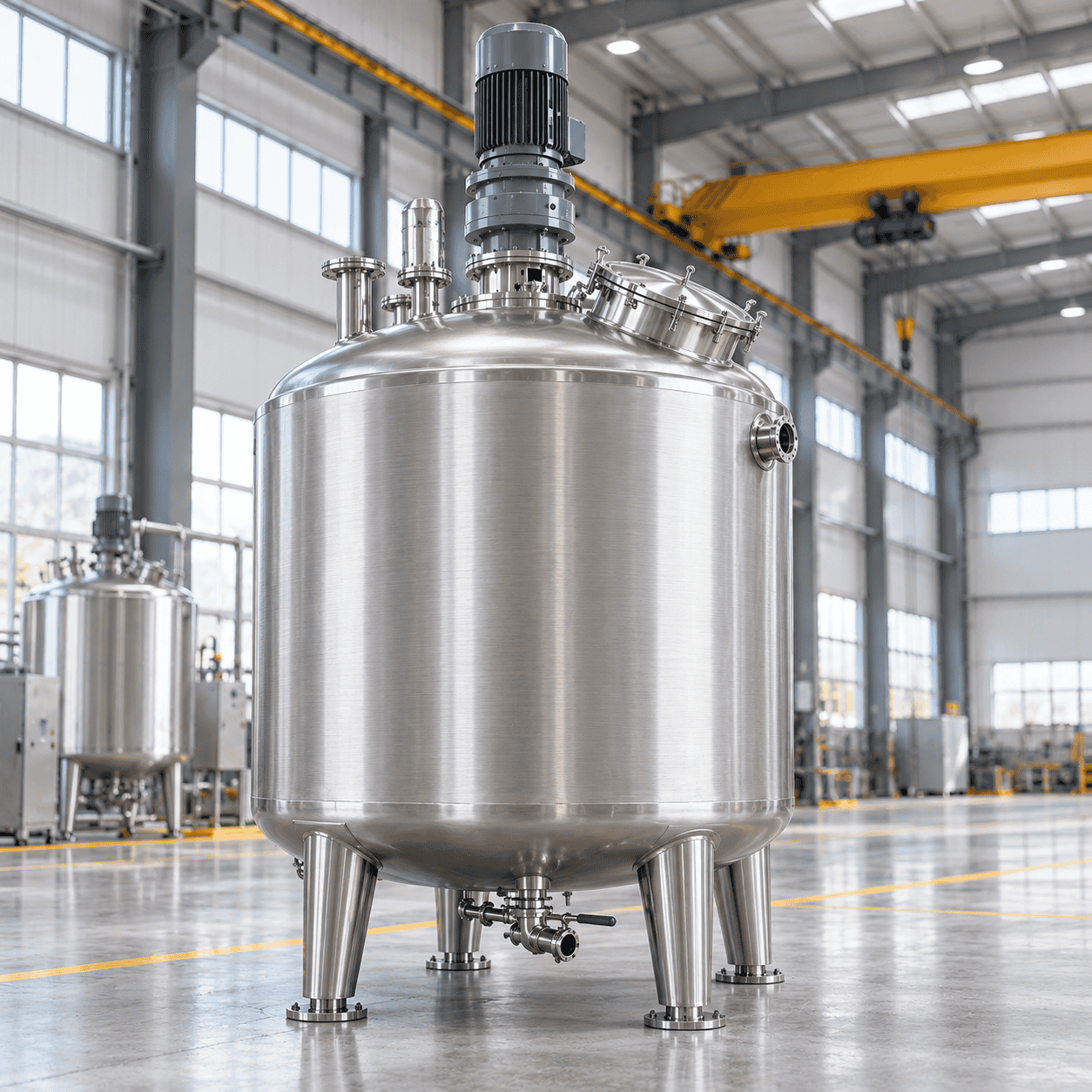
Explore Mixing Tank Types & Configurations
Choose your starting configuration by the task you need to complete. These options can be combined: a stainless steel mixing tank may also include a heating jacket, a high-shear mixer and a cleaning arrangement specified for the product.
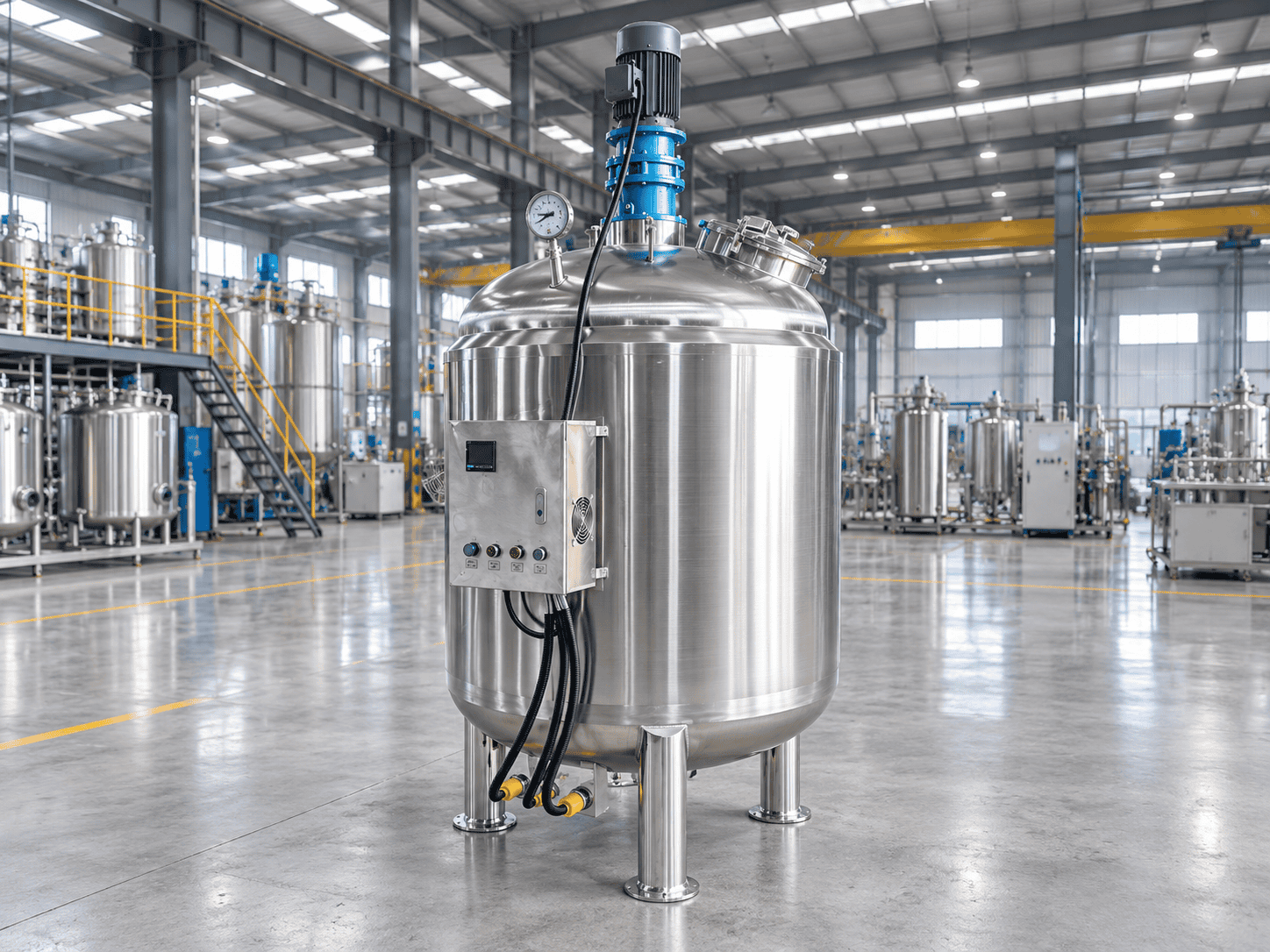
Stainless Steel Mixing Tanks
Specify a stainless steel mixing vessel around its product-contact materials, surface requirements, lid arrangement and connections. Include the ingredients and cleaning conditions in your inquiry so the material specification covers more than the visible tank shell.
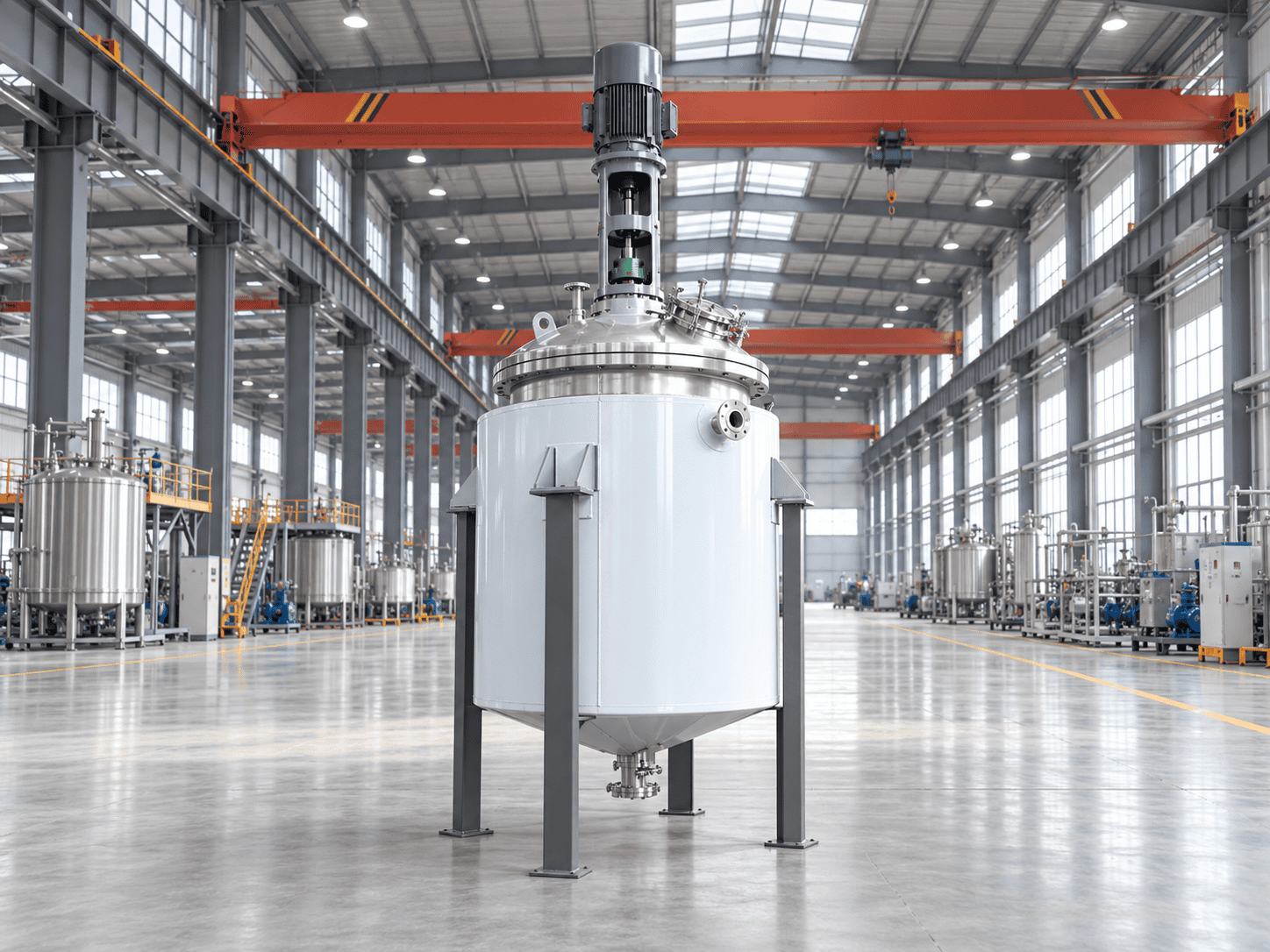
Jacketed Mixing Tanks
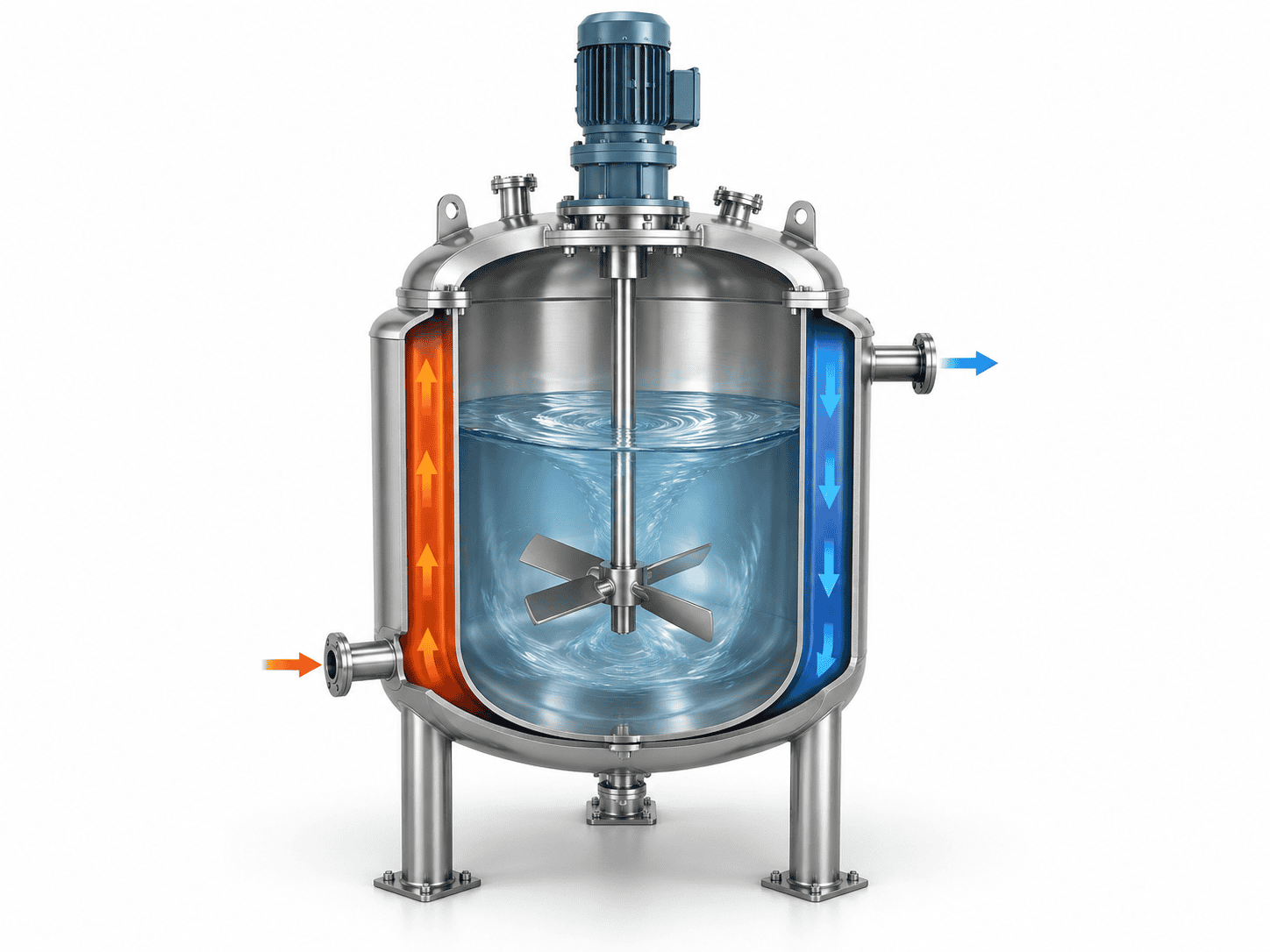
Add a heating or cooling jacket when the batch needs temperature control during processing. Define the utility medium, its supply conditions and the required temperature change. The jacket arrangement and the equipment serving it should be specified together.
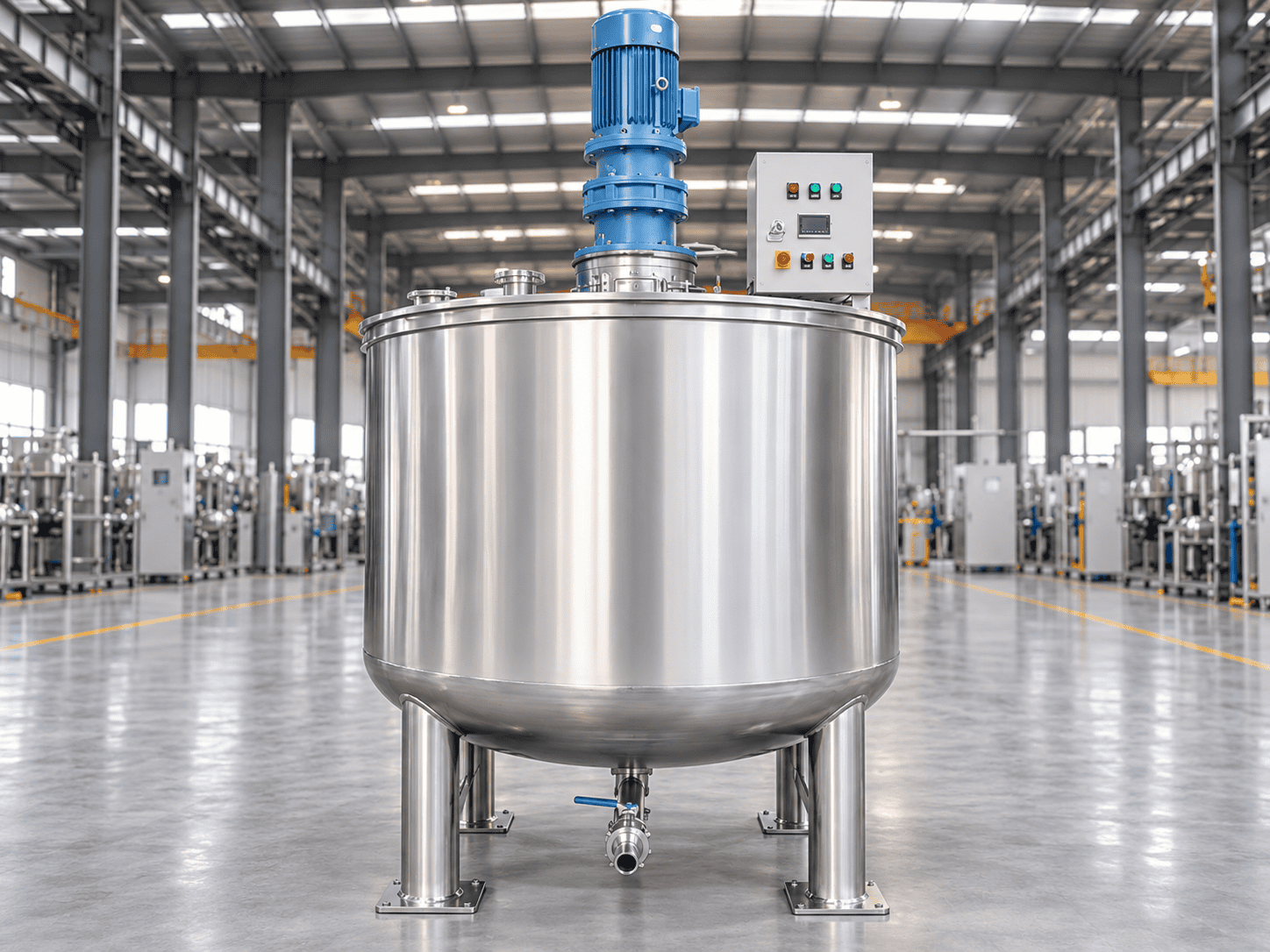
Heated Mixing Tanks
Request a heated mixing tank when your process requires warming, temperature holding or another defined heating step. Identify whether the project needs a tank connected to an existing heat source or a package that includes heating equipment and controls.
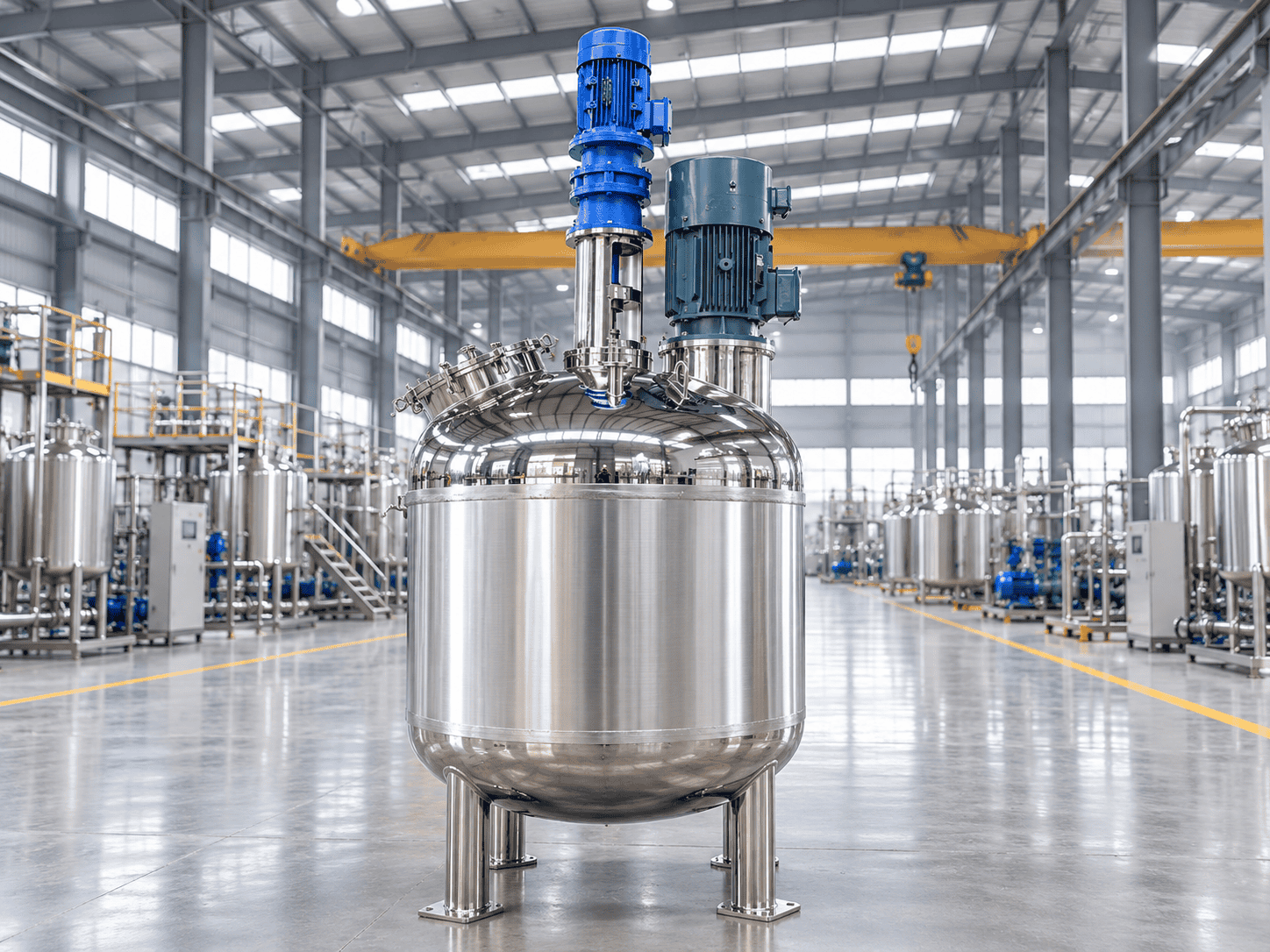
High Shear Mixing Tanks
Consider a high-shear configuration for tasks requiring dispersion, emulsification or the breakdown of agglomerates. Specify the desired product result as well as the batch volume. A high-shear workhead and a bulk agitator perform different jobs and may be combined.

Vacuum Emulsifying Mixers
For a process requiring emulsification under vacuum, define the mixing, homogenizing, vacuum and temperature-control functions as a complete package. Include the operating sequence and target product properties; a vacuum-capable vessel alone does not define an emulsifying system.
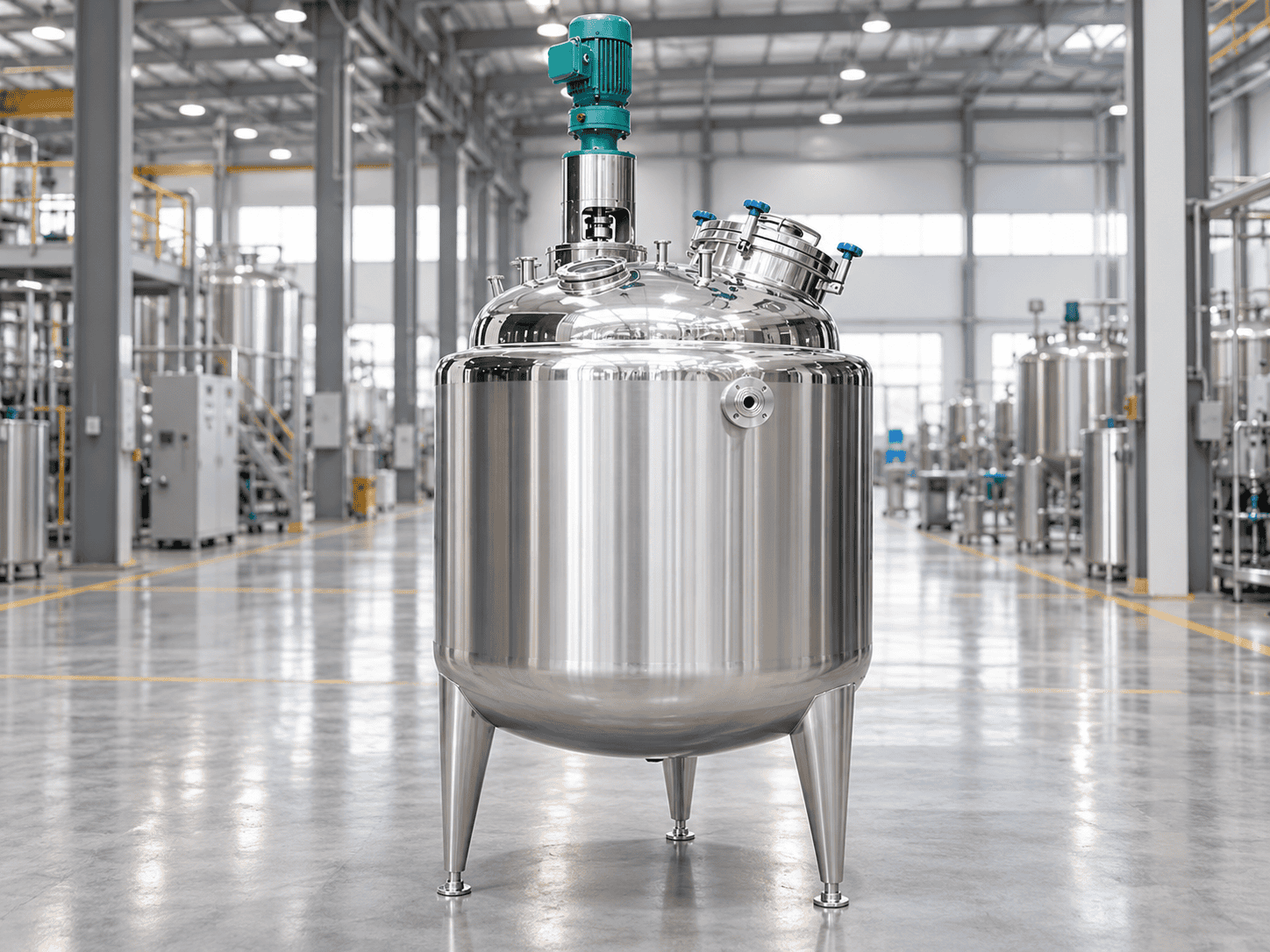
Sanitary Mixing Tanks
Specify a sanitary mixing vessel around cleaning access, product-contact surfaces, seals, connections and drainage. Include the required documentation and cleaning method. A polished surface is one specification item, not a substitute for defining the complete hygienic design.
Not sure which configuration to choose? Start with the product, batch size and process objective.
Mixing Tank Sizes, Specifications & Configuration Options
A useful mixing tank specification connects the vessel size to the equipment installed on it. It should identify what each drive does, how temperature is controlled, and which accessories are included.
Start with Your Required Batch Size
- 100 L
- 200 L
- 300 L
- 500 L
- 1,000 L
- 2,000 L
- 3,000 L
- 5,000 L
- Other Batch Sizes
Use these requested working-batch sizes to start your inquiry. They are selection inputs, not a list of stock models or a guarantee that every configuration has the same usable volume. The project datasheet should state the final working-volume range and total vessel volume separately.
Define the Configuration Behind the Capacity
| Specification item | Details to include in your request |
|---|---|
| Capacity | Normal, minimum and maximum working batches; total vessel volume; L, US gal or Imperial gal |
| Main agitator | Mixing objective, impeller arrangement, drive power, operating speed range and control requirements |
| Disperser or homogenizer | Required function, mounting or recirculation arrangement, separate drive power and speed |
| Heating and cooling | Temperature range, required processing time, utility source, jacket and auxiliary equipment |
| Product-contact parts | Requested grade, such as SS304 or SS316L; shaft, impellers, fittings, seals and surface requirements |
| Design conditions | Operating and design conditions for the product chamber and jacket, specified separately |
| Vessel arrangement | Lid or manway, feed points, sampling, outlet position, support arrangement and access |
| Electrical and controls | Site voltage, frequency, phase, instrumentation, control functions and line interfaces |
This is a specification checklist for a custom proposal. Rated performance and dimensions belong on the agreed equipment datasheet.
Choose the Right Agitator for Your Product
Start with the result you need: an evenly blended liquid, a dispersed powder, an emulsion or a viscous batch that remains in motion. Selecting a mixing tank with agitator requires more than choosing the largest motor or the highest speed.
| Mixing objective | Configuration to evaluate | Information needed for selection |
|---|---|---|
| Liquid blending and bulk circulation | Propeller, pitched-blade or another suitable circulation-focused agitator | Viscosity, density, batch range and target blending time |
| Viscous-product mixing and near-wall movement | Anchor, gate, scraper or a combined agitator arrangement | Viscosity during processing, starting condition and discharge requirements |
| Powder wetting and dispersion | Disperser, powder-liquid system or an appropriate high-shear arrangement | Powder properties, loading, addition method and agglomeration behavior |
| Emulsification and deagglomeration | Rotor-stator mixer, with bulk agitation or recirculation where needed | Formulation, temperature, target result and measurement method |
These are starting points for equipment selection, not universal viscosity limits or guaranteed process outcomes.
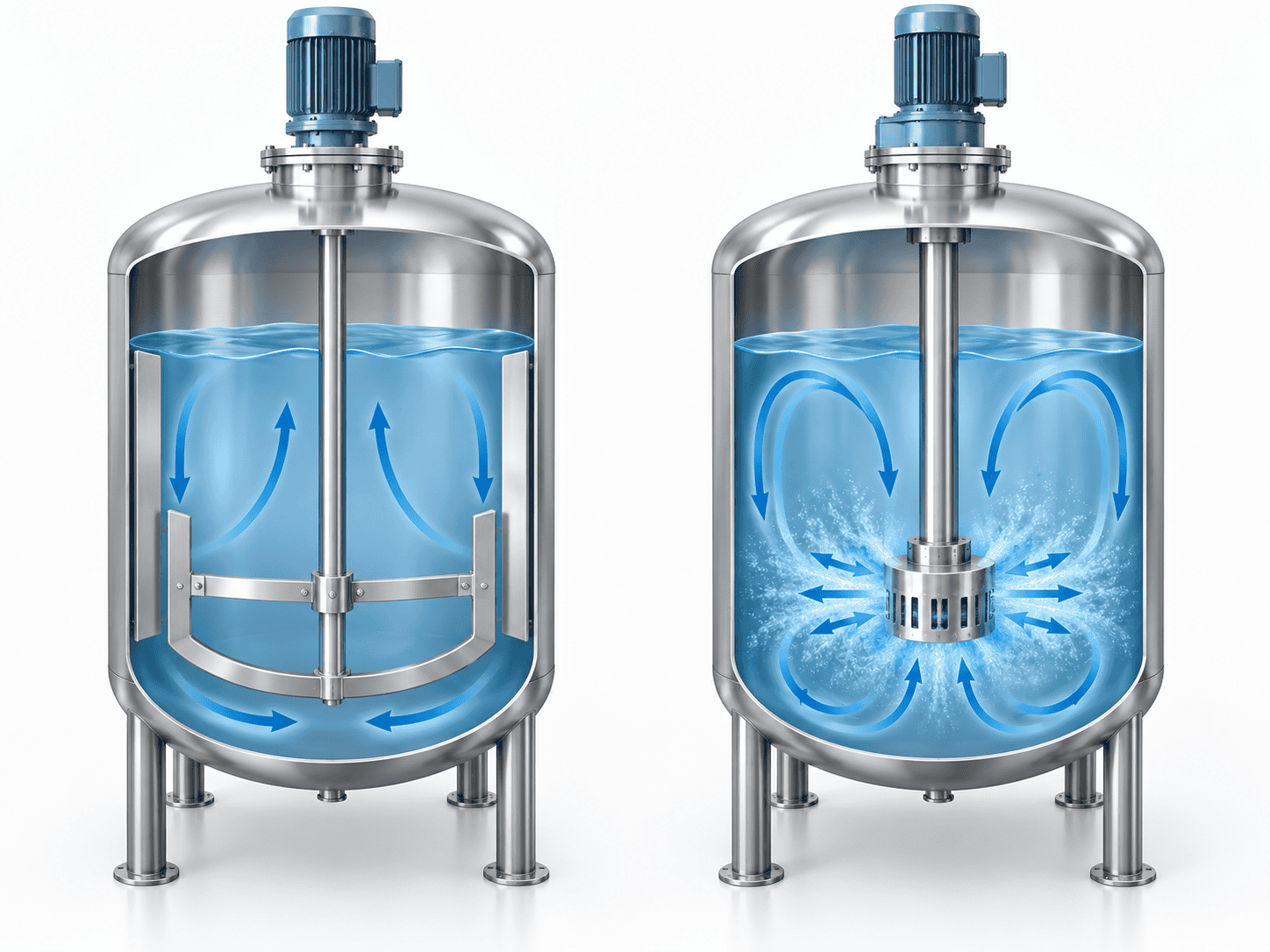
Bulk Movement and High Shear Are Different Duties
For a viscous product, a slow-moving anchor or scraper can circulate material through the vessel while a separate rotor-stator workhead performs localized high-shear mixing. The arrangement should keep product moving to and from the workhead rather than relying on the high-shear device to perform every mixing function.
Specify Viscosity at the Relevant Process Conditions
Include the measurement temperature and method when viscosity data are available. Describe changes during ingredient addition, heating and cooling. A finished-product value alone may not describe the conditions the mixer encounters during preparation.
Do Not Compare RPM in Isolation
For illustration, an impeller rotating at 300 rpm has a tip speed of approximately 6.28 m/s at 0.4 m diameter, but 12.57 m/s at 0.8 m diameter:
This is a geometric example, not a recommended operating condition or evidence of doubled mixing performance. Workhead design, flow, viscosity and the process objective also matter.
Working Volume, Minimum Batch Size & Production Throughput
Select your batch mixing tank by the amount of product you need to process—not by the largest capacity number in a product title.
Separate the Four Volume Definitions
- Total vessel volume
- The internal capacity defined by the vessel geometry and agreed measurement basis
- Normal working volume
- The routine batch you intend to process
- Maximum working volume
- The largest batch approved for the specified configuration and duty
- Minimum working volume
- The smallest batch approved for the specified mixing and operating requirements
Working volume is not determined by a universal filling percentage. The selected arrangement must account for the process, additions and required free space. State both your routine batch and any smaller production batches in the inquiry.
Calculate Output from the Complete Batch Cycle
A 1,000 L working batch does not automatically mean 1,000 L per hour. For scheduling, include charging, processing, discharge and the cleaning time allocated to each batch.
Illustrative production-planning example:- Charging ingredients15minutes
- Processing40minutes
- Discharging the batch15minutes
- Cleaning time allocated per batch20minutes
At a 1,000 L working batch, the average processing rate would be:
This assumes the activities occur sequentially and excludes unplanned downtime and product losses. It is a planning example, not a rated throughput. Use the actual production sequence where operations overlap or cleaning occurs between campaigns.
Make Gallon Units Explicit
Always identify the gallon system in drawings and quotations.
A 1,000 L tank and a 1,000 gallon tank are not equivalent.| Capacity description | Equivalent volume |
|---|---|
| 100 US gal | Approximately 378.5 L |
| 100 Imperial gal | Approximately 454.6 L |
| 1,000 US gal | Approximately 3,785.4 L |
| 1,000 Imperial gal | Approximately 4,546.1 L |
Unit conversions: NIST Guide to the SI: Conversion Factors.
Heating, Cooling & Utility Requirements
Define the temperature change and the time available to complete it. “With heating” is not enough information to determine whether a mixing tank will meet your production schedule.
Specify the Complete Temperature-Control Requirement
| Requirement | Information to provide |
|---|---|
| Product load | Batch mass or volume with density, plus relevant thermal properties |
| Heating duty | Starting temperature, target temperature and required heating time |
| Cooling duty | Starting temperature, final temperature and required cooling time |
| Site utilities | Available heating and cooling media, supply temperatures, pressures and flow conditions |
| Supply boundary | Jacket only, or additional heating, cooling, circulation and control equipment |
Worked Example: Heating a Water-Like Batch
Assume a 1,000 kg batch, a constant specific heat capacity of 4.18 kJ/(kg·K), and a temperature rise from 20°C to 60°C. Ignore phase changes and reactions for this example.
Product heat requirement = mass × specific heat capacity × temperature rise.
1,000 × 4.18 × 40 = 167,200 kJ ≈ 46.4 kWh.
With an 18 kW heater as the only heat source, assuming all its output reaches the product continuously and there are no losses:
Theoretical heating time = 46.4 ÷ 18 ≈ 2.58 hours, or 155 minutes.
This is an idealized energy calculation, not the performance of a particular tank. A real design must also consider heating the vessel, heat losses and achievable heat transfer. To complete the same product-only temperature rise in one hour would require an average 46.4 kW reaching the product—not merely a heater with that nameplate rating.
Technical reference: Spirax Sarco: Energy Consumption of Tanks and Vats.
Keep the Heat Source and Jacket Scope Separate
A jacket provides a heat-transfer interface; it does not, by itself, supply a boiler, chiller or circulation package. Define which utilities already exist at your plant and which equipment the quotation must include.
For cooling, specify both the desired product temperature and the available coolant conditions. Discuss heating and cooling together when both steps are part of the batch cycle.
Materials, Product-Contact Surfaces & Cleanability
Start material selection with the product and cleaning conditions. Include ingredients, concentrations, impurities where relevant, operating temperature and the chemicals used during cleaning. A stainless steel grade should be selected for those conditions, not simply because it is described as “food grade” or “chemical resistant.”
Specify Every Product-Contact Component
For a stainless steel mixing tank, identify whether SS304, SS316L or another material is required by your process. The specification should cover the shell, heads, shaft, impellers, nozzles, valves and seals. Identify any components requiring a different material from the main vessel.
| Design detail | What to define |
|---|---|
| Contact materials | Material grades and supporting documentation required for the project |
| Seals and gaskets | Product and cleaning compatibility, temperature and replacement access |
| Surface finish | Required finish, measurement locations and inspection records where applicable |
| Product outlet | Discharge position, valve arrangement and the agreed approach to residual product |
| Cleaning access | Parts requiring removal, inspection points and access around internal components |

Specify a Cleaning Method, Not Just a Spray Ball
A cleaning device must be selected for the vessel and cleaning duty. Spray pattern, cleaning-fluid supply and the arrangement of internal equipment need to be considered together; a device name alone does not describe the complete cleaning result.
For cleaning-in-place, distinguish the in-tank cleaning device from the external supply, heating, dosing, return and control equipment. State whether these services come from an existing plant system or belong in the equipment package.
Define the cleaning procedure and acceptance method with the project team. Sanitary construction, cleaning-in-place capability and sterile processing are separate requirements; none should be inferred solely from a polished vessel.
Mixing Tanks for Chemicals, Food, Cosmetics & Detergents
Start with the product you make and the operation you need to improve. The application name helps organize the inquiry; your actual formulation, batch sequence and required results define the equipment request.
Chemical Mixing Tanks
For chemical blending and liquid preparation, describe the ingredients, concentrations, density, viscosity and operating conditions. Include solids, corrosive components and any special handling requirements in the process brief.
State whether the task is physical blending or includes a reaction. Request a review of the relevant design and temperature-control requirements rather than treating all chemical duties as the same mixing operation.
Food & Beverage Mixing Tanks
For food and beverage preparation, describe the recipe sequence, ingredient additions, product-contact requirements, temperature steps and changeover needs. Include powders, suspended ingredients or sensitive components that require particular handling.
Identify whether the tank is for preparation, holding or a combined duty, and state any required downstream transfer or filling connections.
Cosmetic & Personal Care Mixing Tanks
For lotions, creams, shampoos and other personal care products, specify whether the process requires straightforward blending, powder dispersion, emulsification or vacuum processing.
Include the batch sequence, viscosity data at relevant conditions and the product characteristics used for acceptance. This helps distinguish the required mixing functions from optional equipment.
Detergent Mixing Tanks
For laundry liquids, dishwashing liquids and household cleaning formulations, describe the raw materials, addition order, viscosity changes and any foaming or air-content requirements.
Include how the finished product leaves the tank and connects to storage or filling. Define the complete batch sequence rather than requesting a vessel solely by nominal capacity.
Plan Installation, Connections & Controls Before Ordering
Bring your installation constraints into the equipment discussion before finalizing the tank arrangement. An overall dimension is only one part of the space needed for operation and maintenance.
Space & Access
Provide the installation area, access route and any doorway or ceiling restrictions. Request an arrangement drawing showing the vessel, drive, supports, outlet and the clearances needed for opening, operation and component removal.
Include floor or platform requirements and the intended method of moving the equipment into position. Use project-specific dimensions for installation planning rather than dimensions taken from a similar tank.
Utilities & Connections
State the site voltage, frequency and phase, together with the available heating and cooling supplies. Identify feed, discharge, sampling, cleaning and other process connections by their function, position and required connection standard.
For replacement equipment, share the existing nozzle schedule, plant layout and mating connections. A similar overall tank size does not establish that the existing interfaces will align.
Controls & Line Integration
Define which functions belong at the tank and which belong in your existing control system. The request may cover variable-speed operation, temperature measurement, level detection, weighing, alarms and production-line signals.
For a mixing and blending skid, specify the boundaries between the vessel, pumps, valves, pipework, instruments and control panel. Identify responsibility for installation and site connections in the supply scope.
Manufacturing, Inspection & Acceptance Criteria
A useful inspection plan connects the equipment specification to the documents and tests required for your project. Define what must be checked before fabrication, before dispatch and after installation, rather than relying on a general statement that a tank has been “tested.”

Agree the Documentation Scope
| Project item | Documentation or check to request |
|---|---|
| Design and layout | Approved equipment datasheet, arrangement drawing and connection schedule |
| Materials and fabrication | Required material records, fabrication records and applicable inspection reports |
| Dimensions and finish | Checks against approved dimensions and specified surface requirements |
| Mechanical and electrical functions | Agitator operation, instrumentation and agreed control checks |
| Handover | Applicable operating, maintenance, parts and equipment documentation |
The quotation and inspection plan should identify the documents included, any customer witness points and the applicable acceptance requirements. Specialized certificates and tests must be expressly included in the project scope.
Define What Successful Mixing Means
| Performance requirement | Conditions to agree before testing |
|---|---|
| Batch uniformity | Test product, batch size, operating conditions, sample locations and analytical method |
| Dispersion or emulsification | Target property, measurement method and agreed sampling procedure |
| Heating or cooling | Product load, start and finish temperatures, available utilities and elapsed time |
| Discharge performance | Product condition, discharge procedure and method for measuring residual material |
| Cleaning | Defined cleaning procedure, inspection method and acceptance criteria |
Separate mechanical checks from product-performance testing. An empty run or a water trial is not, by itself, evidence that a different formulation will meet its mixing target.
Where performance is critical, agree an appropriate product or representative-material trial, its location and its acceptance criteria. For factory acceptance testing, state which tests are included and which require site conditions or actual production material.
Mixing Tank Cost, Lead Time & Scope of Supply
A mixing tank price is meaningful only when its equipment scope is clear. A vessel with one agitator and a package with homogenization, temperature control, transfer equipment and automation are different purchases—even when the requested batch capacity is the same.
Compare Quotations on the Same Basis
Scope Comparison| Quotation item | What to confirm |
|---|---|
| Vessel | Working capacity, materials, structure and design conditions |
| Mixing equipment | Agitator, drive, gearbox, speed control and any separate disperser or homogenizer |
| Temperature control | Jacket, insulation, heating or cooling equipment, circulation and controls |
| Auxiliary equipment | Pumps, valves, pipework, platform, weighing and other requested accessories |
| Inspection and documents | Required tests, records, witness points and equipment files |
| Delivery and services | Packing, transport scope, installation responsibilities and requested support |
When comparing mixing tank manufacturers, ask each supplier to identify inclusions, exclusions and the assumptions behind the quotation. This also gives your team a basis for comparing the cost of a standalone vessel with a more complete package.
Plan Around Defined Delivery Milestones
For scheduling, separate design approval, production release, inspection, readiness for dispatch and arrival at site. Request the quoted lead time and its starting conditions, including any approvals or customer information needed before work proceeds.
- Design approval
- Production release
- Inspection
- Ready for dispatch
- Arrival at site
Mention the required arrival date and installation country with the initial inquiry. Include special document, inspection or packaging requirements before the schedule is finalized.
For a useful budget discussion, send the product, working batch size, main process steps and installation destination. Detailed accessories can then be itemized against that requirement.
Mixing Tank Questions, Answered
Find practical answers about tank sizing, agitator selection, heating systems, equipment scope and quotations.
How do I choose the right mixing tank size?
Start with the product quantity required per batch and the complete production cycle. State your normal batch, largest batch and any smaller batches you need to run. The specification should distinguish working volume from total vessel volume and identify the units clearly. Do not select equipment solely from a nominal capacity label.
Which agitator is suitable for my product?
The choice depends on the mixing objective and the product conditions. Liquid blending, viscous-product circulation, powder dispersion and emulsification may require different configurations. Include viscosity data, process temperature, solids and the desired result. For demanding duties, agree how the proposed configuration will be evaluated rather than selecting by motor power alone.
Can one tank handle both small and large batches?
It may be possible, but the required batch range must be assessed for the selected arrangement. Ask for the minimum approved working batch as well as the normal and maximum volumes. Include small-batch requirements before choosing the vessel and agitator; they should not be assumed from the tank’s maximum capacity.
Do I need a jacket or a complete heating system?
That depends on the utilities already available at your plant. A jacket is the tank’s heat-transfer interface. A complete heating arrangement may also require a heat source, circulation equipment, controls and connections. Specify the product load, temperature change and available time, then define which equipment is included in the quotation.
Can the tank process viscous products or powders?
Request a configuration matched to the material and task. A viscous formulation may require bulk agitation combined with another mixing function; powder processing may require an appropriate wetting or dispersion arrangement. Provide the material properties, addition sequence and required outcome. Capacity alone does not establish that a particular configuration is suitable.
Can a mixing tank operate under pressure or vacuum?
Only when the equipment is designed and rated for the required conditions. State the product-chamber and jacket requirements separately, including operating temperatures and applicable project requirements. An atmospheric mixing tank should not be treated as pressure- or vacuum-rated equipment. Confirm the relevant ratings, seals, connections and documentation in the equipment specification.
What affects the price and delivery schedule?
The quoted scope matters: vessel construction, mixing equipment, temperature control, automation, accessories and required inspection or documentation. Ask for an itemized scope and a delivery schedule with a defined starting point. Distinguish readiness for dispatch from arrival at your site, and include the installation destination and required date in your inquiry.
What information is needed for a quotation?
Start with your product or material, required working batch size and contact details. Add available information on viscosity, temperatures, mixing objectives, site utilities and delivery location. Drawings, an existing equipment datasheet or a short process description are also useful. You do not need a complete engineering specification to begin the discussion.
Tell Us What You Need to Mix
Share your product, required batch size and the result you need to achieve. ChannelVessel can use that starting information to discuss a mixing tank configuration and prepare a project-specific equipment proposal.
Already have a drawing, equipment specification or production-line layout? Include it with your inquiry so the vessel arrangement, process connections and supply scope can be discussed together.
Start with Three Details
Additional information is welcome: process temperatures, viscosity, required mixing result, installation country, site utilities and drawings.
Not all process data available yet? Send the information you already have.
