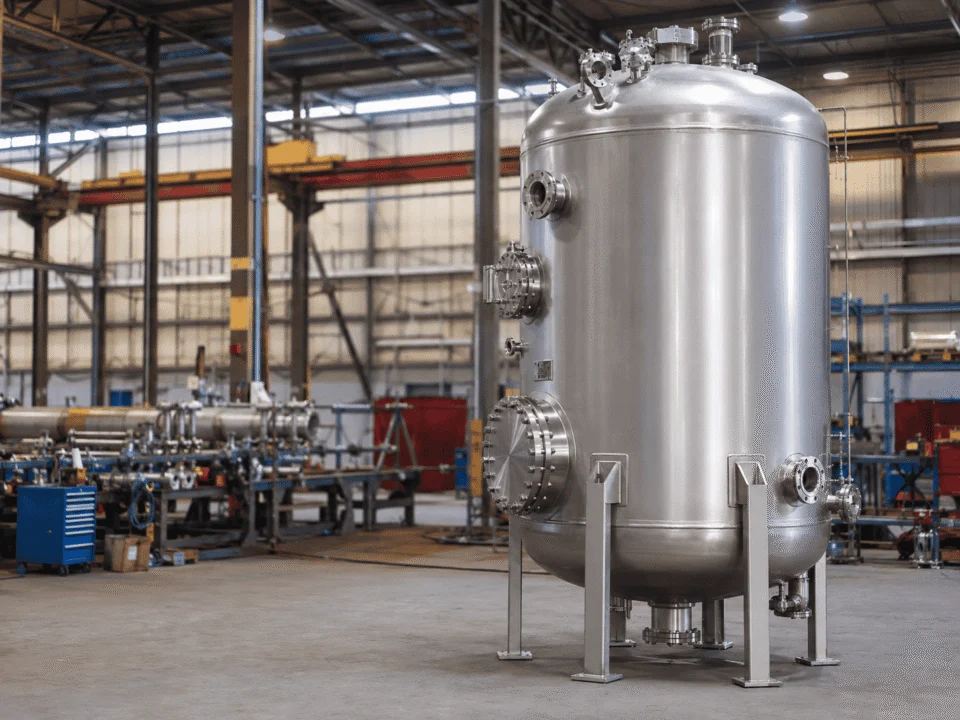
Vacuum Vessels Built for Full & Partial Vacuum Service
Custom-engineered vacuum vessels for industrial process applications, with shell geometry, wall thickness and reinforcement designed around your actual vacuum, temperature and operating conditions.
VACUUM Full / Partial
ORIENTATION Vertical / Horizontal
MATERIAL SS / Carbon Steel
Which Vacuum Vessel Configuration Fits Your Process?
Start with the role the vessel performs in your system. Receiver duty, processing duty, temperature control and system integration each lead to different vessel connections and project requirements.

Vacuum Receiver Vessels
Used to collect condensate, buffer vacuum-system volume, handle liquid carryover or protect downstream vacuum equipment.
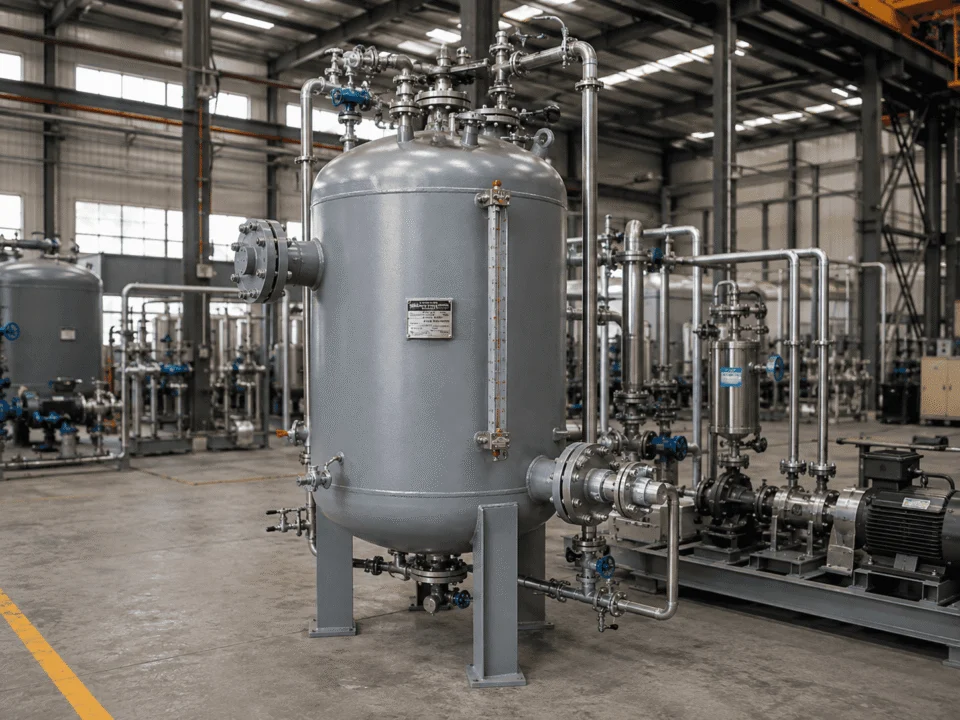
Vacuum Process Vessels
Used when the vessel itself performs the process step, including drying, degassing, evaporation and other vacuum-assisted operations.
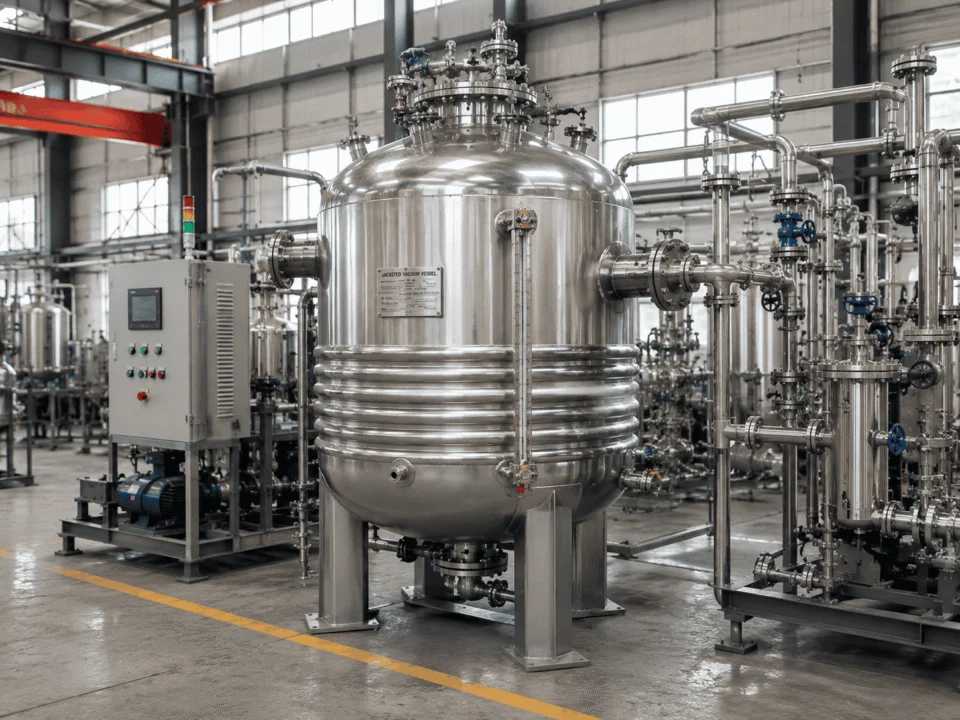
Jacketed Vacuum Vessels
Used when vacuum processing also requires heating, cooling or controlled temperature holding through a jacketed vessel configuration.
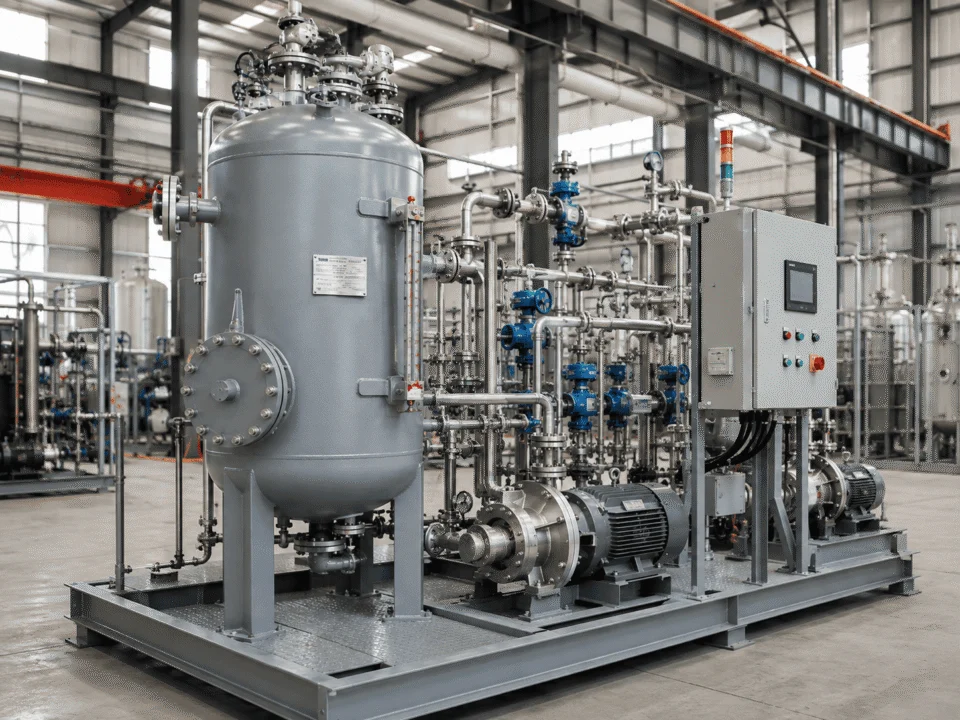
Custom Vacuum System Vessels
Used when the vessel must integrate with condensers, vacuum pumps, process skids, custom internals, instruments or project-specific piping.
Send the process medium, vessel function, required volume and operating conditions. We can review the basic configuration before quotation.
Different Vacuum Conditions Require Different Design Inputs
“Vacuum service” alone is not a complete design basis. The vessel must be evaluated against the lowest internal pressure, any positive-pressure condition and the temperature associated with each operating case.
(Full Vacuum)
FULL VACUUM SERVICE
The vessel may operate close to complete vacuum.
WHAT IT MEANS
- Internal pressure can approach full vacuum.
- May occur during normal operation or non-production conditions.
- External pressure becomes a governing design condition.
WHAT YOU SHOULD PROVIDE
- Can full vacuum occur?
- At what temperature?
- Is it normal operation or only shutdown / draining?
- How long can the condition last?
PARTIAL VACUUM SERVICE
The vessel operates within a defined vacuum range rather than at full vacuum.
WHAT IT MEANS
- Internal pressure remains above full vacuum.
- The minimum internal pressure is the key design input.
- Vacuum level may be steady or fluctuate with the process.
WHAT YOU SHOULD PROVIDE
- Normal operating vacuum.
- Minimum internal pressure.
- Design temperature.
- Is vacuum stable or fluctuating?
PRESSURE + VACUUM SERVICE
The vessel experiences both positive pressure and vacuum during different stages.
WHAT IT MEANS
- The vessel is subject to both internal and external pressure conditions.
- Pressure / vacuum cycling may influence the design review.
- Different process stages can create different governing cases.
WHAT YOU SHOULD PROVIDE
- Maximum positive pressure.
- Maximum vacuum / minimum internal pressure.
- Temperature under both conditions.
- Pressure / vacuum cycling frequency.
THE NORMAL OPERATING POINT
A vessel may see its most severe vacuum during draining, cooling, steam condensation, startup or shutdown rather than during normal production.
Please provide all possible pressure and temperature conditions.
Internal Pressure and Vacuum
Load the Vessel in Opposite Ways
Changing the pressure direction changes how the vessel behaves. Vacuum introduces risks that do not exist in positive-pressure service.
Internal pressure pushes against the vessel wall.
Wall thickness is based on pressure-retaining capacity.
ASME Section VIII rules for internal pressure apply.
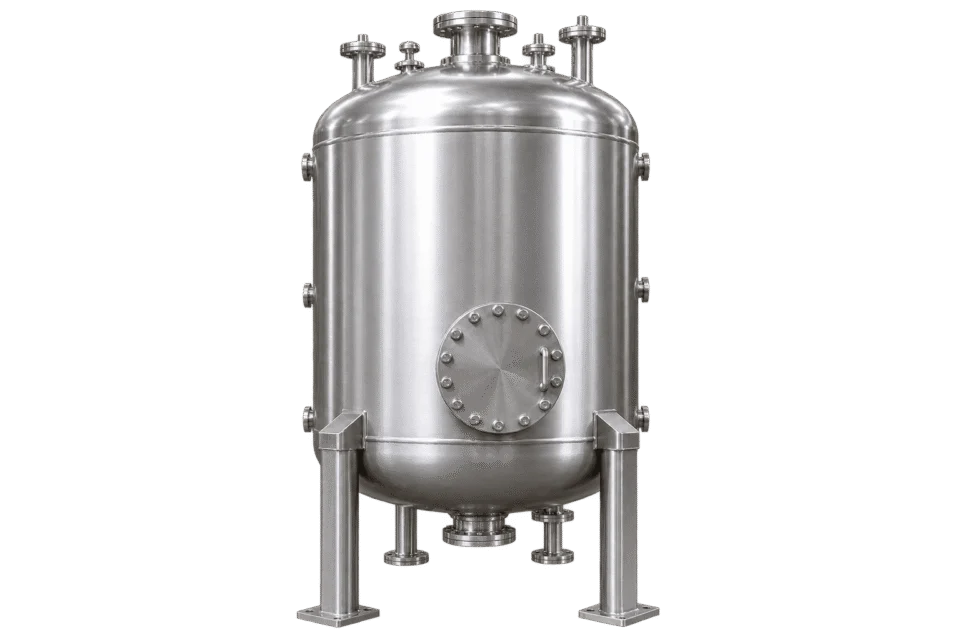
DIRECTION
MATTERS
External pressure pushes the vessel toward the center.
Shell stability is the governing factor, not just wall thickness.
Diameter, unsupported length and shape greatly affect performance.
Vessel must resist buckling and overall shell instability.
Larger diameter and thin shells are more prone to deformation.
Longer unsupported spans increase buckling risk.
Ovality, dents and weld profile can reduce vacuum capability.
A vessel’s positive-pressure rating alone does not confirm its suitability for vacuum service.
The vacuum condition must be included in the design basis.Engineering Vacuum Vessels Against Buckling and Deformation
Vacuum-vessel design is developed from the complete operating condition, vessel geometry, material properties and structural arrangement—not from vacuum level alone.
Stiffening, wall thickness and vessel proportions are reviewed as one structural system. No single dimension should be selected independently from the complete design condition.
How the Design Basis Becomes a Vessel Configuration
Final dimensions, wall thickness, reinforcement and allowable operating conditions are confirmed after the complete project data has been reviewed.
Vacuum Vessel Design Parameters & Configuration Options
Final vessel dimensions and construction details are developed from the process data. The items below are the main parameters normally confirmed during technical review and quotation.
Include the minimum internal pressure and any full-vacuum condition.
Provide the required usable volume and any process hold-up requirement.
State the temperature associated with each relevant pressure condition.
Medium information supports material, surface and connection review.
Selected around process function, footprint, support and installation layout.
Material grade can follow process requirements or project specification.
Utility medium, pressure and required temperature control should be defined.
Support arrangement follows vessel orientation and installation condition.
Nozzle locations should match piping, process access and maintenance needs.
Connections can be prepared for project-specified instruments and controls.
Interfaces should be coordinated with the surrounding process system.
Confirm applicable code, certification and documentation before quotation.
If you already have a drawing, P&ID or vessel datasheet, send it with the inquiry. If not, the process data above is enough to begin technical review.
Vacuum Vessels for Different Process Applications
The vessel role changes with the process. Drying, distillation, degassing, evaporation and recovery duties each require different operating inputs, interfaces and vessel configurations.

Vacuum Drying
Reduced-pressure processing for moisture or solvent removal with coordinated heating and vapor handling.
Vacuum Distillation
Low-pressure vapor-liquid separation coordinated with vapor generation, condenser duty and downstream receiving.
Vacuum Degassing
Removes dissolved or entrained gases from liquids, slurries or process materials before downstream processing.
Vacuum Evaporation
Supports evaporation at reduced pressure where product temperature, heat-transfer duty and vapor removal must be coordinated.
Solvent Recovery & Receiving
Collects recovered solvent, condensate or process liquid downstream of a condenser or vacuum line.
Vacuum Transfer & Filtration
Works as a receiver or buffer in vacuum conveying, filtration and pump-protection arrangements.
Selecting the Right Material for Vacuum Vessel Service
Material selection is based on the process medium, corrosion environment, cleanliness requirement, design temperature and project specification—not on vacuum level alone.
Match the Vessel Material to the Process
Select a material to see which project factors usually become most important.
Vacuum level defines structural loading.
ENVIRONMENT
Considers chemical composition, pH, chlorides, impurities and expected corrosion risk.
REQUIREMENT
Determines the need for smooth surface finish, cleanable construction and sanitary design.
TEMPERATURE
Affects material strength, toughness and long-term stability under hot or cold conditions.
SPECIFICATION
Includes code, standard, customer requirements, inspection level and documentation.
MEDIUM Compatibility is the starting point for material selection.
Final material selection should consider both process compatibility and the complete design condition. Corrosion allowance, lining, surface finish and documentation requirements should be confirmed before fabrication.
SS304
GENERAL INDUSTRIAL STAINLESS SERVICECommon for general process duties requiring stainless construction, cleanability and moderate corrosion resistance.
SS316L
HIGHER CORROSION / CLEAN PROCESS REQUIREMENTSOften selected where the process requires improved corrosion resistance, cleaner fabrication or tighter surface requirements.
Carbon Steel
INDUSTRIAL SERVICE WHERE CORROSION CONDITIONS PERMITA practical choice for industrial vacuum receivers and process vessels where the medium and corrosion conditions allow carbon-steel construction.
Project-Specified
ALTERNATIVE ALLOYS / CLAD / LINED CONSTRUCTIONOther stainless grades, duplex materials, nickel alloys, clad or lined construction can be reviewed where the process or specification requires it.
Manufacturing Controls That Matter in Vacuum Vessel Fabrication
External-pressure performance depends not only on design calculation, but also on how accurately the shell, heads, stiffening rings, nozzles and supports are formed and assembled during fabrication.
Keep the Designed Geometry Through Fabrication
Each checkpoint protects a different part of the geometry assumed during engineering.
After fabrication, the completed vessel proceeds to the specified inspection and testing scope.
Shell roundness, alignment, stiffening-ring fit-up and welding distortion must also be controlled so the completed vessel reflects the geometry assumed during engineering.
Inspection & Testing Before a Vacuum Vessel Leaves the Factory
Inspection scope is defined by the applicable code, approved drawing and project requirements. Dimensional checks, weld examination, testing and documentation are completed before final release.
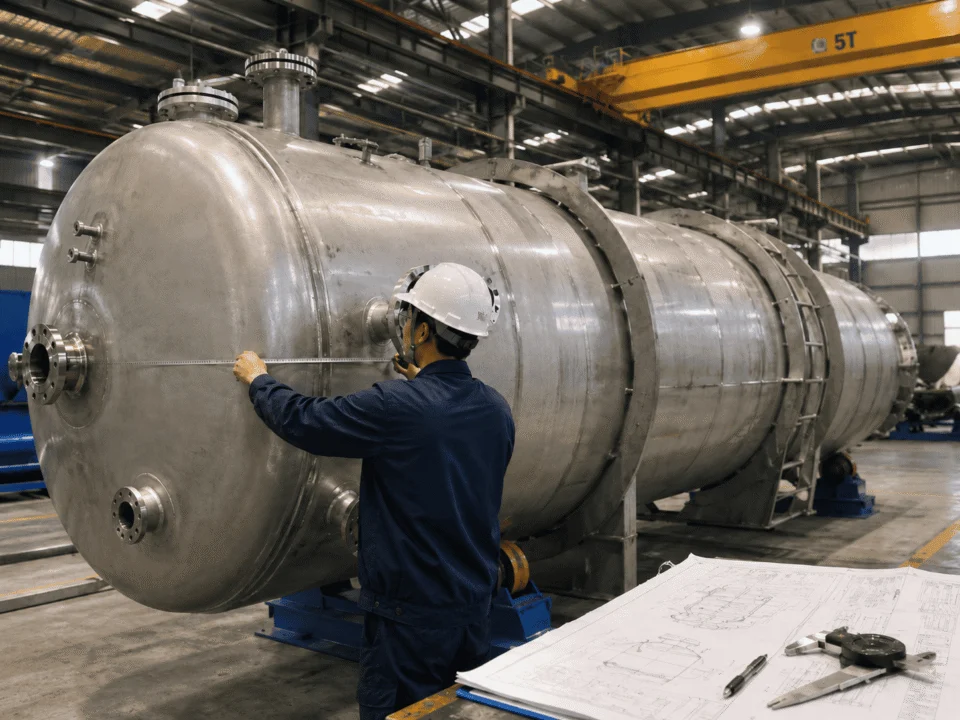
Final Verification Checklist
The completed vessel is reviewed against the approved project basis before it is released for packing and shipment.
Diameter, roundness, nozzles, supports and overall dimensions are checked.
NDT is performed where required by the applicable code or project specification.
Pressure, leak or vacuum testing follows the approved project test scope.
Required drawings, reports, certificates and test records are assembled.
Inspection and testing scope varies by vessel design, material, code and customer specification.
Five Gates Before Final Release
Each stage closes a different part of the manufacturing record before the vessel moves to packing and shipment.
Material identification, certificates and fabrication records are reviewed according to the required documentation scope.
Vessel geometry, nozzle orientation, supports and stiffening-ring positions are checked against the approved drawing.
RT, UT, PT or MT may be used where applicable, with method and extent defined by the code and project specification.
Hydrostatic, pneumatic, leak or vacuum testing is performed according to the approved procedure where required.
Required reports, drawings, identification and release records are completed before packing and shipment.
The final inspection and test plan should reflect the vessel design, applicable code, approved procedure and any project-specific leak or vacuum requirements.
Prepared for Safe Shipment and Site Installation
After final inspection, the vessel is prepared for transport around its size, weight, nozzle arrangement, surface condition and installation requirements. Protection and shipping details are confirmed before dispatch.
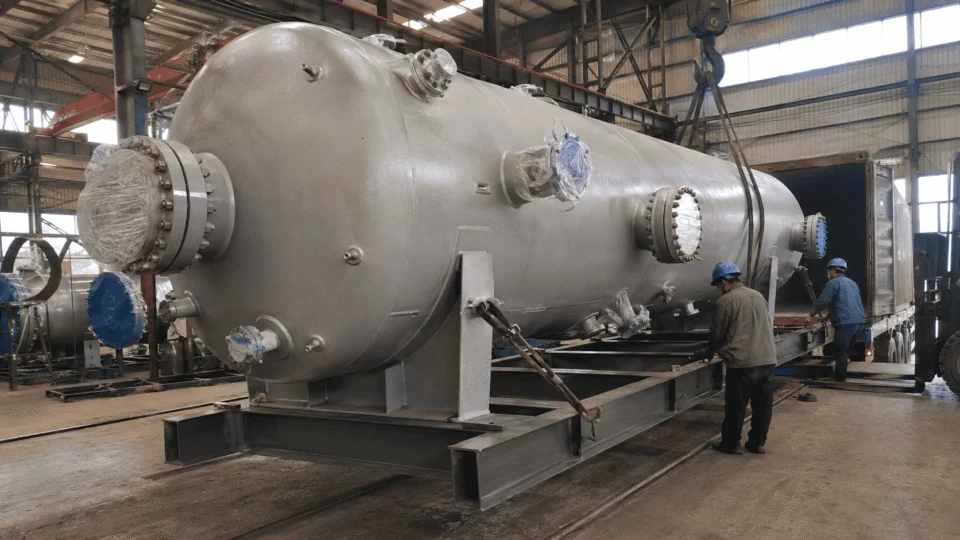
Protection, Handling, Packing & Site Handover
Each area addresses a different risk between factory release and site arrival, from protecting interfaces to preparing lifting and receiving information.
Nozzle & Surface Protection
Flange faces, nozzles, openings and finished surfaces are protected before loading, with internal cleanliness preserved where specified.
Lifting & Transport Support
Packing Method Follows the Vessel
Packing is selected around vessel size, weight, surface condition and the required sea or land transport route.
Identification for Receiving & Installation
Oversized Vessels Require a Different Shipping Plan
Vessel diameter, overall length, shipping weight and route restrictions may affect transport orientation, temporary supports, lifting arrangement and the final shipping method.
Frequently Asked Questions About Vacuum Vessels
Practical answers to common questions about vacuum design conditions, combined pressure and vacuum service, materials, fabrication and project documentation.
A useful quotation normally starts with the process medium, required volume, minimum internal pressure or vacuum level, design temperature and any positive-pressure condition. Material preference, vessel orientation, nozzle requirements and installation constraints should also be provided where known. A process datasheet, P&ID, nozzle schedule or existing drawing can make the engineering review more accurate and reduce back-and-forth before the quotation is finalized.
Not automatically. A vessel that is suitable for positive internal pressure may not be suitable for external pressure created by vacuum service. Vacuum design requires evaluation of shell geometry, unsupported length, wall thickness, material properties, roundness and any required reinforcement. The vacuum condition should therefore be included in the design basis rather than assumed from the vessel's positive-pressure rating.
Yes, when both operating conditions are defined as part of the project basis. The maximum positive pressure, minimum internal pressure, associated design temperatures and expected operating cycles should be identified before final engineering. The vessel can then be evaluated for both internal-pressure strength and external-pressure stability instead of treating vacuum and positive pressure as separate assumptions.
Not necessarily. The need for stiffening rings depends on the complete external-pressure design rather than vacuum level alone. Vessel diameter, shell length, wall thickness, material, design temperature, geometry and allowable unsupported length all influence the result. In some designs shell thickness may provide sufficient stability; in others, properly located stiffening rings may be a more practical engineering solution.
Common options include SS304, SS316L, carbon steel and other project-specified materials. Material selection is normally driven by the process medium, corrosion environment, cleanliness requirement, design temperature and customer specification rather than by vacuum level alone. Final material selection should also consider fabrication requirements and any project-specific documentation or surface-finish requirements.
Yes. Customer drawings, datasheets, nozzle schedules and P&IDs can be used as the basis for project review. Before fabrication, the operating conditions, pressure and vacuum basis, material, vessel orientation, nozzle interfaces and other project requirements still need to be confirmed. Manufacturing should proceed only after the relevant drawings and technical details have been reviewed and approved for the agreed project scope.
Vacuum vessels can be engineered around applicable ASME requirements where this is included in the project scope. The design basis, materials, fabrication requirements, inspection, testing and documentation should be confirmed for the specific project before production. Code requirements do not replace the need to define the actual vacuum condition, design temperature, positive-pressure cases and other operating inputs.
The inspection and test plan depends on the applicable code, vessel design, material, approved drawings and customer specification. Depending on the project, the scope may include dimensional inspection, NDT, pressure testing, leak testing or vacuum testing. The required methods and acceptance basis should be defined before fabrication so the manufacturing and release records match the approved project requirements.
Have a Vacuum Vessel Project to Review?
Send your operating conditions and available drawings. We can review the project basis before preparing the vessel proposal.
A vacuum vessel should be evaluated around the actual operating case rather than selected from a generic size chart. The more complete the project data, the more accurately the vessel configuration, material, interfaces and design basis can be reviewed.