Pressure Vessel Maintenance & Troubleshooting
Identify abnormal conditions, understand common damage mechanisms, and make better maintenance decisions throughout the operating life of your pressure vessel.
Pressure vessels operate under combinations of pressure, temperature, process media, mechanical loads, and repeated operating cycles. Over time, corrosion, erosion, fatigue, leakage, deformation, or changes in operating conditions can affect vessel integrity.

Understand the condition before selecting the repair.
What Should Be Checked During Routine Pressure Vessel Maintenance?
Routine maintenance should focus on changes that may indicate deterioration of the pressure boundary, supporting structure, connected components, or operating conditions.
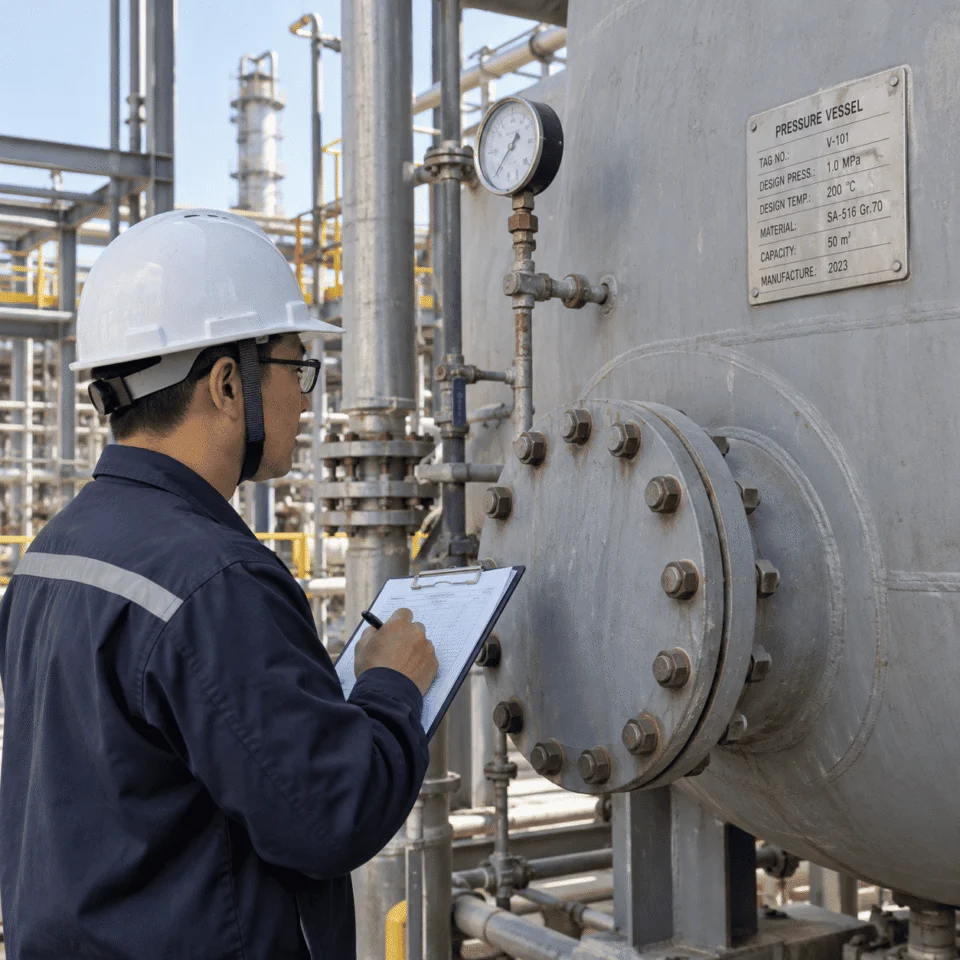
The inspection frequency and depth should reflect vessel design, process media, operating history, applicable code, and jurisdictional requirements.
Inspect accessible vessel surfaces for visible signs of deterioration, including:
- General corrosion or rusting
- Localized corrosion and pitting
- Coating or insulation damage
- Bulging, denting, or visible deformation
- Cracks or suspicious surface indications
- Evidence of overheating or discoloration
- Moisture accumulation around insulated areas
Connections and discontinuities can experience local stress, vibration, thermal movement, or leakage. Check for:
- Leakage around flanged joints
- Damaged or deteriorated gaskets
- Loose or visibly degraded bolting
- Corrosion around nozzles
- Cracking near welds
- Distortion around attachments
- Signs of repeated leakage or previous repair
Maintenance records should be reviewed together with the vessel’s actual operating history.
- Normal operating pressure
- Normal operating temperature
- Pressure and temperature fluctuations
- Start-up and shutdown frequency
- Unexpected process excursions
- Changes in process media
- Vacuum conditions
- Abnormal vibration or noise
Pressure-relieving devices and instrumentation are part of the vessel’s protection system.
- Pressure relief valves
- Rupture discs where applicable
- Pressure gauges
- Temperature instruments
- Level instruments
- Alarms and interlocks
- Associated isolation and discharge arrangements
The vessel does not operate independently from its supports and connected piping. Inspect accessible areas for:
- Saddle deterioration
- Skirt corrosion
- Anchor bolt problems
- Support movement
- Settlement
- Pipe loads affecting nozzles
- Vibration transmitted from connected equipment
- Corrosion where supports contact the vessel
External damage does not always show the full extent of deterioration. Where corrosion, cracking, deformation, or abnormal operation is suspected, additional inspection may be required.
Learn more about Pressure Vessel Inspection & Testing →Start With the Symptom — Then Find the Cause
A pressure vessel problem should not be diagnosed from one symptom alone. Low pressure, leakage, corrosion, vibration, cracking, or deformation can each have several possible causes.
Confirm what changed, collect reliable operating and inspection information, and narrow down the cause before corrective work begins.
- External leakage
- Flange or gasket leakage
- Valve leakage
- Instrument error
- Process supply problem
- Internal connection problem
Confirm that the pressure indication is reliable. Review operating conditions and inspect accessible connections, flanges, valves, instruments, and visible pressure-boundary areas for evidence of leakage.
Do not assume that the vessel itself is leaking until instrumentation and connected systems have also been checked.
- Blocked outlet
- Closed or incorrectly positioned valve
- Process upset
- Excessive heat input
- Chemical reaction
- Incorrect control response
- Pressure-relieving system problem
Review the process condition, inlet and outlet paths, valve positions, pressure indication, temperature, and pressure-protection system.
Unexpected overpressure should be treated as an operating abnormality rather than a routine maintenance issue.
- Gasket failure
- Loose or damaged bolting
- Flange misalignment
- Nozzle damage
- Corrosion
- Weld defect
- Crack in a pressure-retaining component
Identify the exact source of leakage before deciding on corrective action.
A leak around a connection does not necessarily mean that replacing the gasket will solve the underlying problem. Repeated leakage may indicate flange distortion, piping load, corrosion, thermal movement, or damage to the connected pressure boundary.
- Flow instability
- Pulsation
- Connected rotating equipment
- Two-phase flow
- Loose support
- Piping vibration
- Inadequate restraint
- Mechanical resonance
Determine whether the vibration originates from the vessel, piping, connected machinery, or process flow.
Inspect supports, nozzles, attachments, piping connections, and nearby equipment. Persistent vibration can contribute to fatigue damage, especially around welded attachments and stress concentration areas.
- Change in process chemistry
- Incorrect material for actual service
- Water accumulation
- Condensation
- Chloride or other aggressive contaminants
- Coating failure
- Corrosion under insulation
- Dead zones or deposits
- Galvanic interaction
Determine where the corrosion is occurring and whether it is general or localized.
Review the process media, temperature, cleaning chemicals, operating changes, drainage conditions, material selection, and previous thickness measurements.
A low average corrosion rate does not automatically mean that isolated deep pits are acceptable.
- Pressure cycling
- Thermal cycling
- Mechanical fatigue
- Stress concentration
- Vibration
- Environmental cracking
- Welding-related defects
- Material degradation
Record the location, orientation, length, and surrounding condition of the indication and review the operating history.
Cracks generally require qualified inspection and engineering evaluation. Simply grinding or welding over a crack without identifying its cause may allow the problem to return.
- External mechanical damage
- Overpressure
- Vacuum or external pressure
- Excessive temperature
- Local wall thinning
- Support problems
- Fabrication or installation damage
Compare the affected geometry with available original drawings and previous inspection records.
Determine whether the vessel experienced abnormal pressure, vacuum, temperature, impact, settlement, or support movement. Visible deformation should not be corrected mechanically before its cause and structural significance are understood.
- Vessel not designed for actual external pressure
- Unexpected vacuum
- Blocked vent
- Condensing vapor
- Draining without adequate venting
- Insufficient shell stiffness
- Excessive unsupported shell length
- Loss or damage of stiffening components
Review the actual vacuum condition, operating sequence, venting arrangement, vessel geometry, shell thickness, stiffening rings, and original design basis.
Internal-pressure capability does not automatically mean that a vessel is suitable for full vacuum.
Learn more about Vacuum Vessel Design →Understanding Why Pressure Vessel Damage Occurs
Troubleshooting identifies the visible symptom. Damage-mechanism analysis asks a different question: why did the deterioration occur? Two vessels with similar-looking damage may require completely different responses.
General corrosion removes material relatively uniformly from a larger surface area. As wall thickness decreases, the available corrosion allowance and structural margin may also decrease.
Thickness loss should be evaluated against the applicable design and in-service requirements rather than judged by appearance alone.
Pitting produces concentrated metal loss over relatively small areas. A vessel may retain substantial average wall thickness while individual pits penetrate much deeper.
Localized corrosion is one reason systematic thickness mapping can be more useful than isolated spot readings.
High fluid velocity, entrained solids, droplets, flashing, turbulence, or repeated impingement can accelerate metal loss.
When metal loss repeatedly appears in a specific flow path, replacing material without addressing the operating mechanism may only postpone recurrence.
Fatigue damage develops through repeated stress cycles rather than one single overload.
Potentially sensitive locations include welded attachments, nozzles, geometric discontinuities, and areas subject to cyclic thermal gradients.
Certain combinations of material, tensile stress, temperature, and process environment can contribute to cracking mechanisms such as stress corrosion cracking.
Changing the repair method alone may not solve the problem if the service environment remains unchanged.
Unexpected high temperature or severe thermal cycling can affect the vessel in ways that may not be obvious from normal pressure readings.
When overheating is suspected, operating history and material condition should be reviewed before returning the equipment to normal service.
External pressure creates a different structural problem from internal pressure. Instead of primarily resisting outward expansion, the shell must resist instability and buckling.
This is why a vessel designed for substantial positive internal pressure may still be unsuitable for full vacuum.

The repair method should follow the actual damage mechanism, not just the visible symptom.
From an Abnormal Condition to the Right Engineering Decision
Good maintenance is not a list of isolated repair tasks. When an abnormal condition is discovered, the first question is not “How do we repair it?” but “What is actually wrong, and why?”
A leak, unusual pressure change, vibration, corrosion, crack, deformation, instrument alarm, or another abnormal condition is detected.
Follow the facility’s applicable operating and safety procedures before inspection or maintenance work begins. The process condition must be understood before personnel approach, open, inspect, or work on pressure-containing equipment.
Where required, appropriate inspection methods may be used to determine the location, type, and extent of deterioration. The examination method should match the type of damage being investigated.
Measured damage must be interpreted in the context of vessel design, materials, operating conditions, applicable code, and expected future service.
The same symptom does not always lead to the same decision.
The condition remains acceptable for the intended service under the applicable inspection and engineering requirements.
The vessel remains in service, but additional inspection or shorter monitoring intervals are established.
Corrective work is required to restore an acceptable pressure-retaining condition.
The vessel or its design conditions are changed in a way that requires formal engineering and code consideration.
Permitted operating conditions are revised following applicable engineering, inspection, documentation, and jurisdictional requirements.
The vessel is replaced when continued operation or repair is no longer technically, economically, or operationally appropriate.
The visible defect is only one part of the decision. The cause, extent, operating history, and future service all matter.
When Does a Pressure Vessel Need Engineering Review, Repair or Replacement?
Routine maintenance can address cleaning, coatings, accessible sealing components, instrumentation, and other non-pressure-boundary issues. Pressure-retaining damage is different.
Significant Wall Loss
If measured wall thickness approaches or falls below the thickness required for the actual service condition, routine corrosion maintenance is no longer sufficient.
Cracks Are Detected
Cracks should not be treated like ordinary surface defects. Before repair, the cause should be investigated.
- Why did the crack develop?
- Is it active?
- Is it related to fatigue?
- Is the service environment contributing?
- Does it extend beyond the visible area?
- Has the same location been repaired before?
Repeated repair without addressing the underlying mechanism can lead to repeated failure.
Weld Defects Require Corrective Work
Weld repair on a pressure-retaining vessel should not be treated as ordinary fabrication welding. Applicable requirements may affect:
The original code of construction and applicable in-service requirements should be identified before repair work is planned.
Nozzle or Connection Damage
Nozzles can be affected by external piping loads, thermal expansion, vibration, local corrosion, weld cracking, or flange distortion.
Repairing only the visible damage without correcting excessive piping loads or vibration may allow the defect to return.
Permanent Deformation Is Present
Bulging, buckling, collapse, or other significant geometry changes may indicate that the vessel has experienced loading outside its intended condition.
- What caused the deformation?
- Were material properties affected?
- Did wall thinning contribute?
- Does the vessel remain structurally acceptable?
Operating Conditions Have Changed
A vessel designed for one set of conditions should not automatically be assumed suitable for a new process.
Repeated Leakage Continues
Repeated leakage after gasket replacement or local repair is a warning that the root cause may not have been corrected.
There is no universal percentage of wall loss or number of repairs that automatically determines whether every pressure vessel should be replaced.
Remaining thickness, cracking, deformation, material condition, and extent of deterioration.
Whether the cause can be effectively controlled after repair.
Whether the true extent of damage can be adequately characterized.
Expected pressure, temperature, media, cycles, and remaining operating life.
Welding, heat treatment, NDE, testing, accessibility, shutdown requirements, and jurisdictional requirements.
The consequence of another leak or unexpected shutdown.
The total cost of repeated inspection and repair compared with replacement.
Discuss the New Operating Requirement Before the Next Fabrication Decision.
ChannelVessel manufactures custom pressure vessels based on process conditions, materials, pressure, temperature, geometry, nozzle requirements, internals, and applicable project specifications.
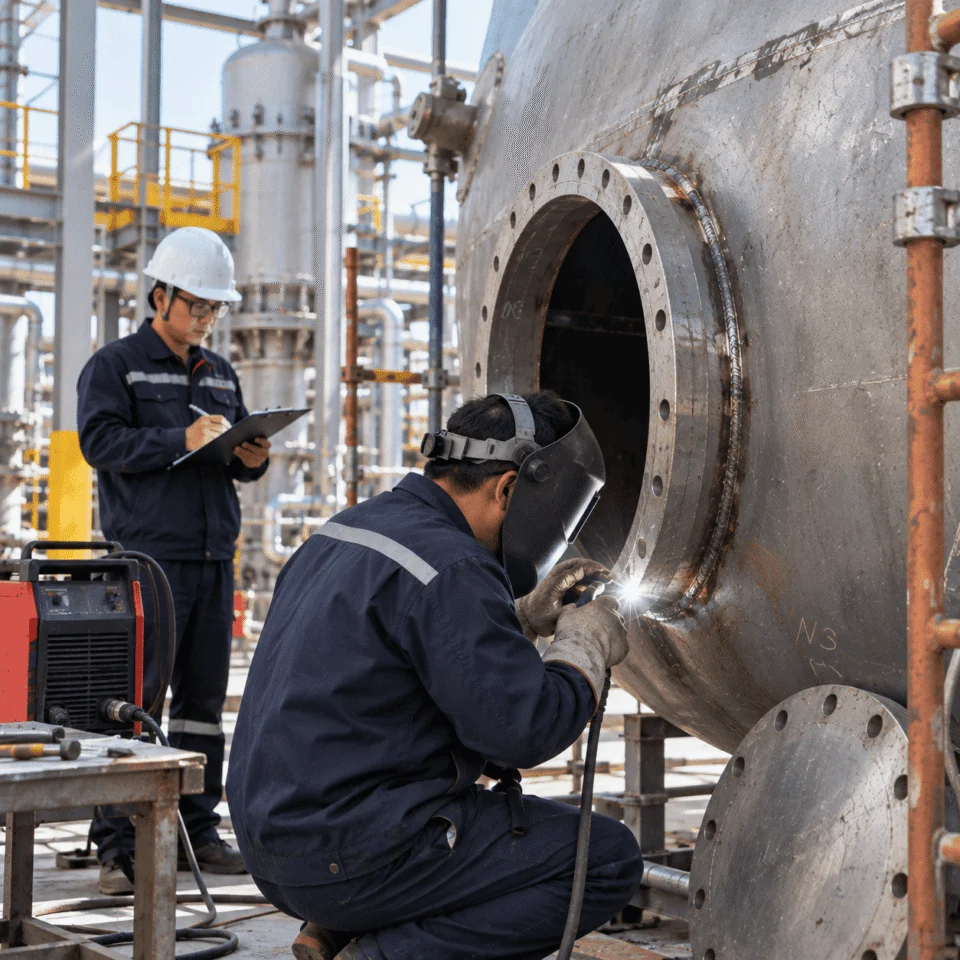
Cause, extent, code requirements, future service, and repair feasibility all matter.
The Best Troubleshooting Starts Before Failure
Reactive maintenance begins after a problem becomes visible. Preventive maintenance aims to identify deterioration early enough that inspection, engineering, and corrective work can be planned instead of becoming an unexpected shutdown.
Find Deterioration Before It Becomes a Pressure-Retaining Problem
Look for visible corrosion, leakage, coating failure, deformation, damaged insulation, and support problems.
Track selected locations over time to identify metal-loss trends and areas requiring closer inspection.
Compare actual deterioration with previous inspection data and expected service conditions.
Maintain pressure-relieving devices according to applicable requirements and the owner-user program.
Review abnormal pressure, temperature, vacuum, cycling, vibration, and process events that may affect vessel integrity.
Control deposits, retained liquid, contamination, or conditions that may contribute to corrosion where appropriate for the service.
Treat recurring leakage as a condition to investigate rather than something to repeatedly seal without further review.
Watch for settlement, vibration, damaged supports, or connected piping loads that could affect the vessel.
The goal is not to eliminate every inspection or repair. It is to make the next decision earlier and with better information.
Work Begins After an Abnormal Condition Is Already Visible
Even after a problem appears, the root cause should still be identified before the visible symptom is removed.
Maintenance Records Matter
A single inspection shows the condition at one point in time. A good maintenance history shows how the condition is changing.
The objective is not simply to repair failures. It is to detect degradation early, understand why it is happening, and make the next decision with better information.
Maintenance & Troubleshooting Frequently Asked Questions
These questions cover the most common maintenance, corrosion, cracking, repair, inspection, and operating-condition issues encountered during pressure vessel service.
There is no single inspection interval that applies to every pressure vessel.
The required interval can depend on the applicable jurisdiction, inspection code, vessel type, service environment, corrosion rate, remaining thickness, operating history, damage mechanisms, previous inspection findings, and the owner-user inspection program.
Pressure vessels in aggressive, cyclic, high-temperature, or otherwise demanding service may require different inspection strategies from vessels operating under stable conditions. Applicable local regulations and inspection requirements should always be confirmed.
Inspection & Testing →Common problems can include general corrosion, localized corrosion and pitting, erosion, external leakage, flange or gasket problems, cracking, fatigue damage, abnormal vibration, nozzle damage, support deterioration, pressure-relief problems, thermal damage, vacuum deformation, and damage caused by unexpected process conditions.
The frequency of each problem depends heavily on the vessel material, design, operating conditions, process media, and maintenance history.
Possibly, but the source and cause of the leak should be determined first.
A flange gasket leak may require a very different response from leakage caused by corrosion, cracking, nozzle damage, or a pressure-boundary weld defect.
Pressure-retaining repairs may be subject to specific code, inspection, welding, examination, testing, documentation, and jurisdictional requirements. The vessel should therefore be properly evaluated before selecting a repair method.
Fabrication & Welding →Pressure vessel corrosion can result from process chemistry, moisture, chlorides or other contaminants, condensation, deposits, incorrect material selection, temperature, coating deterioration, corrosion under insulation, cleaning chemicals, stagnant areas, or changes in process conditions.
The corrosion pattern is important. Uniform corrosion, isolated pitting, crevice corrosion, and environmentally assisted cracking should not automatically be evaluated in the same way.
Material Selection →Cracking may be associated with pressure cycling, thermal cycling, vibration, stress concentration, environmental cracking, welding-related conditions, material degradation, mechanical loading, previous repair, or other service-specific damage mechanisms.
The crack location, orientation, operating history, material, temperature, environment, and surrounding geometry can help determine the likely cause. A crack should generally be investigated before any repair method is selected.
Vacuum creates external pressure on the vessel shell. Under external pressure, the shell can become unstable and buckle if the vessel geometry, wall thickness, unsupported length, material properties, out-of-roundness, and stiffening arrangement are not suitable for the actual vacuum condition.
A vessel’s ability to withstand internal pressure does not automatically establish its ability to withstand full vacuum.
Vacuum Vessels →The presence of corrosion does not by itself determine whether the vessel must be removed from service.
The important questions include how much metal has been lost, whether the damage is general or localized, what thickness remains, what thickness is required, how fast the damage is progressing, where the damage is located, what the actual operating conditions are, and what future service is expected.
Appropriate inspection data and engineering evaluation are required to determine the next action.
Replacement may become more practical when damage is extensive, repeated repairs continue to be required, cracking repeatedly returns, corrosion is difficult to control, the original material is unsuitable for the process, operating requirements have changed substantially, repair complexity becomes excessive, or reliability requirements cannot be met confidently.
The decision should consider technical condition, applicable requirements, future service, reliability, shutdown impact, repair feasibility, and lifecycle cost.
Existing vessels can sometimes be modified, but changes affecting the pressure boundary, design conditions, nozzles, geometry, or other critical features may be considered alterations rather than routine maintenance.
The original construction code, applicable in-service code, new operating conditions, material, design calculations, welding requirements, examination, documentation, and jurisdictional requirements may all need to be reviewed.
Modifications should therefore be engineered before fabrication work begins.
No. Maintenance includes activities intended to preserve equipment condition and correct operating problems. Inspection is used to determine and document the actual condition of the pressure-retaining equipment.
Inspection findings may show that no action is currently required, additional monitoring is needed, further NDE is needed, engineering evaluation is needed, repair is required, alteration or rerating should be considered, or replacement is appropriate.
Maintenance and inspection support each other, but they perform different functions.
Inspection & Testing →We can review your new vessel requirement or help determine what information is needed before a replacement or modification is specified.