ChannelVessel Intelligent Equipment Co., Ltd. Contact Us
ENGINEERING SELECTION CENTER

Pressure Vessel Selection Guides

Selecting process equipment starts with understanding what the equipment must do, what conditions it must withstand, and how it will interact with the process around it.

These pressure vessel selection guides help engineers, project teams and buyers narrow down the right equipment type, material, orientation and configuration before requesting a quotation.

Whether your project involves liquid storage, pressurized processing, vacuum operation, mixing, reaction, heat transfer or separation, the selection should begin with the actual process conditions—not simply with a vessel size or product name.

Industrial pressure vessel selection guide
DEFINE THE OPERATING ENVELOPE

Start With the Process, Not the Vessel

A vessel should be selected around the process it serves.

Two tanks with a similar capacity may require completely different materials, wall construction, supports, nozzles, internals or pressure design because their operating conditions are different.

Before deciding on a vessel type, define the project inputs that establish the actual operating envelope.

SELECTION PRINCIPLE Process conditions define the equipment. Equipment should not define the process.
PROJECT INPUTS

Define These Before Selecting Equipment

6 INPUT GROUPS
PROCESS MEDIUM

What will the equipment contain or process?

Consider the chemical composition, concentration, solids content, viscosity, corrosiveness and any cleanliness requirements associated with the medium.

Can influence Material · Surface finish · Seals · Internal configuration
PRESSURE & VACUUM

What pressure conditions will the vessel experience?

Define atmospheric operation, positive pressure, partial vacuum, full vacuum, pressure cycling or alternating pressure and vacuum conditions.

Atmospheric Pressure Vacuum Cycling
TEMPERATURE

What operating and design temperatures are required?

Define normal operation as well as temperatures during startup, heating, cooling, cleaning, shutdown and abnormal operating conditions.

Can influence Material · Allowable stress · Seals · Thermal configuration
CAPACITY

What volume does the process actually require?

Clarify whether the project is defined by total volume, working volume, batch size, liquid level, residence time or process throughput.

Working Volume Total Volume Batch Size Flow
CORROSION & CLEANLINESS

What level of compatibility and cleanliness is needed?

Material selection may depend on corrosion potential, chloride exposure, product purity, contamination risk, cleanability and required service life.

Consider Corrosion · Hygiene · Surface finish · Maintenance
PROCESS FUNCTION

What does the equipment actually need to do?

Once the process function is clear, the appropriate equipment category and configuration become much easier to narrow down.

Store Mix React Heat Separate Filter
ENGINEERING NOTE

Capacity alone is not enough to select a vessel. Pressure, temperature, medium, process duty and project requirements must be considered together.

SELECT BY PROCESS FUNCTION

What Does the Equipment Need to Do?

Different vessel types solve different process problems. Once the main process function is clear, the equipment category can usually be narrowed down before detailed engineering begins.
START HERE Choose the function first, then refine material, pressure, orientation and configuration.
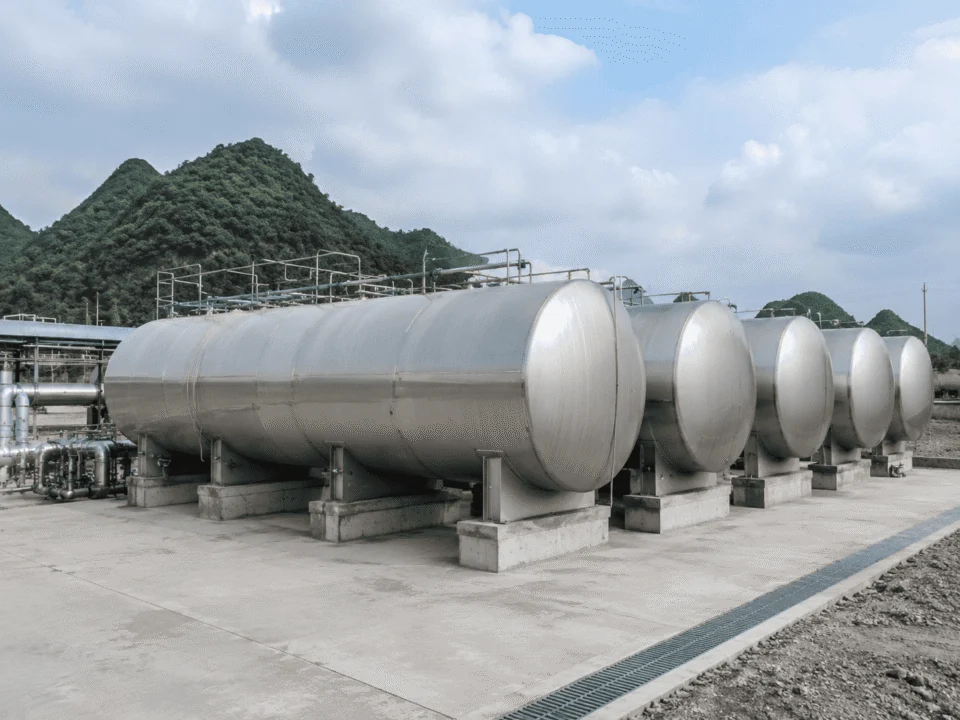
Industrial storage tanks
STORE

Storage Tanks

For storing raw materials, intermediate products, finished products, water, chemicals and other process liquids.

Atmospheric or pressurized storage Working and total volume Vertical or horizontal arrangement Heating, insulation or sanitary needs
Industrial pressure vessels
CONTAIN PRESSURE

Pressure Vessels

For gases or liquids that must be contained safely above or below atmospheric pressure.
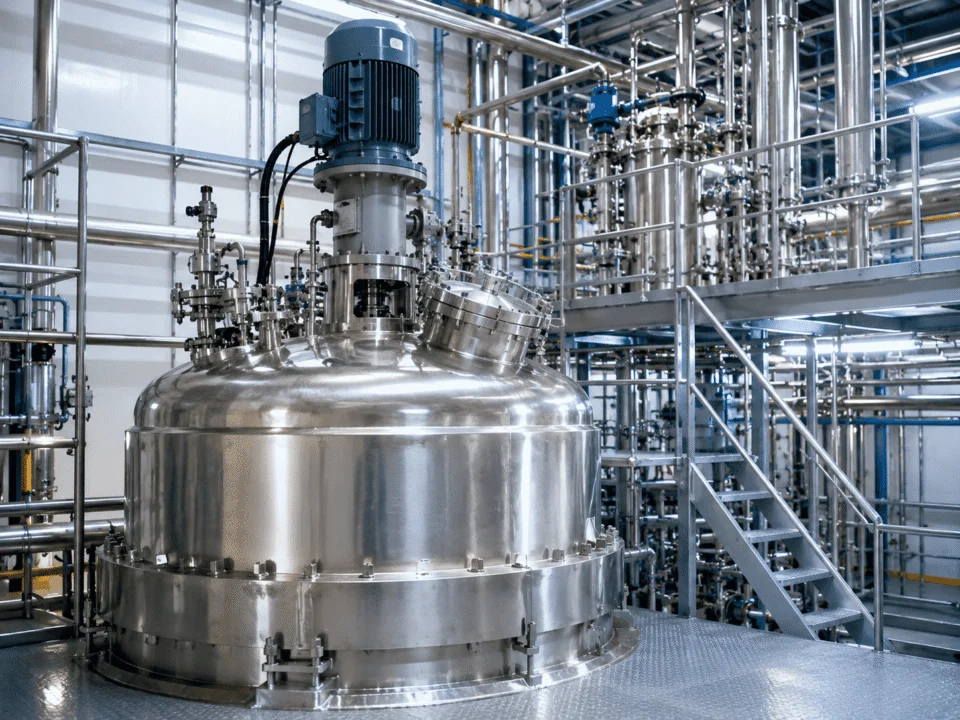
Design pressure and temperature Vacuum conditions Material and vessel geometry Nozzles, supports and internals
Industrial reactor vessel
MIX OR REACT

Reactors

For controlled chemical or physical processes involving mixing, reaction, dissolution, blending, heating or cooling.
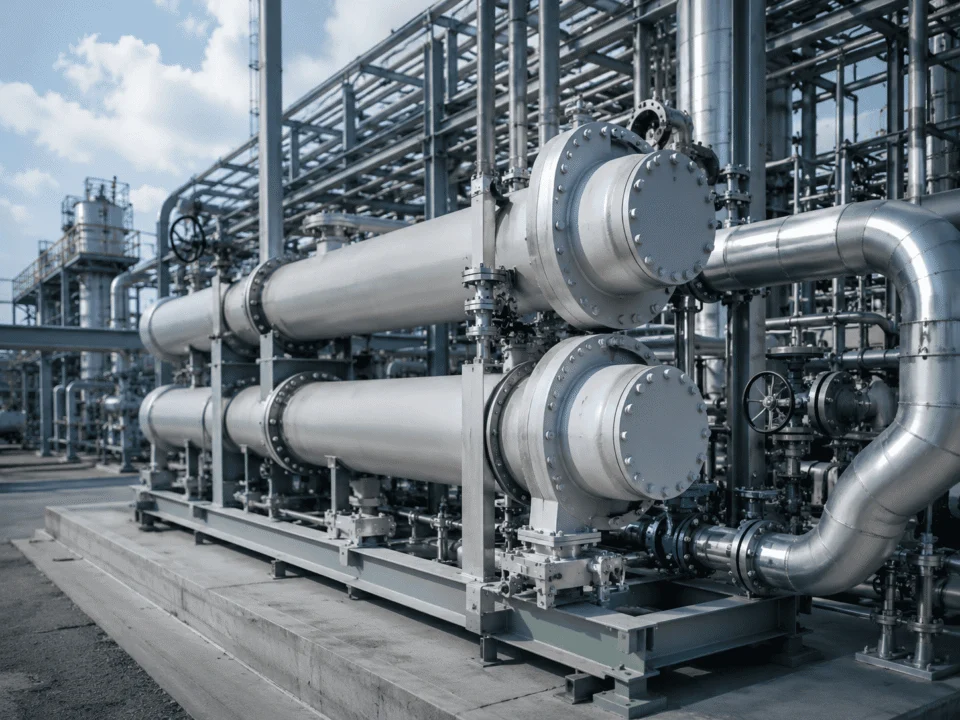
Agitator and mixing intensity Viscosity and solids handling Heating or cooling duty Reaction volume and temperature
Shell and tube heat exchanger
TRANSFER HEAT

Heat Exchangers

For heating, cooling, condensation, evaporation and heat recovery between process streams.
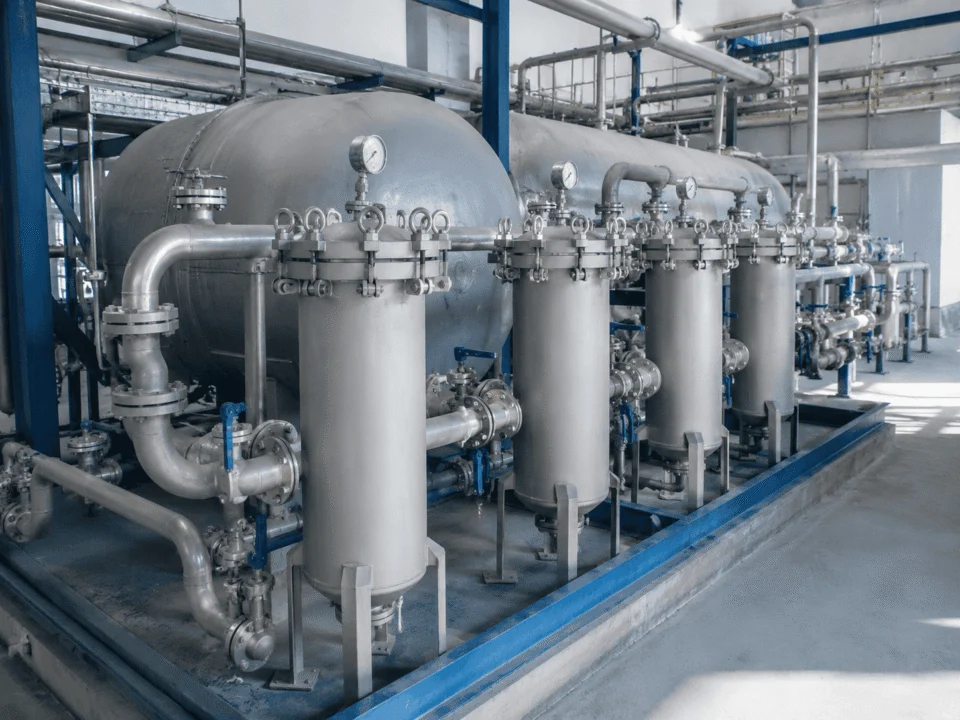
Thermal duty Flow rates and pressure drop Fouling tendency Material compatibility
Separators and filter vessels
SEPARATE OR FILTER

Separators & Filter Vessels

For gas-liquid, liquid-liquid and solids separation, filtration, entrainment removal and similar process duties.

Flow rate and phase composition Droplet or particle size Separation efficiency Internal elements
Integrated industrial process skid
INTEGRATE A PROCESS

Process Skids

For projects where vessels, pumps, piping, valves, instrumentation and controls must operate as one integrated package.

Complete process flow Piping and valves Instrumentation and control Structural integration
SELECTION LOGIC

The product category should follow the process duty. Material, pressure class, vessel orientation and accessories are refined after the primary equipment function is established.

Next: Refine the Configuration

REFINE THE CONFIGURATION

Common Vessel Selection Decisions

After identifying the basic equipment type, the next step is deciding how that equipment should be configured.

Several decisions appear repeatedly across pressure vessel, tank and reactor projects.

COMPARE THE REQUIREMENTS

Material, orientation, pressure conditions and thermal configuration should be considered together.

MATERIAL SELECTION Stainless Steel or Carbon Steel?

There is no single material that is correct for every vessel.

Stainless Steel

Stainless steel is commonly considered where the application requires:

  • corrosion resistance
  • product cleanliness
  • hygienic construction
  • frequent washing or cleaning
  • controlled surface finish
  • reduced contamination risk

Different stainless steel grades can behave very differently in different process media, so material grade should still be checked against the actual chemical environment.

Explore Stainless Steel Pressure Vessels

Carbon Steel

Carbon steel can be appropriate where:

  • the process medium is compatible
  • sanitary surfaces are not required
  • corrosion can be controlled
  • the operating environment allows its use
  • project economics favor carbon steel construction

Protective coatings, linings or corrosion allowance may be considered depending on the service.

Explore Carbon Steel Pressure Vessels
SELECTION PRINCIPLE

Material selection should be based on the complete process environment, not initial vessel cost alone.

Read the Material Selection Guide

VESSEL ORIENTATION Vertical or Horizontal?

Orientation affects much more than appearance.

Vertical Vessels

A vertical vessel may be preferred where:

  • floor space is limited
  • liquid level or gravity drainage is important
  • process internals favor vertical flow
  • a tall liquid column is beneficial
  • the installation layout supports vertical access
Explore Vertical Pressure Vessels

Horizontal Vessels

A horizontal vessel may be preferred where:

  • overall height is restricted
  • horizontal phase separation is required
  • transport dimensions favor the arrangement
  • maintenance access benefits from a lower vessel height
  • process geometry requires greater horizontal length
Explore Horizontal Pressure Vessels
CHECK THE COMPLETE LAYOUT

Orientation should be selected together with support design, nozzle arrangement, maintenance access and installation constraints.

PRESSURE CONDITIONS Positive Pressure or Vacuum?

Pressure vessels are often discussed in terms of internal pressure, but vacuum service requires a different engineering check.

Internal Pressure

Positive internal pressure tends to load the vessel wall outward.

Selection normally considers the pressure boundary, material strength, geometry, temperature and openings.

Explore High Pressure Vessels

Vacuum and External Pressure

Vacuum creates external pressure on the shell.

The design can become sensitive to:

  • vessel diameter
  • shell length
  • shell thickness
  • unsupported length
  • geometry
  • fabrication tolerances
  • stiffening arrangement
Explore Vacuum Vessels
DO NOT ASSUME EQUIVALENCE

A vessel designed for internal pressure is not automatically suitable for full vacuum operation.

THERMAL CONFIGURATION Jacketed or Non-Jacketed?

A jacket becomes relevant when the process requires controlled heat transfer through the vessel wall.

Jacketed Vessels

Typical jacket duties include:

  • heating a product
  • cooling a batch
  • maintaining temperature
  • removing reaction heat
  • supporting temperature-sensitive processing

Non-Jacketed Vessels

Consider non-jacketed construction when the process does not require a vessel jacket.

A non-jacketed vessel may still use an internal coil or a separate heat exchanger. Confirm how the process will meet its temperature requirements before omitting the jacket.

The choice is about the required heat-transfer arrangement, not simply whether the vessel has an extra outer wall.

START WITH THE THERMAL DUTY

Selection should consider the required heat transfer duty rather than simply adding a jacket as an accessory.

Depending on the process, the final thermal configuration may involve a conventional jacket, half-pipe jacket, dimple jacket, internal coil or another heat-transfer arrangement.

PREPARE THE PROJECT DATA

Pressure Vessel Selection Checklist

A useful quotation begins with useful process information.

Providing the following data allows the equipment configuration to be evaluated more accurately and reduces unnecessary assumptions during technical discussions.

BEFORE REQUESTING A QUOTATION You do not need every answer before contacting us, but the more operating data you can provide, the faster the technical direction can be narrowed down.

Define the process itself before deciding the mechanical configuration.

  • Process medium
  • Chemical composition
  • Concentration
  • Solids content where applicable
  • Viscosity where relevant
  • Process purpose
  • Batch or continuous operation
  • Expected operating cycle

Include both normal operation and the most demanding credible pressure condition.

  • Normal operating pressure
  • Maximum operating pressure
  • Required design pressure
  • Vacuum conditions
  • Pressure cycling requirements where applicable
If both pressure and vacuum can occur, identify both conditions.

Temperature should reflect the full operating envelope, not only the normal production setpoint.

  • Normal operating temperature
  • Maximum operating temperature
  • Required design temperature
  • Heating or cooling requirements
  • Cleaning temperature where applicable

Capacity may be defined by volume, batch size, residence time or throughput depending on the process.

  • Required working volume
  • Total volume if known
  • Normal liquid level
  • Batch size
  • Required residence time where relevant
  • Process flow rate where relevant

If material has not yet been selected, provide the process medium and operating conditions first.

  • Preferred material if specified
  • Process medium compatibility information
  • Corrosion concerns
  • Product-contact requirements
  • Required surface finish
  • Lining or coating requirements if applicable

Not every project requires every item. Include only the configuration requirements relevant to your process.

  • Vertical or horizontal orientation
  • Vessel diameter or height restrictions
  • Jacket
  • Internal coil
  • Agitator
  • Baffles
  • Demister
  • Distributor
  • Filter elements
  • Manway
  • Nozzles
  • Drain
  • Vent
  • Level instrumentation
  • Support type

Site constraints can influence vessel geometry, supports, transport planning and maintenance access before detailed design begins.

  • Installation country
  • Indoor or outdoor location
  • Available floor area
  • Available installation height
  • Transportation limits
  • Lifting restrictions
  • Surrounding equipment
  • Maintenance access

Documentation and inspection requirements should be identified early because they can affect engineering, fabrication and project planning.

  • Applicable design code
  • Inspection requirements
  • Testing requirements
  • Material documentation
  • Welding documentation
  • Drawing format
  • Certification requirements
  • Third-party inspection
  • Required documentation package
YOU DO NOT NEED A FINISHED DATASHEET

Start with the process information you already have.

Missing details can be clarified during technical review. The important part is to separate known process requirements from assumptions that still need engineering verification.

Next: Engineering Review
ENGINEERING REVIEW

When Standard Selection Is Not Enough

Selection guides help narrow the direction. Final vessel configuration still needs to be verified against the actual process and project requirements.

A pressure vessel, reactor, storage tank or process package is rarely defined by one number. Pressure, temperature, material, geometry, nozzles, supports, internals, fabrication and inspection requirements interact with each other.

Changing one project input can affect several others, which is why a final equipment decision should move from general selection into engineering review.

BETTER STARTING QUESTION

Instead of asking:

“What vessel should I buy?”

Start with:

“What does my process require this vessel to do?”
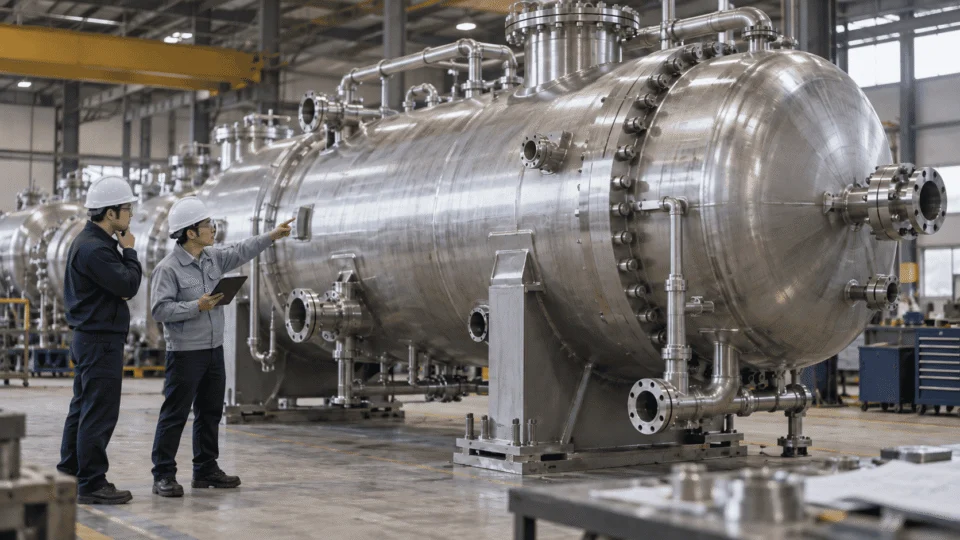
Engineering review for industrial pressure vessel project
FINAL CONFIGURATION MAY DEPEND ON

Review the Complete Operating and Project Envelope

Design Conditions

Design pressure, design temperature, vacuum conditions and pressure cycling.

Process Medium

Chemical compatibility, corrosion, cleanliness and product-contact requirements.

Materials

Material grade, corrosion allowance, lining, coating and surface requirements.

Geometry

Diameter, length, orientation, heads, wall thickness and unsupported length.

Loads & Supports

Supports, external loads, nozzle loads, lifting and installation constraints.

Nozzles & Internals

Connections, manways, distributors, coils, demisters, baffles and other internals.

Thermal Requirements

Heating, cooling, jackets, coils, insulation and process temperature control.

Fabrication & Inspection

Welding, testing, inspection, documentation and applicable project specifications.

WHY ONE CHANGE CAN MATTER

Selection Inputs Do Not Work Independently

Larger Diameter

May change the structural design, wall thickness, support arrangement and transport planning.

Different Process Medium

May change the material grade, corrosion allowance, lining or product-contact requirements.

Vacuum Operation Added

May require additional external-pressure evaluation, geometry checks or stiffening strategy.

Heating or Cooling Added

May change the vessel wall, jacket, coil, nozzle arrangement and thermal control strategy.

READY FOR TECHNICAL REVIEW?

Send the project information you already have.

ChannelVessel can review your operating conditions, specification or drawings and help determine an appropriate equipment direction before the project moves into detailed engineering.

Scroll to Top
DRAWING & FILE REVIEW

Send Your Drawings

Upload your drawings, datasheets or existing specifications. Our engineering team will review the files and respond with technical feedback.

Engineering Review

Drawings, specifications and process requirements

Confidential File Handling

Project files are used only for technical review and quotation

Faster Technical Feedback

Clearer inputs help us respond more accurately and efficiently

DRAWING & FILE REVIEW

Send Your Drawings

Upload your drawings, datasheets or specifications. Our engineering team will review your files and provide technical feedback.

Contact Form Demo (#3)
Project Protected NDA available
12h Response
ASME / PED
AFTER SUBMISSION
01 Review
→
02 Confirm
→
03 Quote
TECHNICAL QUOTATION

Get a
Technical Quote

Tell us what you need. Our engineering team will review your requirements and respond within 12 hours.

Engineered for Your Application

From concept to certified manufacturing

Global Compliance

ASME, PED and other international standards

Expert Support

Direct access to our engineering team

TECHNICAL QUOTATION

Get a Technical Quote

Tell us what you need. Our engineering team will review your requirements and respond within 12 hours.

Contact Form Demo
Project Protected NDA available
12h Response
ASME / PED
AFTER SUBMISSION
01 Review
→
02 Confirm
→
03 Quote