Packed Towers for Gas–Liquid Mass Transfer
Custom packed towers engineered around your process conditions, packing selection, liquid distribution and project-specific mechanical requirements.
Send your process conditions, equipment data sheet or existing drawings. Final dimensions, materials and supply responsibilities are confirmed against the agreed design basis.

Is a Packed Tower Right for Your Process?
“Packed” describes the internal contacting structure, not a single process. A packed column may serve as an absorber, stripper or distillation column depending on the separation duty and surrounding process system.
Absorption and Gas Scrubbing
Bring a gas stream into contact with a suitable liquid to absorb selected components. Start with gas composition, inlet concentration, absorbent chemistry and the required outlet condition. Packing alone does not determine removal performance.
Explore Absorption TowersStripping and Desorption
Transfer selected components from a liquid into a gas or vapor phase. Confirm the stripping medium, residual concentration target and how the overhead stream will be recovered or treated.
Explore Stripping TowersDistillation, Including Vacuum Service
Use vapor–liquid contact to support component separation. Evaluate packing against separation requirements, vapor and liquid loads, and the available pressure-drop allowance.
Explore Distillation ColumnsThese services may require pretreatment, a more open contacting structure or another equipment arrangement. Do not assume conventional packing will remain clear simply because the nominal process duty is suitable.
Describe the operating problem as well as the required capacity. “Treat this stream to this outlet condition” is a better starting point than “supply a tower of this diameter.”
How a Packed Tower Works
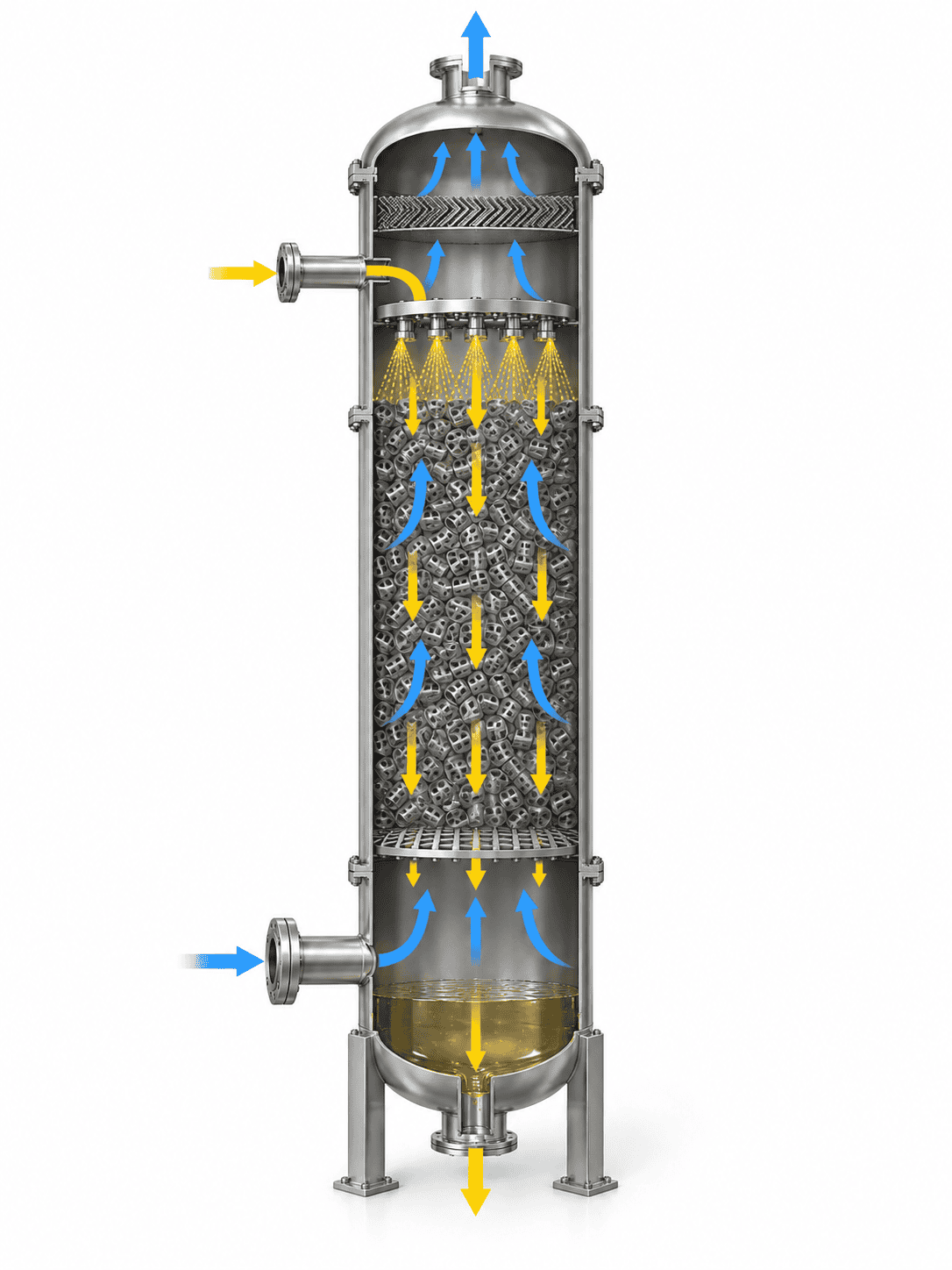
In a typical counter-current tower, liquid enters above the packed bed and flows downward over the packing. Gas or vapor enters below the bed and travels upward through the open passages. Contact between the phases enables mass transfer.
Distribute the Liquid
The liquid distributor feeds the bed across its cross-section rather than allowing most of the flow to follow only a few preferred paths.
Create Gas–Liquid Contact
Packing provides contact surfaces while leaving open passages for both phases. Random packing uses individual elements; structured packing uses ordered modules.
Collect the Outlet Streams
Liquid collects below the bed while gas or vapor leaves above it. Where required, a mist eliminator removes entrained droplets but does not replace the mass-transfer duty of the packed section.
Random Packing or Structured Packing?
Select the packing together with the column dimensions, liquid distribution system and operating range. Neither family is the best choice for every service.

Metal Pall Rings and Other Random Media
Individual packing elements form a randomly arranged bed. Metal Pall rings are a practical option to evaluate for absorption, stripping and other gas–liquid contacting duties.
State the packing shape, nominal size, material, thickness and required quantity. Do not treat “stainless steel packing” as a complete specification.
Corrugated Metal Sheet Packing
Ordered packing modules are worth evaluating where pressure-drop allowance, separation efficiency or available packed height strongly influences the design.
Common series can correspond to nominal areas near 125, 250, 350 and 500 m²/m³. Confirm the selected product geometry, material and hydraulic data before comparing alternatives.
Compare the Complete Design
Compare at the same gas and liquid duty, not by a catalogue statement alone.
Check the required separation duty together with the available packed height.
Consider solids, deposits, access and how easily the selected bed can be inspected or replaced.
Confirm module size, manway access, support arrangement and transport restrictions before finalizing the packing.

Specify the packing and tower internals as one coordinated assembly.
Good Packing Needs the Right Distribution System
Suitable packing cannot compensate for liquid delivered unevenly across the bed or for internals that restrict the required operating range. The distributor, packing support and other internal components should be checked together.
Review flow uniformity, drip-point coverage, available liquid head and vapor passage area. Evaluate the actual minimum and maximum liquid rates rather than checking only the normal operating point.
Where the bed arrangement requires redistribution, collect and re-feed the liquid deliberately. Intermediate feeds, draws and bed divisions should be reflected in the internal layout before the shell is finalized.
Confirm the installed packing load, retained-liquid load, support details and clear flow area. Use bed limiters or hold-down arrangements appropriate to the selected media and service.
Check how gas reaches the packed section and whether the outlet requires droplet removal. Mist elimination is a separate duty involving gas loading, drainage and fouling potential.
Ask the quotation to identify the packing, distributor, support, redistribution and any mist-elimination equipment. State who is responsible for checking their compatibility.
Match Materials to the Process and Mechanical Duty
ChannelVessel packed towers can be specified in carbon steel, SS304/304L or SS316/316L, with other alloys reviewed against the project requirements. Select the shell, internals, packing, fasteners and seals deliberately rather than assigning one material label to the entire assembly.
Consider carbon steel where the process chemistry and corrosion-management approach support its use. State any lining, coating or corrosion allowance separately, including how it applies to wetted surfaces and maintenance requirements.
Assess SS304/304L and SS316/316L against composition, concentration, temperature, chlorides and cleaning chemistry. SS316L should not be described as universally suitable for acidic or chloride-bearing service.
A corrosion allowance suitable for a vessel shell does not protect thin packing sheets in the same way. Review the actual internal-component thickness and service exposure, not only the shell specification.
Define More Than Internal Pressure
State operating pressure and temperature separately from design conditions.
Identify full-vacuum or other external-pressure cases where they are credible.
Include filled weight, test weight, support reactions, nozzle loads and site loads where applicable.
Consider transport splits, lifting, erection access and field assembly before finalizing the shell arrangement.

Use a real manufacturing detail rather than a generic stock image.
Define the Equipment, the Process Inputs and the Supply Boundary
Use one specification to describe the proposed tower, another to capture the buyer’s process inputs, and a separate scope statement to identify who is responsible for each engineering and supply activity.
Absorption, stripping, distillation or another defined gas–liquid contacting duty.
Flow, composition, temperature, absolute pressure and the stated flow reference basis.
Corresponding flows, composition, temperature, density, viscosity and surface tension where available.
Solids, foaming, scaling, crystallization, polymerization and expected feed variation.
Outlet concentration, purity, recovery or residual-content target, including its measurement basis.
Clarify whether the limit applies to the packed section, complete tower or wider process system.
Design conditions, material specification, project standard, site loads and access constraints.
Available space, transport limitations, installation scope and required document package.
Mark unknown inputs as “to be confirmed” rather than substituting estimated values without identifying them.
The agreed scope may include the tower shell, packing, internals and specified auxiliary equipment. Pumps, fans, piping, controls and site work are included only when listed in the quotation.
Preliminary information is enough to start when unknown values are clearly identified.

Use a real workshop image showing fabrication or inspection, not a staged office or stock-photo scene.
Fabrication, Inspection and Documentation
Define quality requirements before fabrication begins. The quotation and approved inspection plan should identify the applicable checks, acceptance criteria, witness points and records—not simply state “factory tested.”
Agree the equipment data sheet, general arrangement, nozzle orientation, materials and internal-component interfaces. Identify transport splits, installation access and document approval responsibilities before cutting material.
Use the agreed inspection plan to address material traceability, applicable welding qualifications, dimensional checks and required examinations. Include internal-support locations, fit-up and other details needed for final assembly.
Confirm assembly status, outstanding field work, preservation, protected openings, component identification and packing arrangements. State which pressure or leak tests apply and which records will accompany delivery.
The Document Package
A vessel pressure test does not demonstrate gas-removal efficiency or distillation performance. Mechanical acceptance and process-performance acceptance require different criteria.
Plan for Inspection, Cleaning and Troubleshooting
Keep a baseline record of stable operation so later changes can be compared with the original duty. Pressure differential, gas and liquid rates, process-liquid condition and outlet performance should be reviewed together rather than diagnosing the tower from one symptom alone.
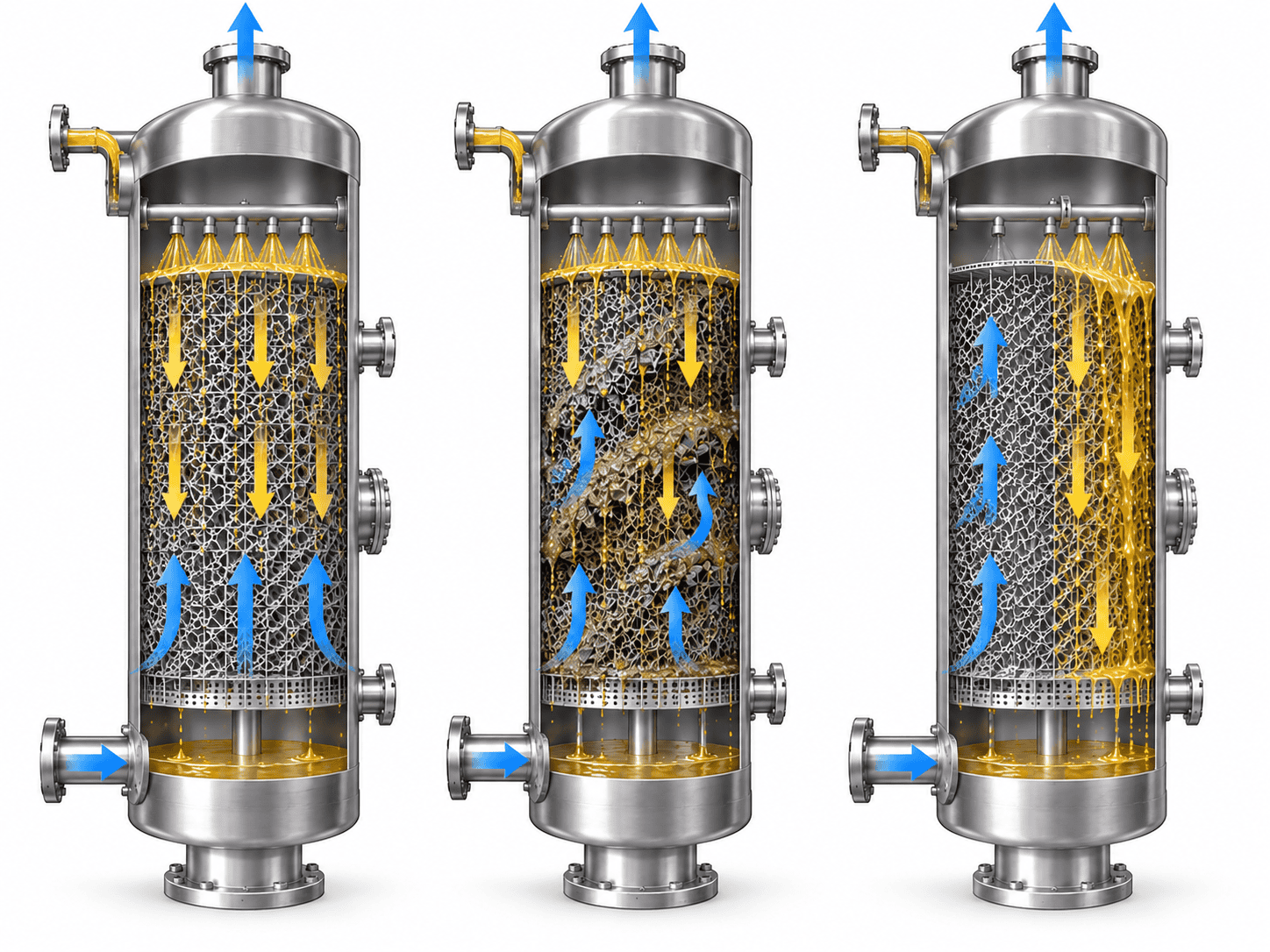
Illustration only. Confirm the actual cause with operating data and inspection.
Verify instrument readings, gas and liquid rates, and signs of deposits or restriction. Review the packing and any mist eliminator separately; an increase across the whole tower does not identify the restricted component.
Review feed composition, process-liquid condition, temperatures and liquid distribution. A normal pressure-drop reading does not by itself confirm the required mass-transfer result.
Review actual gas loading, liquid level, mist eliminator condition and drainage. Confirm whether the problem is entrained droplets or a change in process composition before selecting a remedy.
Compare liquid delivery with the distributor operating range and confirm the required process conditions at reduced throughput. The normal-duty packing selection does not automatically guarantee the same result at every lower flow.
Design for inspection before the tower is built
Define how personnel will inspect internals and remove or replace packing before fixing the access arrangement. Internal entry requires the site’s applicable isolation, depressurization, draining, cleaning and entry procedures.
Send the Duty—Not Only the Diameter
Tell us what the tower needs to achieve, the expected operating range and the equipment you need included. ChannelVessel can prepare a project-specific quotation around your data sheet, drawings and agreed supply scope.
Absorption, stripping, distillation or another defined gas–liquid contacting requirement.
Gas and liquid flows, compositions, temperatures, pressures and expected operating range.
Outlet concentration, purity, recovery, residual-content target or another acceptance criterion.
Preferred materials, available space, transport limitations, installation scope and destination.
Preliminary enquiries are welcome. Identify any unconfirmed values so the technical scope can be reviewed before dimensions and performance requirements are finalized.

Dimensions, internals, materials and delivery scope confirmed against the agreed design basis.