ChannelVessel Intelligent Equipment Co., Ltd. Contact Us
Custom Jacketed Pressure Vessel Manufacturing

Jacketed Pressure Vessels for Heating, Cooling & Temperature Control

ChannelVessel designs and manufactures custom jacketed pressure vessels for controlled heating, cooling and temperature-sensitive industrial processes. Vessel geometry, jacket configuration, material and pressure conditions are engineered around your process requirements.

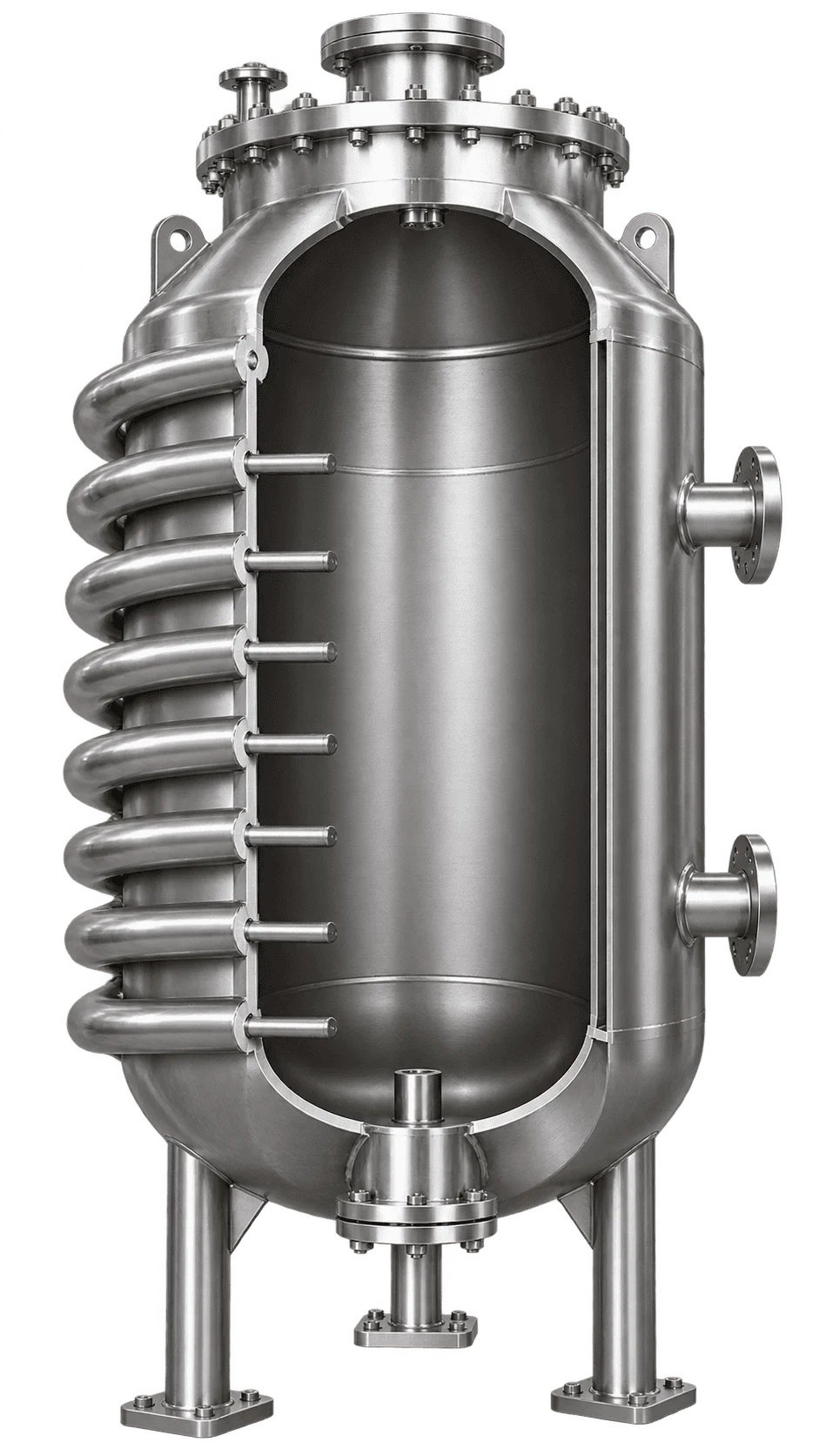
Available with conventional full jackets, half-pipe coil jackets and dimple jackets, with configurations for steam, hot water, thermal oil, cooling water and other project-specified heat-transfer media.
Jacket Types
Full / Half-Pipe / Dimple
Thermal Media
Steam / Water / Thermal Oil
Materials
SS304 / SS316L / Carbon Steel
Engineering
Vessel & Jacket Designed Separately
Heating Cooling Temperature Control
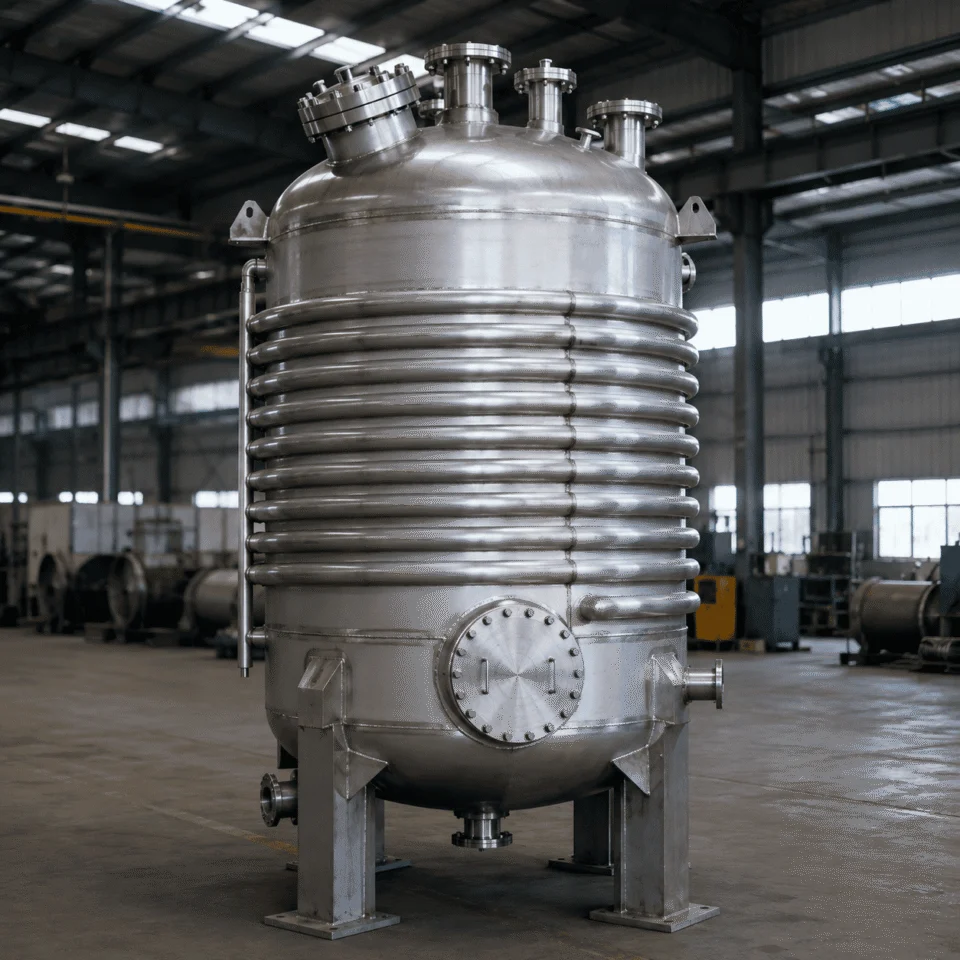
Custom jacketed pressure vessel with half-pipe coil jacket manufactured by ChannelVessel
Process Temperature Control

Why Use a Jacketed Pressure Vessel?

A jacket creates a separate heat-transfer zone around the vessel shell, allowing heating or cooling media to control process temperature without entering the product.

Heating

Transfer heat through the vessel wall to bring the process to the required temperature.
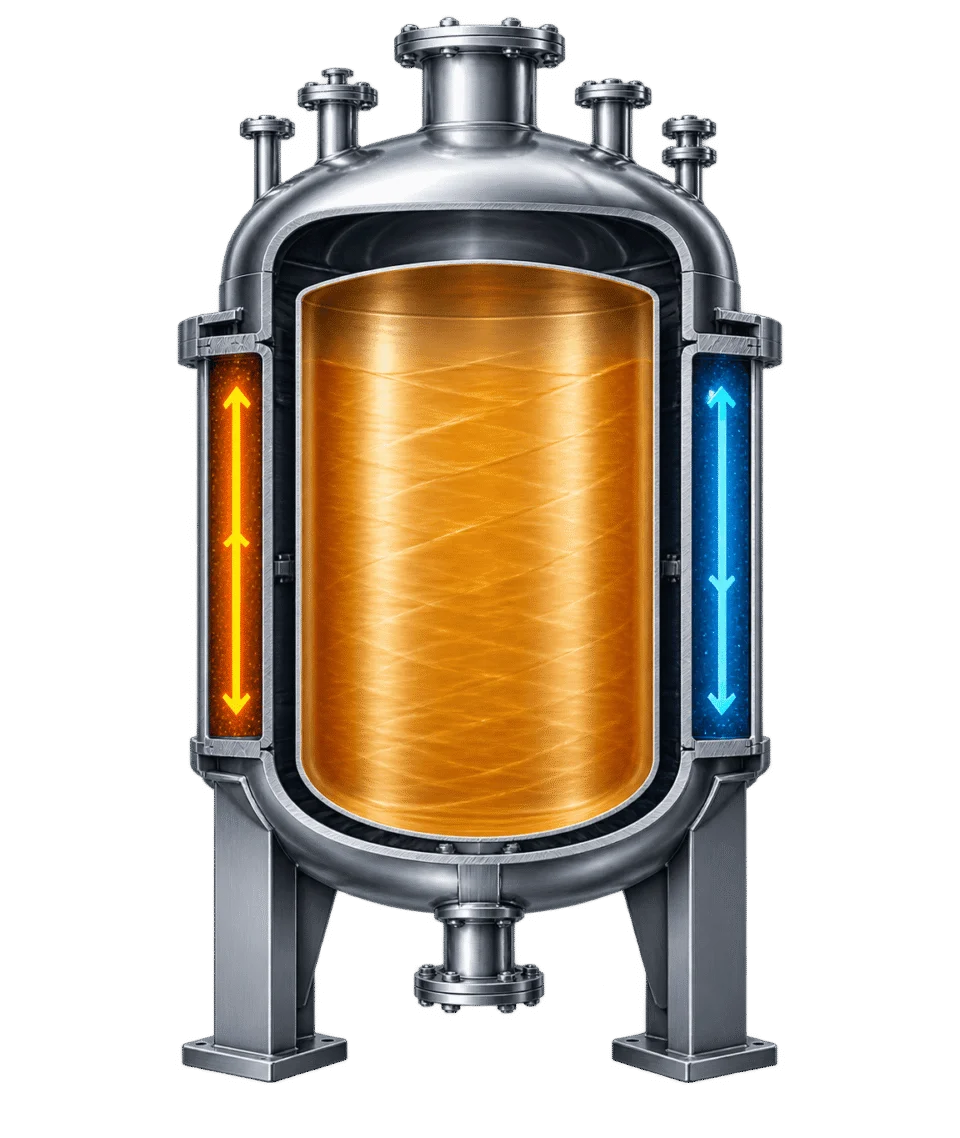
Steam Hot Water Thermal Oil
Jacketed pressure vessel cutaway showing heating and cooling flow

Cooling

Remove process heat through the jacket to control temperature or cool before transfer.

Cooling Water Chilled Water Glycol

Temperature Holding

Maintain the process within a controlled target range during operation or temporary holding.

Controlled Target Range
Low Temp High Temp
Heat a Batch
Remove Reaction Heat
Maintain Viscosity
Prevent Crystallization
Cool Before Transfer
Jacket Configurations

Choose the Right Jacket Configuration

Jacket selection depends on heat-transfer duty, jacket-side pressure, operating temperature, vessel geometry and process requirements. The three configurations below cover most industrial heating and cooling duties.

1

Full Jacket

Conventional / Full Jacket
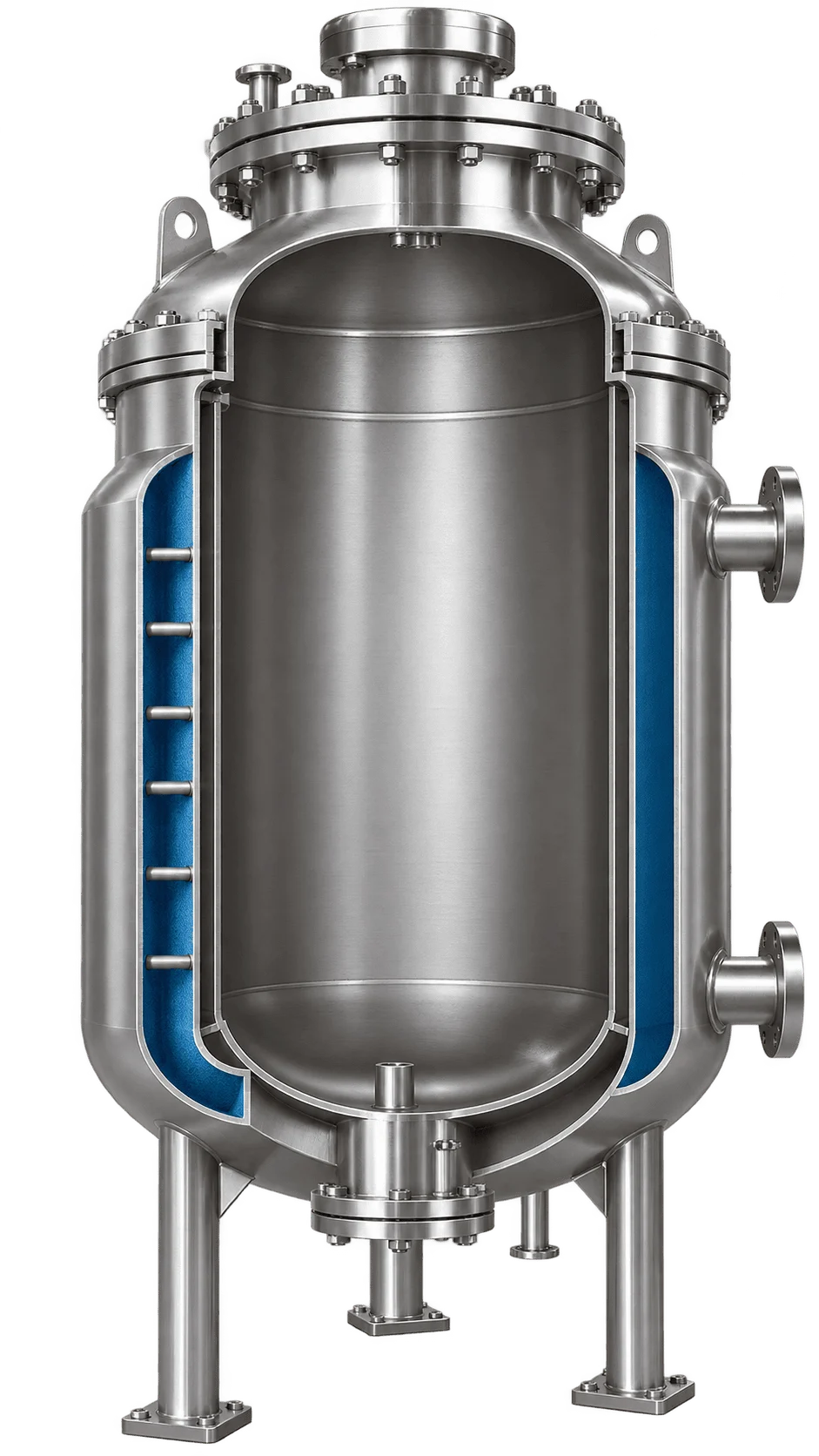
Full jacket pressure vessel structure

Large Heat-Transfer Area for General Heating & Cooling

Covers a large portion of the vessel shell
Suitable for general heating and cooling duties
Commonly used with steam, hot water or cooling water
Best suited to low-to-moderate jacket-side pressure
Relatively straightforward fabrication
Best For
General Process
Heating & Cooling
3

Dimple Jacket

Dimple Jacket

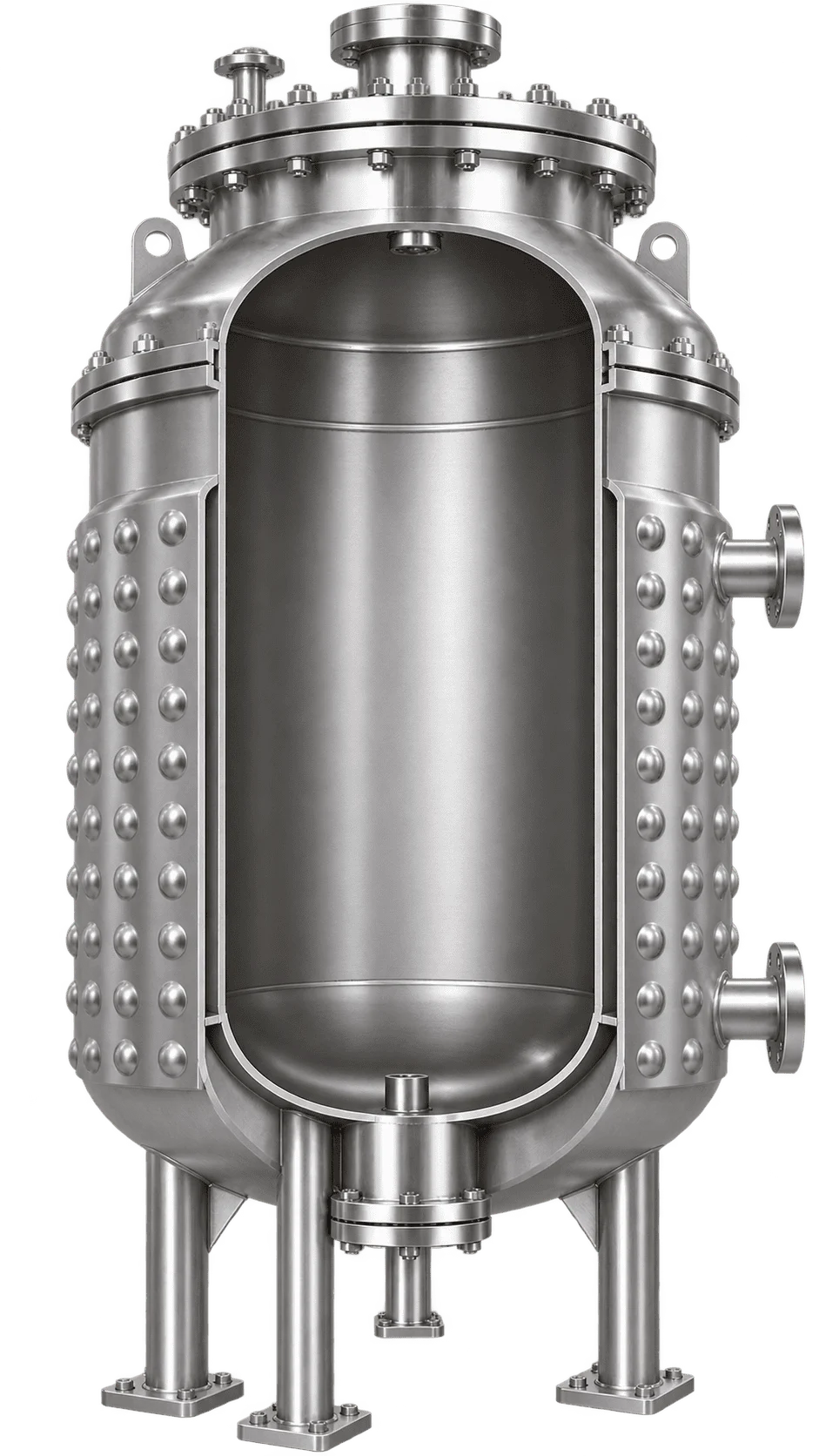
Dimple jacket pressure vessel structure

Compact Jacket Construction for Controlled Thermal Duty

Outer jacket sheet is attached through patterned weld points
Creates distributed flow passages around the shell
Compact external profile
Suitable for moderate heating and cooling duty
Common where cleanliness and compact construction are important
Best For
Sanitary /
Compact Process Equipment
Jacket Configuration Comparison
Full Jacket
Half-Pipe Coil Jacket
Dimple Jacket
Heat-Transfer Coverage
High
High
Jacket Pressure Capability
Low – Moderate
Low – Moderate
Steam Service
Good
Good
Thermal Oil Service
Good
Application Dependent
Fabrication Complexity
Moderate
Moderate
External Profile
Smooth
Compact
Typical Duty
General Heating & Cooling
Sanitary / Compact Process
Selection Logic

How to Choose the Right Jacket for Your Process

Jacket selection depends on thermal duty, jacket-side pressure, heating/cooling medium, vessel geometry, and process constraints.

Selection Inputs

Jacket-Side Pressure

Define maximum operating pressure on jacket side.

Thermal Duty

Specify required heat transfer rate and temperature targets.

Heating / Cooling Medium

Identify the medium and its operating temperature range.

Vessel Geometry

Consider vessel size, diameter, height, and available space.

Process Cleanliness

Determine cleanliness, product contact, and sanitation needs.

Fabrication & Lifecycle

Evaluate fabrication complexity, inspection, and lifecycle costs.

Start with your process
Higher Pressure
Demanding Duty
Steam / Thermal Oil
Compact / Sanitary

Recommendation

Full Jacket

General process
heating & cooling

Dimple Jacket

Compact / sanitary-oriented
thermal control

Final jacket selection should be confirmed from operating conditions, medium, geometry and project constraints.
Dual Pressure Boundaries

Two Pressure Boundaries, One Engineered Vessel System

A jacketed pressure vessel has two separate pressure boundaries: the internal process vessel that contains your process and the external jacket that controls the thermal environment.

Process Vessel Side

Process Medium

Type, composition, phase, and properties

Working / Design Pressure

Internal pressure conditions under operation

Vacuum Condition

Internal vacuum during operation and design basis

Operating / Design Temperature

Normal operating range and design temperature

Corrosion / Cleanliness

Corrosion allowance, materials, and cleanliness requirements

Process Requirements

Nozzles, internals, agitation, inspection, and code requirements
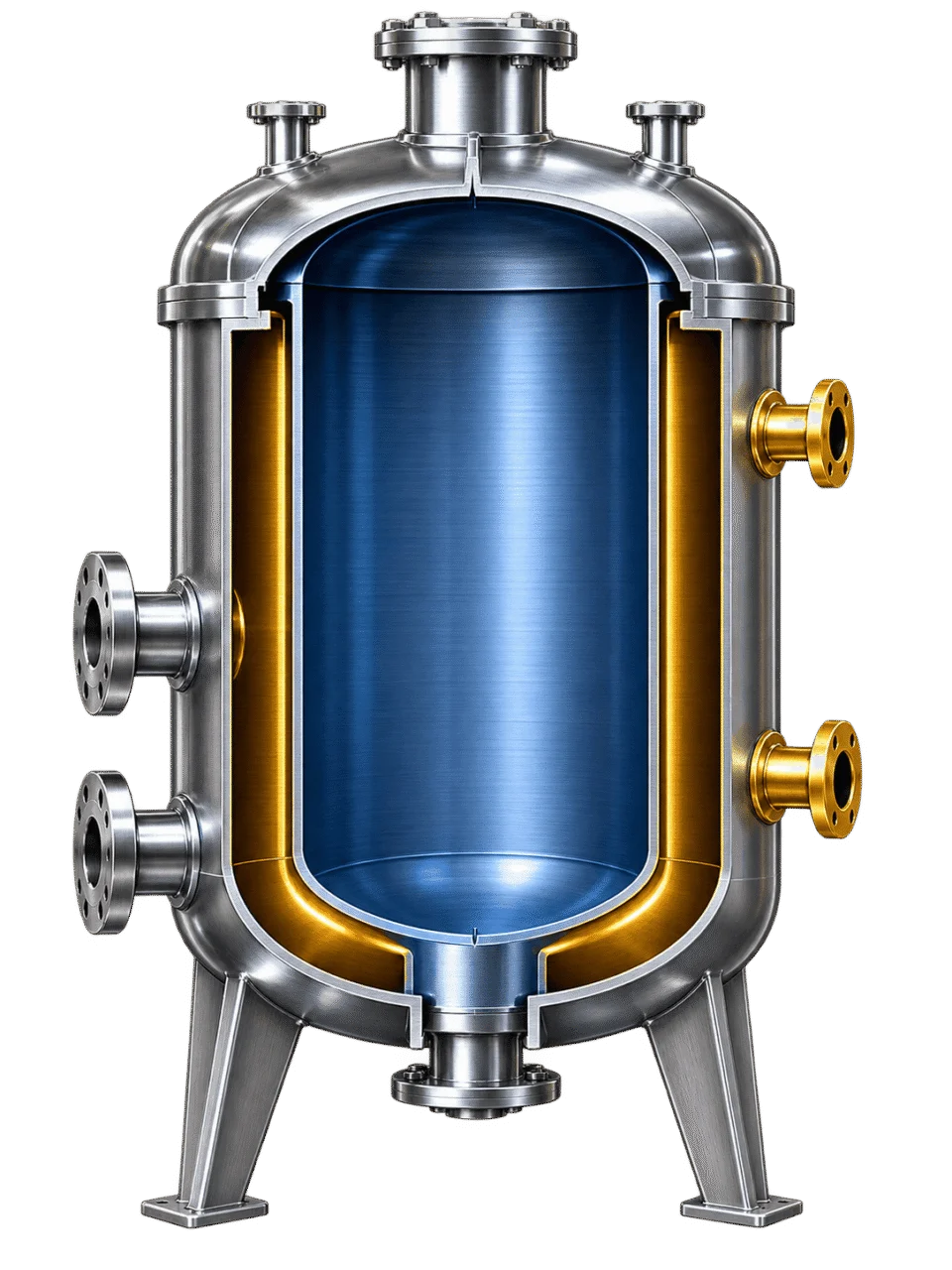
Process Side Jacket Side
Jacketed pressure vessel cutaway showing process and jacket pressure boundaries
Jacket Side

Heating / Cooling Medium

Type, composition, and properties of jacket medium

Working / Design Pressure

Jacket pressure conditions under operation

Inlet Temperature

Temperature of medium entering the jacket

Return Temperature

Temperature of medium leaving the jacket

Flow Requirement

Flow rate or velocity requirements for heat transfer

Thermal Duty

Required heat duty and heat transfer performance

Mechanical Integration

Differential Pressure

Check allowable pressure differential between sides

Wall Thickness

Adequate thickness for both pressure boundaries

Reinforcement

Supports for openings, nozzles, and load conditions

Thermal Expansion

Manage expansion mismatch between vessel and jacket

Jacket Attachment

Secure attachment and sealing of jacket to vessel

Operating Cycles

Fatigue evaluation for thermal and pressure cycling

Thermal Performance

What Determines Heating and Cooling Performance?

Jacket area alone does not determine heating or cooling performance.

Actual thermal performance depends on the complete heat-transfer path—from the utility medium flowing through the jacket, through the vessel wall, and into the process material inside.

The Heat-Transfer Path

Utility Medium

Steam / Hot Water /
Thermal Oil / Cooling Water

Jacket Flow

Flows through the jacket around the vessel

Jacket Medium
Vessel Wall
Process Product

Heat Transfer

Heat passes through
the vessel wall

Agitation /
Circulation

Distributes heat throughout
the product

Target
Temperature

Achieve the desired
process temperature

Key Factors That Influence Performance

Temperature Difference (ΔT)

Greater temperature difference increases heat-transfer driving force.

Effective Jacket Area

More effective area enhances overall heat-transfer capacity.

Jacket Medium

Medium type and temperature affect heat-transfer efficiency.

Flow Rate & Distribution

Adequate flow and uniform distribution improve performance.

Product Properties

Viscosity, density, heat capacity, and conductivity influence heating/cooling rate.

Agitation / Internal Circulation

Proper mixing ensures uniform temperature and faster heat transfer.

Insulation & Heat Loss

Good insulation and lower ambient loss improve efficiency and holding ability.

Define Your Target Performance

Example Project Inputs

Start Temperature
°C / °F
Target Temperature
°C / °F
Required Time
min / hr
Batch Volume
L / m³ / gal

Thermal performance is the result of multiple interacting factors. Provide complete process and utility data so our engineers can design the jacketed pressure vessel to meet your heating and cooling requirements.

Optimized Design

Engineered for your specific conditions

Reliable Performance

Consistent heating or cooling results

Energy Efficient

Lower utility consumption and operating cost

Process Success

Achieve your production goals with confidence

Process Integration

Integrating Jacket Heat Transfer with Agitation & Process Flow

The jacket transfers heat through the vessel wall, but temperature uniformity inside the batch depends on how the process material moves. Agitation, internal circulation, viscosity and vessel internals must therefore be considered together with the jacket design.

1. Low-Viscosity Liquid

  • Natural circulation helps distribute heat
  • Moderate agitation improves temperature uniformity
  • Jacket coverage and internal flow work together effectively

2. Medium / High-Viscosity Product

  • Heat transfer near the wall is faster than in the batch center
  • Agitation becomes increasingly important
  • Impeller type, speed and clearance affect product circulation
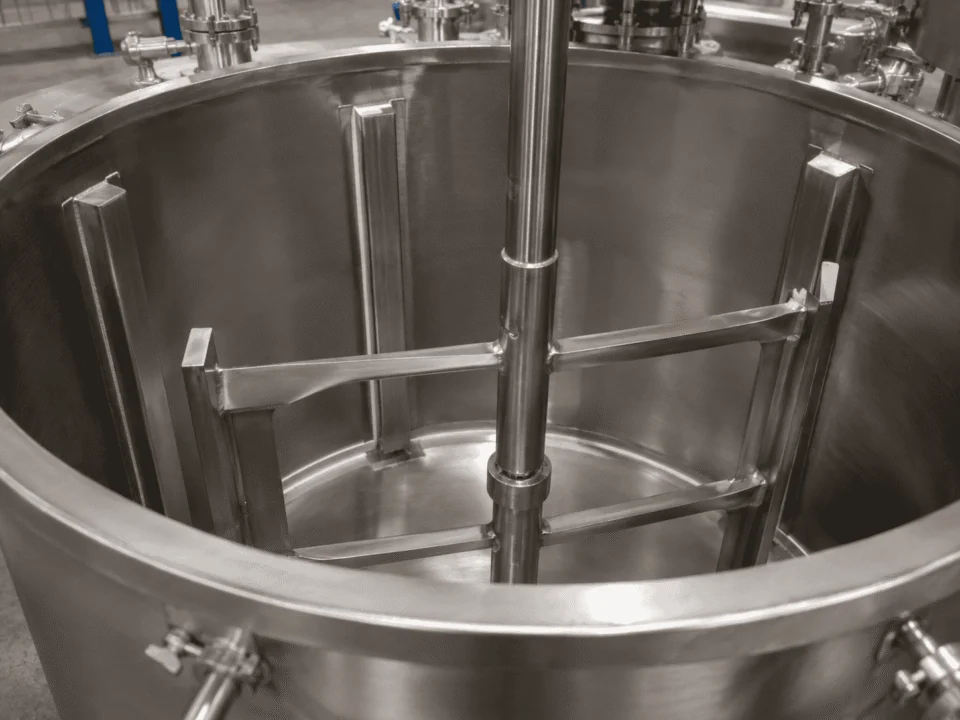
  • Scraped-wall or anchor-type mixing may be considered for viscous duties
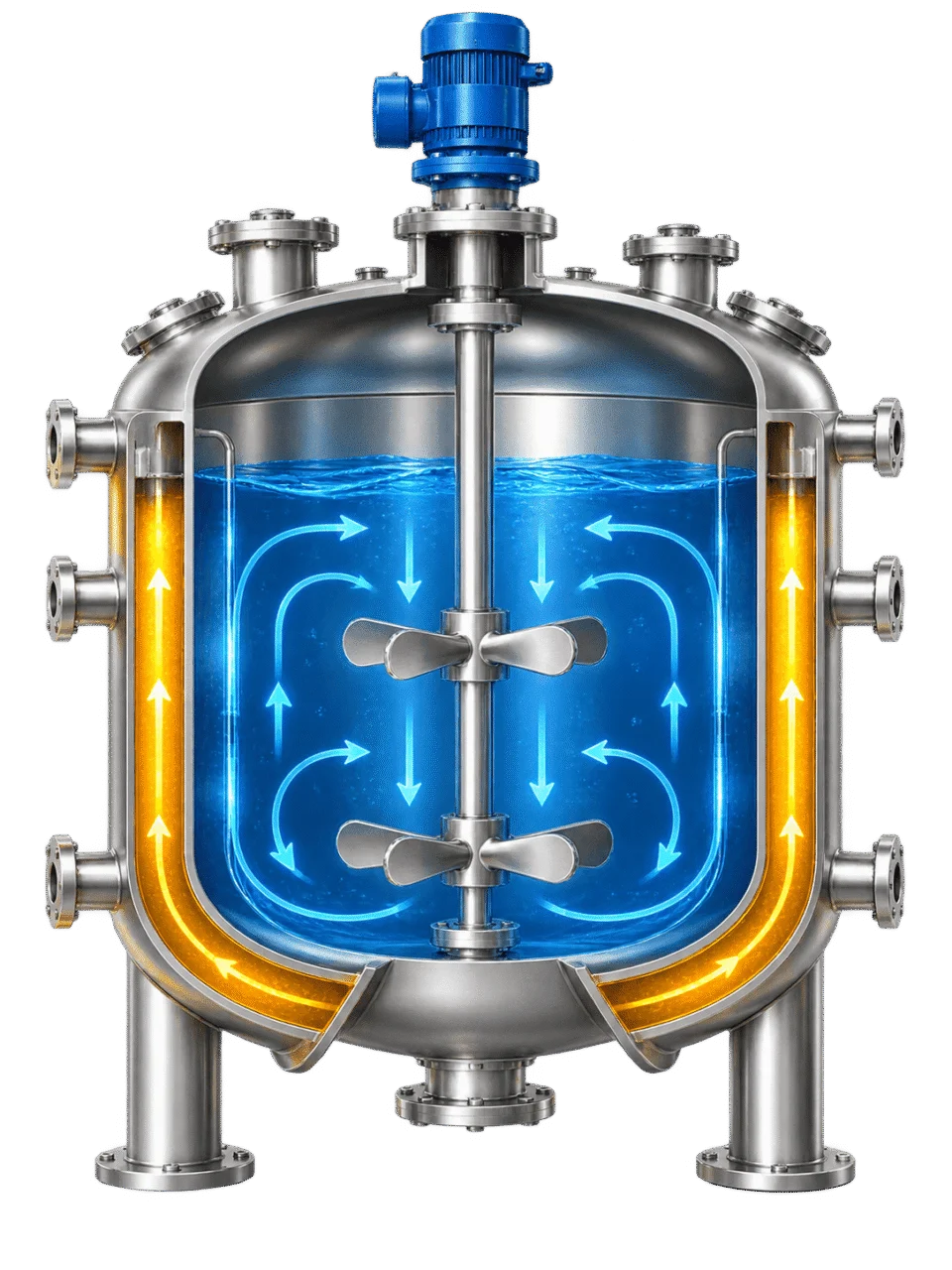
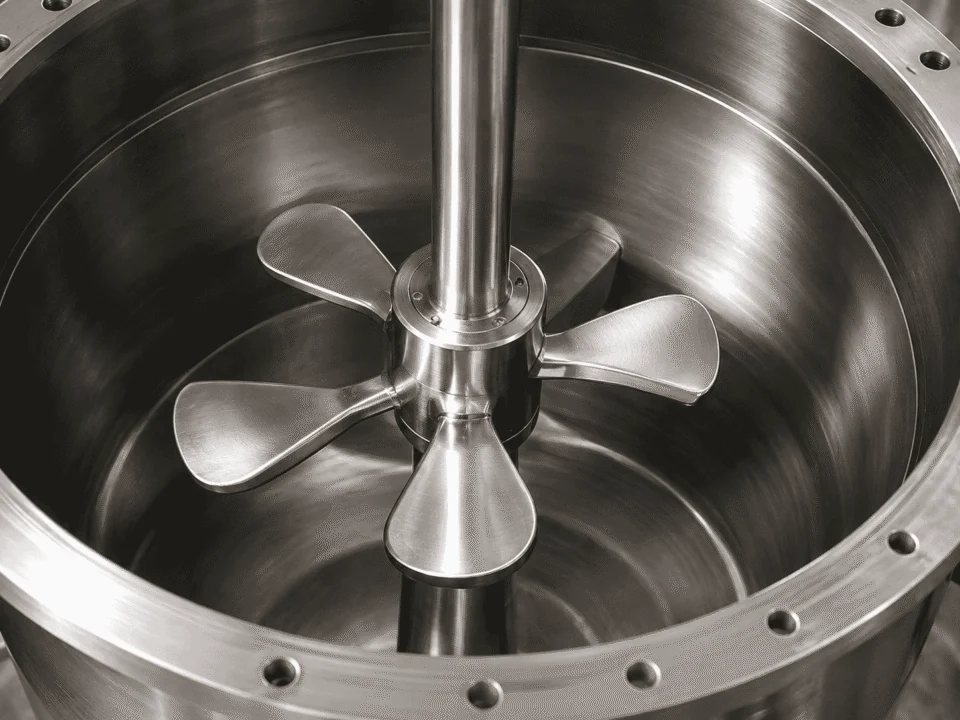
Jacketed pressure vessel with agitator and internal circulation
Heat In
Heat Out

3. Reaction / Exothermic Process

  • Heat generated by the process must be removed efficiently
  • Internal mixing helps reduce local hot spots
  • Jacket duty and agitation should be evaluated as one thermal-control system

4. Temperature-Sensitive / Uniformity-Critical Process

  • Narrow temperature band is required
  • Internal circulation and control strategy become more important
  • Suitable for food, pharmaceutical, fine chemical and specialty materials
What Our Engineers Review

Product Viscosity

Affects flow behavior and heat distribution

Impeller Type

Selected for mixing and circulation needs

Agitation Speed

Optimized for mixing efficiency and shear

Vessel Geometry

Diameter, height and liquid level considered

Baffles / Internals

Improve circulation and reduce dead zones

Temperature Uniformity

Achieve stable and consistent process performance
Material Selection

Select Materials for Both the Process Side and Jacket Side

Material selection for a jacketed pressure vessel must consider both the process medium inside the vessel and the heating or cooling medium circulating through the jacket. Corrosion resistance, cleanliness, temperature, fabrication requirements and lifecycle cost can lead to different material choices for each side.

Process Contact Side

Material is primarily driven by:

Medium Compatibility

Match material to the process medium

Corrosion

Resistance to chemical attack

Cleanliness

Meet hygiene and purity requirements

Surface Finish

Appropriate finish for the application

Temperature

Withstand operating temperature
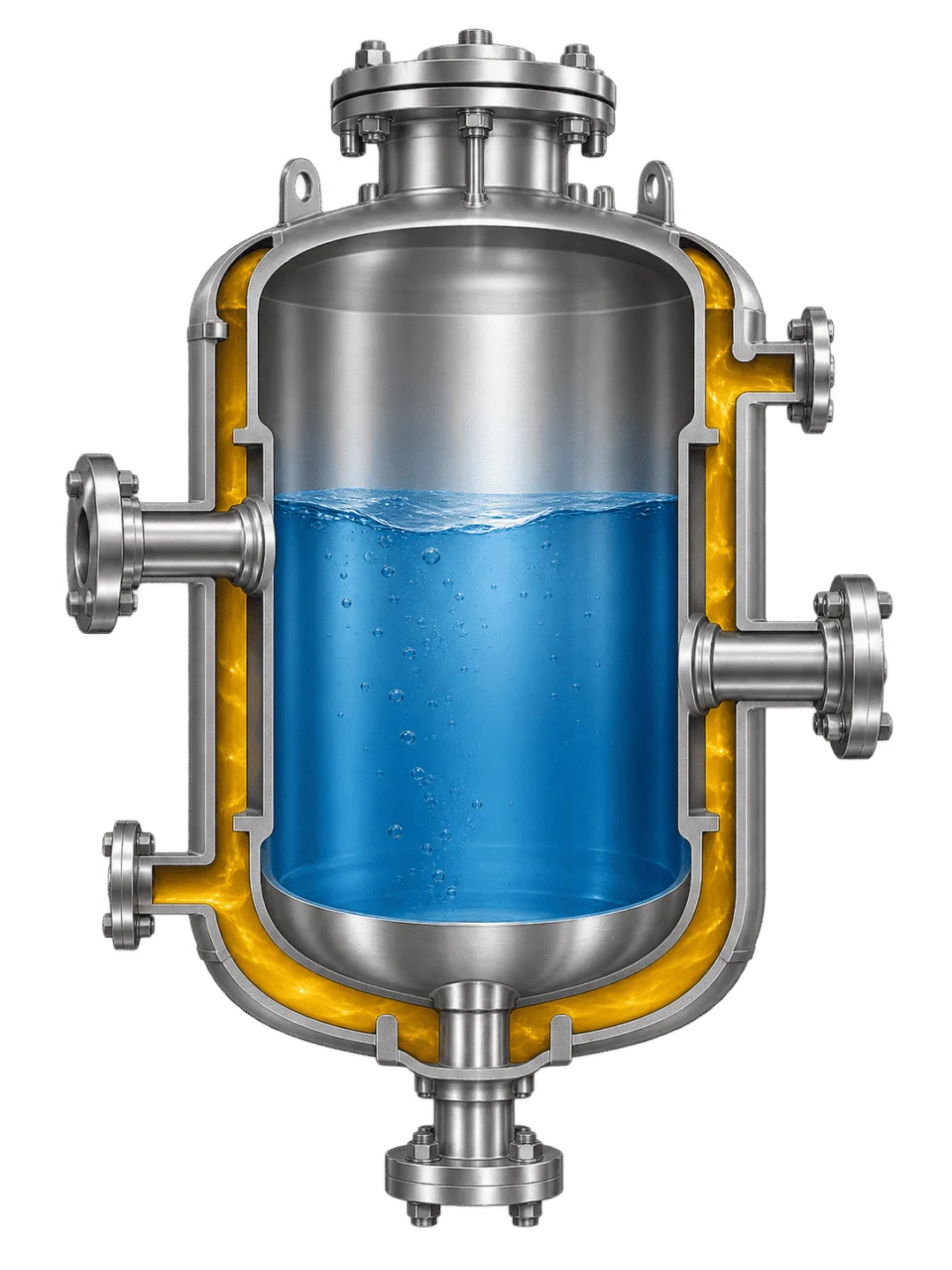
Jacketed pressure vessel cutaway showing process-side and jacket-side material boundaries
Process
Product
Utility
Medium
Inner Vessel Wall
Jacket

Jacket / Utility Side

Material is primarily driven by:

Utility Medium

Steam, hot water, thermal oil, etc.

Corrosion

Resistance to jacket-side corrosion

Temperature

Jacket operating temperature

Pressure

Design pressure of the jacket side

Fabrication Compatibility

Suitable for vessel construction

Materials Are Selected
for Both Sides

SS304

General-Purpose Stainless

  • General corrosion resistance
  • Suitable for many water-based and non-aggressive fluids
  • Common in general industrial and food-related duties
  • Can be used for vessel shell, jacket or complete assembly

Carbon Steel

Cost-Effective Construction
for Suitable Industrial Service

  • Economical for compatible non-corrosive service
  • Common in general chemical and industrial applications
  • Can be used for the jacket when utility-side conditions permit
  • External coating or protection can be specified
  • Selection must consider both process and utility media
Explore Carbon Steel Pressure Vessels

Project-Specified Materials

Custom Solutions for
Special Requirements

  • Other materials can be evaluated according to medium compatibility
  • Design temperature and corrosion requirements are reviewed
  • Material selection follows project specifications
  • Final suitability is confirmed during engineering review

Material selection is an engineering decision based on process conditions, codes, standards and project requirements. Our team will recommend the most suitable materials for your jacketed pressure vessel.

Jacket Fabrication

From Vessel Shell to Finished Jacketed Assembly

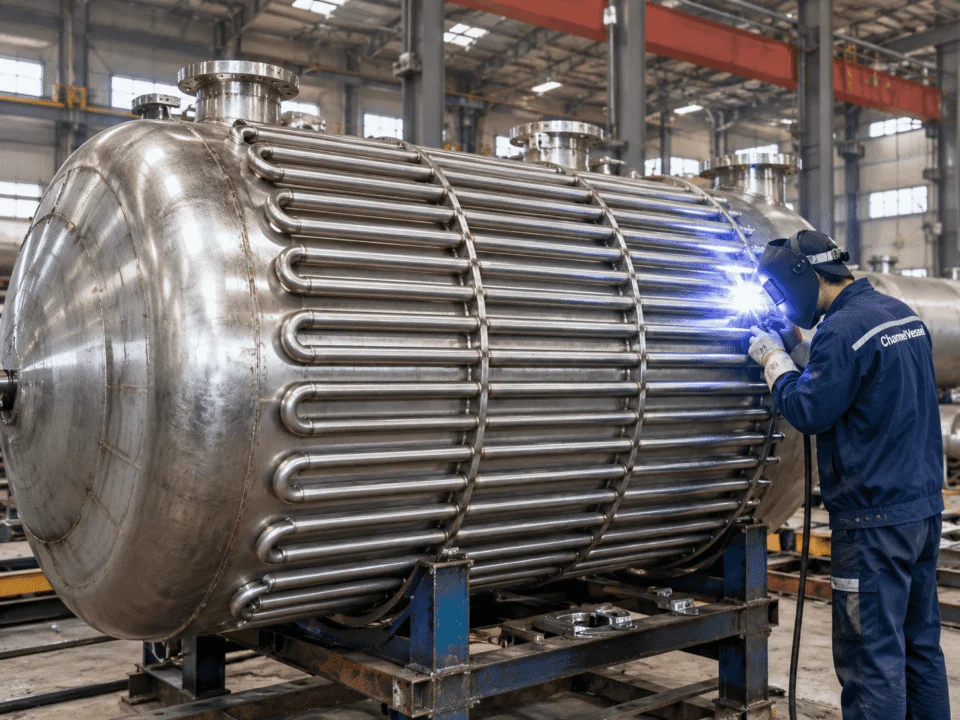
With experienced fabricators, qualified welding procedures and strict process control, we manufacture jacketed pressure vessels to meet your design requirements and industry standards.

01

Shell Forming

Plate cutting, rolling, head forming and fit-up

02

Pressure Vessel Welding

Qualified procedures, precise welding and distortion control

03

Jacket Fit-Up

Jacket positioning and spacing control

04

Jacket Attachment

Jacket welding, closure rings and nozzle preparation

05

Nozzle Integration

Process nozzles, utility connections and reinforcements

06

Inspection Before Testing

Dimensional check, NDT and jacket-side leak test
Critical
Fabrication Controls

We focus on key manufacturing details to ensure the jacketed pressure vessel is built for safe, reliable and long-term operation.

Jacket Spacing

Accurate control of jacket gap and alignment

Weld Continuity

Full and consistent weld quality

Distortion Control

Minimized deformation during fabrication

Nozzle Alignment

Correct positioning and reinforcement

Drain & Vent Orientation

Proper arrangement for stable operation

Inspection & Testing

Verify Both Pressure Boundaries Before Delivery

A jacketed pressure vessel must be verified as an integrated system, while the internal vessel and external jacket are inspected and tested according to their own design conditions, approved procedures and project requirements.

Process Vessel Side
Pressure Boundary A
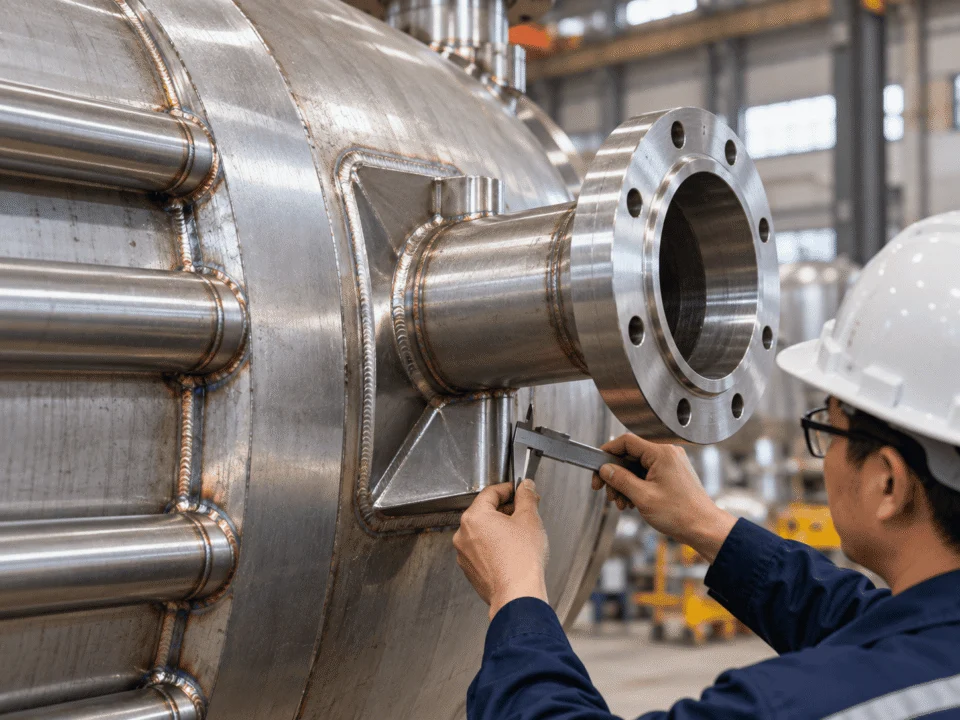
Dimensional Inspection
Weld Inspection / NDT
Pressure Testing
Leak Check
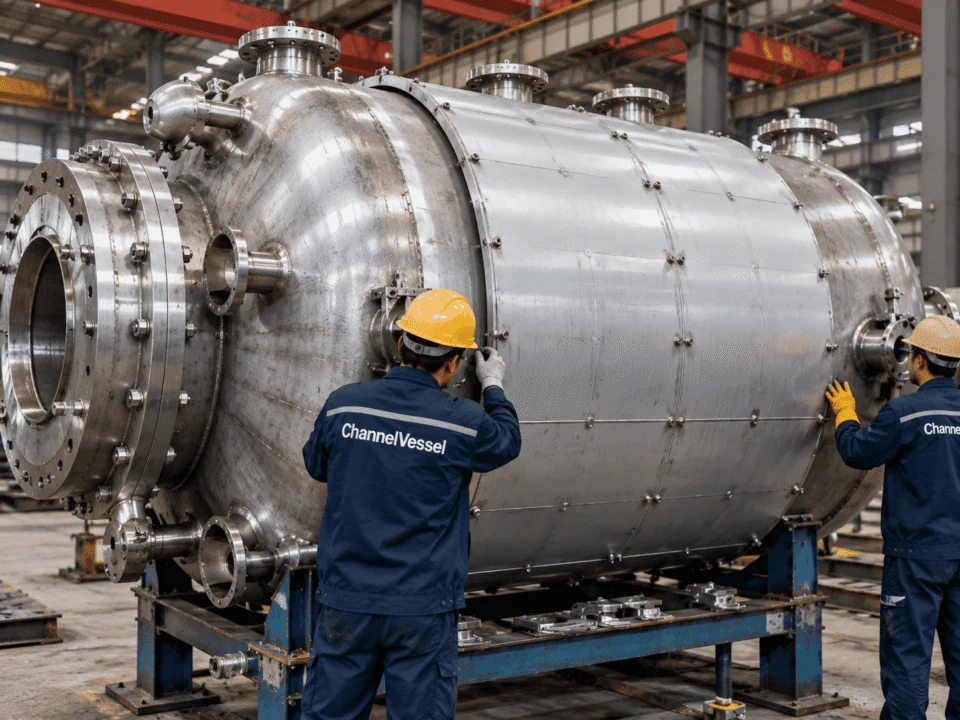
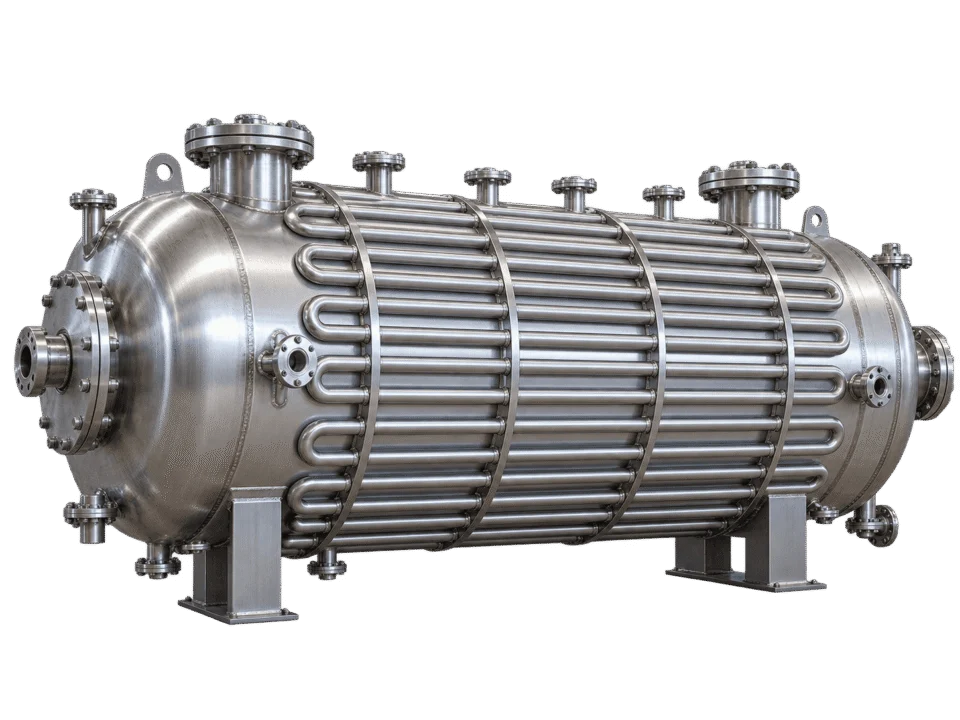
Horizontal stainless steel jacketed pressure vessel for inspection and testing
Verified as One System
Safe / Reliable / Ready for Your Project

Jacket Side

Pressure Boundary B
Jacket Weld Inspection
Closure Areas Check
Utility Connections
Jacket Pressure / Leak Test
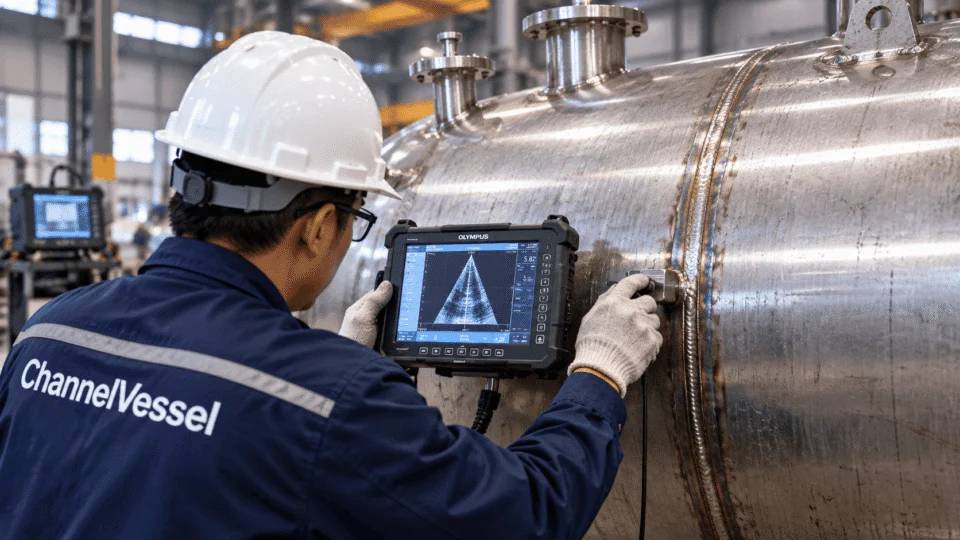
NDT inspection of a stainless steel pressure vessel weld

NDT Inspection

Welds are inspected by qualified personnel using project-specified NDT methods such as RT, UT, PT or MT.

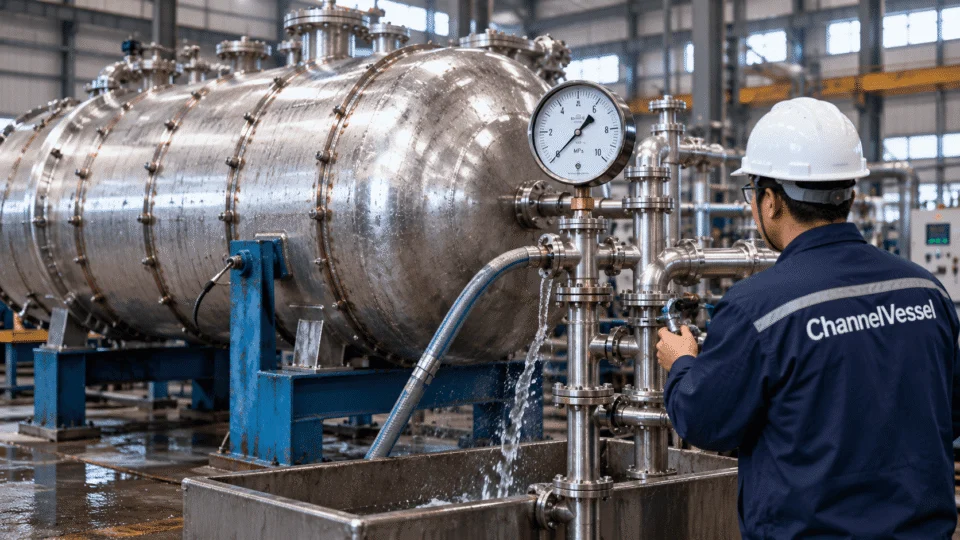
Hydrostatic pressure testing of a stainless steel pressure vessel

Hydrostatic Pressure Testing

Both the process vessel side and jacket side are pressure tested according to the approved procedure and project requirements.

Inspection
Records

Complete inspection and test records are provided as required by the applicable code and project contract.

Material Traceability

Material identification and mill certificates

Dimensional Check

Key dimensions, nozzles and overall alignment

Weld Inspection

Visual inspection and weld quality check

NDT Reports

RT, UT, PT or MT as required

Pressure Test Records

Process side and jacket side test records

Final Documentation

Complete dossier for delivery and installation

Codes & Compliance

Built to the Code and Documentation Requirements of Your Project

Jacketed pressure vessels can be engineered and fabricated according to the applicable design code, material specifications, welding requirements and project documentation requirements defined for each order.

Project
Specification

Your code, standards and project requirements

Design Code

ASME Section VIII Div. 1 or other applicable codes as specified

Materials

Material specifications and full traceability

Welding

Qualified procedures and welders (ASME Section IX as applicable)

Inspection

Controlled by code, approved procedures and project ITP

Documentation

MDR, test reports and final data package per project requirements

Compliant
Vessel Package

Safe / Reliable / Ready for Your Project

Typical Requirements
We Can Review

We will work with your technical specifications and provide a compliant solution for your jacketed pressure vessel.

ASME Section VIII Division 1
(design and fabrication)
Customer ITP
(inspection and test plan)
ASME Section IX
(welding requirements)
NDT scope as defined by code
or project specification
Project-specified
material standards
MDR and inspection dossier
(as required)
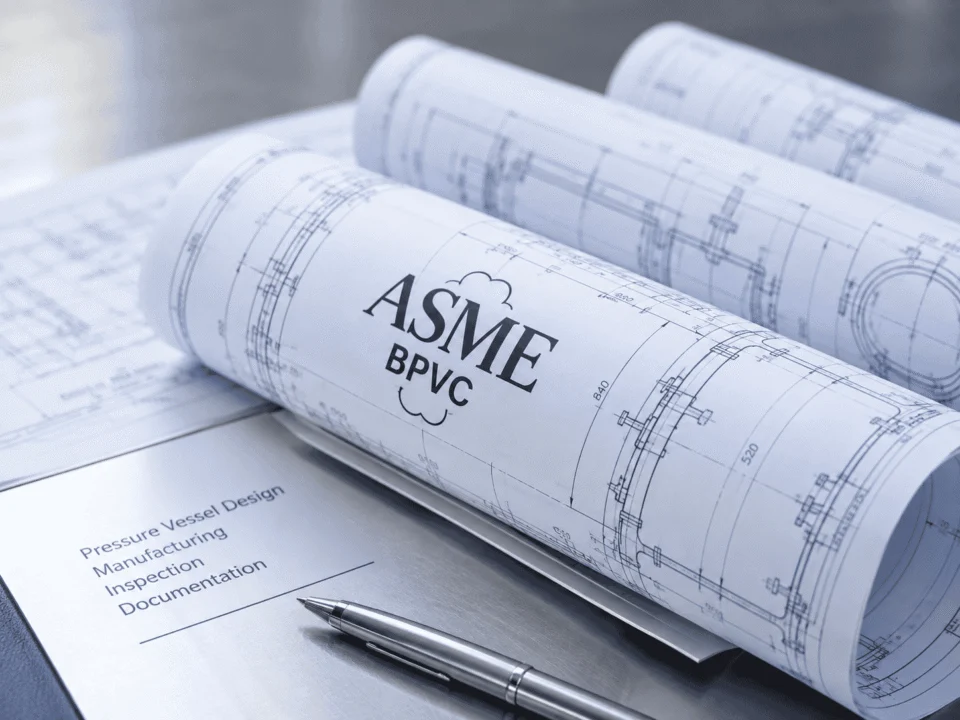
Pressure vessel engineering blueprints and ASME documentation
From Your Requirements to a Reliable Solution

What We Need to Engineer Your
Jacketed Pressure Vessel

Provide the following information as available. You do not need to have every item ready.
Our engineers can help define the missing design inputs and provide a suitable solution for your project.

PROCESS VESSEL DATA

Tell us about your product and process conditions.

Process Medium

Product / fluid name, composition and relevant properties

Working & Design Pressure

Operating pressure, design pressure and vacuum condition (if any)

Operating & Design Temperature

Normal operating range and design temperature

Required Volume / Batch Size

Working volume, total vessel capacity and batch size

Material / Cleanliness Requirement

Material grade, corrosion considerations, hygiene and surface finish

Internals / Agitation

Agitator, baffles, coils, dip pipes or other internals

JACKET / UTILITY DATA

Tell us about your heating or cooling requirements.

Jacket Type

Full jacket / Half-pipe coil / Dimple jacket / Let our engineers recommend

Heating / Cooling Medium

Steam / Hot water / Cooling water / Thermal oil / Glycol / Other

Utility Pressure

Operating pressure and design pressure of the jacket circuit (if known)

Utility Temperature

Supply and return temperature (if known)

Required Heating / Cooling Duty

Heat duty (kW) or starting temperature, target temperature and time

Flow Requirement

Flow rate, velocity or pump conditions (if known)

INSTALLATION & INTERFACE DATA

Help us understand how the vessel will be installed and connected.

Orientation

Vertical / Horizontal

Installation Location

Indoor / Outdoor

Nozzle Requirements

Size, rating and orientation

Support Type

Legs / Skirt / Saddles

Space / Height Restrictions

Available installation envelope

Insulation Requirement

Insulation type and thickness

Surface Finish

Internal and external finish requirements

Electrical / Instrument Requirements

Motors, sensors, control system, etc.

SEND WHAT YOU ALREADY HAVE

Upload your existing documents to help us understand your project faster.

Process Datasheet
P&ID
GA / Vessel Drawing
Existing Equipment Drawing

You do not need to have every item ready. Send the information currently available and our engineers can help identify the missing design inputs.

Your information is kept confidential.
Process Applications

Where Jacketed Pressure Vessels Are Used

Jacketed pressure vessels are used wherever a process requires controlled heating, cooling or temperature maintenance under pressure or vacuum conditions. The vessel, jacket, agitation and utility system are engineered together for the specific process duty.
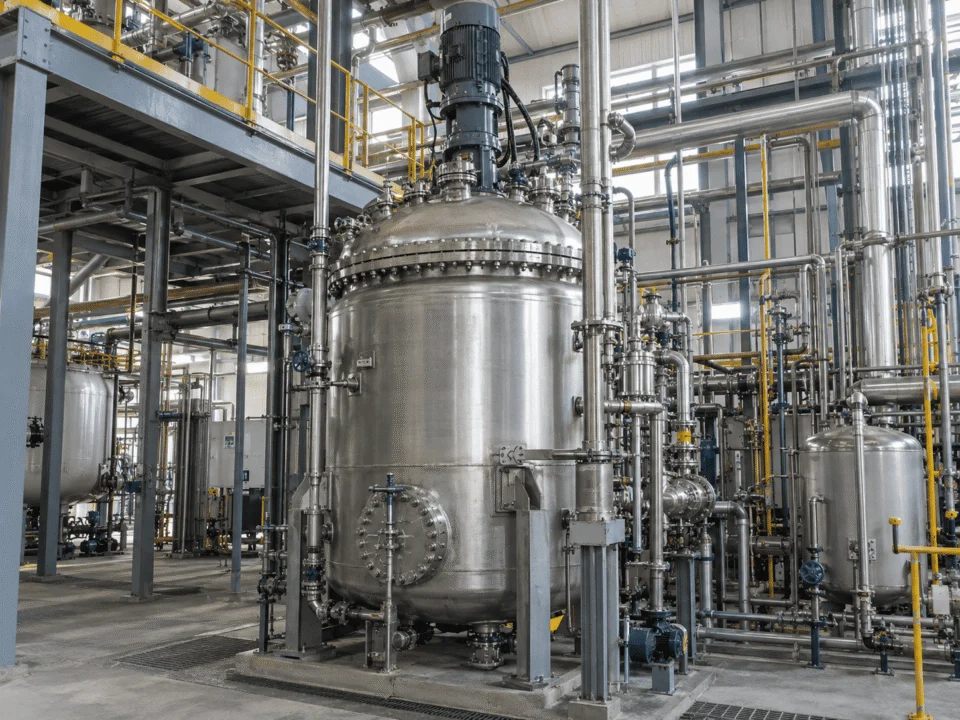
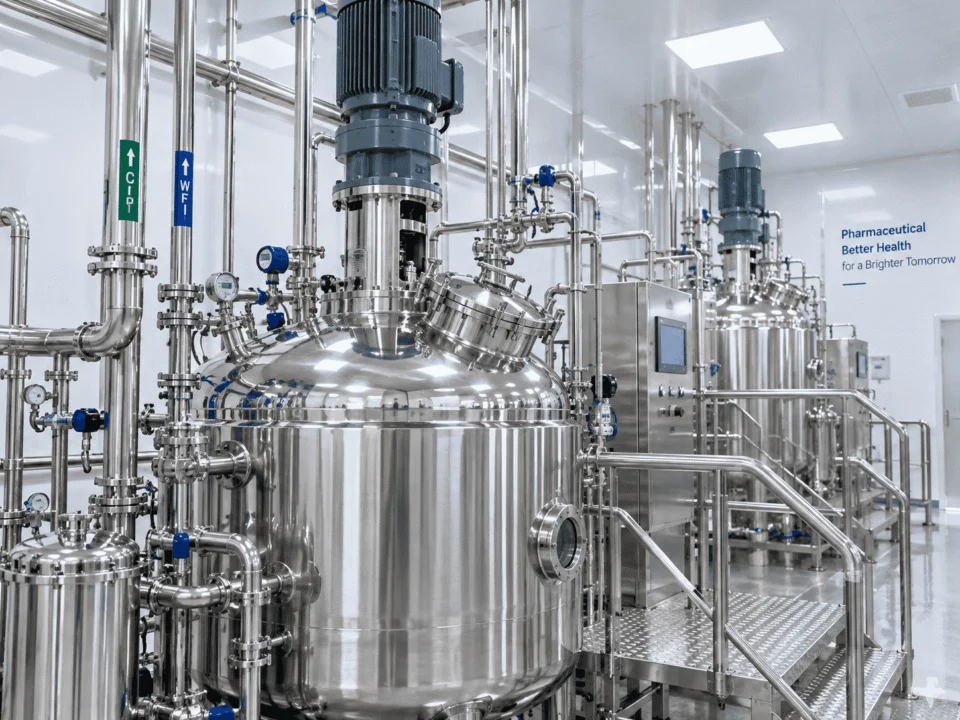
Jacketed pressure vessel used in chemical and petrochemical processing

Chemical & Petrochemical

Reaction, process fluids and more

Jacketed pressure vessel used in pharmaceutical and food processing

Pharmaceutical & Food

High-cleanliness and hygienic processing

Jacketed pressure vessel used for viscous and specialty product processing

Viscous & Specialty Products

Resins, adhesives, coatings and more

01

Chemical Reaction &
Batch Processing

Heating reactants, removing reaction heat and maintaining controlled temperature with agitation and internal components.

Explore Chemical Industry
02

Pharmaceutical &
High-Cleanliness Processing

Temperature-controlled mixing and reaction with high-purity materials, cleanable design and hygienic connections.

Explore Pharmaceutical Industry
03

Food & Beverage
Processing

Used for syrups, sauces, ingredients, oils and dairy-related products with precise temperature control and gentle mixing.

Explore Food & Beverage Industry
04

Petrochemical &
Process Fluids

Heating or cooling process fluids, maintaining viscosity and supporting various hydrocarbon and solvent systems.

Explore Petrochemical Industry
05

Viscous & Specialty
Product Processing

Suitable for resins, adhesives, coatings, polymers and other high-viscosity formulations with efficient heat transfer.

Explore Related Solutions
06

Temperature-Controlled
Holding & Storage

Maintaining product temperature, preventing solidification and supporting buffer or receiving duties before transfer.

Explore Related Solutions
FAQ

Frequently Asked Questions About Jacketed Pressure Vessels

Practical answers to common engineering, purchasing and project-definition questions.

A full jacket is commonly used for general heating and cooling duties, while a half-pipe coil jacket is often preferred when the jacket side requires higher pressure or more demanding industrial service. Dimple jackets are useful where a compact external profile and efficient heat-transfer area are important. Final selection should consider vessel size, process medium, jacket pressure, utility temperature, required thermal duty and fabrication requirements.

Yes. The internal process vessel and the external jacket are separate pressure boundaries, so their working and design pressures can be different. Each side is evaluated according to its own pressure, temperature, material and service conditions. Wall thickness, reinforcement, nozzle details, jacket attachment and testing requirements are then reviewed as part of the complete vessel system rather than assuming both sides operate at the same pressure.

Common jacket utilities include steam, hot water, cooling water, thermal oil, glycol solutions and other project-specified fluids. The correct utility depends on the required temperature range, heating or cooling duty, jacket pressure, material compatibility and the utilities available at your plant. The jacket material, nozzle arrangement and circulation path should also be checked against the selected medium and its operating conditions.

Not necessarily. If the required heat duty is not known, you can provide the batch volume, starting temperature, target temperature, required heating or cooling time, product properties and available utility temperature. These inputs allow our engineers to evaluate the thermal requirement and recommend an appropriate jacket configuration. If some data is still unavailable, send what you currently have and the missing inputs can be identified during engineering review.

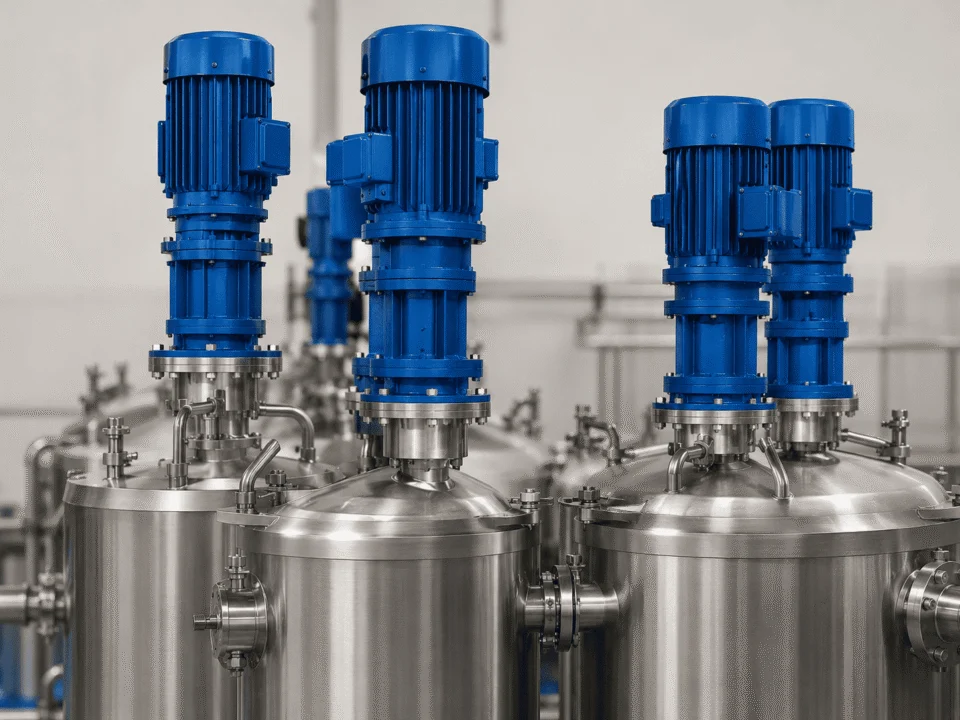
Yes. Agitation can be integrated with the vessel when required, including the agitator, impeller, gearbox or motor, shaft sealing arrangement, baffles and other internals. Selection depends on viscosity, batch volume, mixing objective, vessel geometry and heat-transfer requirements. For higher-viscosity products, agitation becomes especially important because circulation near the vessel wall can strongly influence heating or cooling uniformity and overall process performance.

Yes. The process-contact vessel and jacket can use different materials when the service conditions justify it. For example, the product-contact side may require SS316L for corrosion resistance or cleanliness, while the jacket material can be selected according to the heating or cooling medium. Final material selection should consider both process and utility fluids, corrosion, temperature, cleanliness, applicable code requirements and fabrication compatibility.

Yes. ASME Section VIII Division 1 requirements can be applied when specified for the project, subject to the agreed design basis, scope and certification requirements. Welding qualifications, material documentation, inspection, NDT, pressure testing and final records are controlled according to the applicable code and project specifications. Other project-specific standards or customer requirements can also be reviewed during the engineering stage.

The most useful information includes the process medium, required volume, process-side pressure and temperature, jacket medium, jacket pressure and temperature if known, material requirements, agitation needs and nozzle details. If your information is incomplete, you can send a vessel datasheet, P&ID, GA drawing or existing equipment drawing. Our engineers can review what is available and help identify the remaining project inputs.

Start Your Project

Ready to Engineer Your Jacketed Pressure Vessel?

Send us your process conditions, vessel datasheet, P&ID or existing drawings. Our engineers will review your requirements and help define the vessel, jacket, materials, agitation and testing scope for your project.

Your project does not need to be fully defined before contacting us.

Project-Specific Engineering

Designed around your process conditions

Two Pressure Boundaries Reviewed

Process vessel and jacket evaluated together

Manufacturing & Testing Support

From approved drawings through inspection and delivery
Reliable Quality
Professional Team
Global Delivery
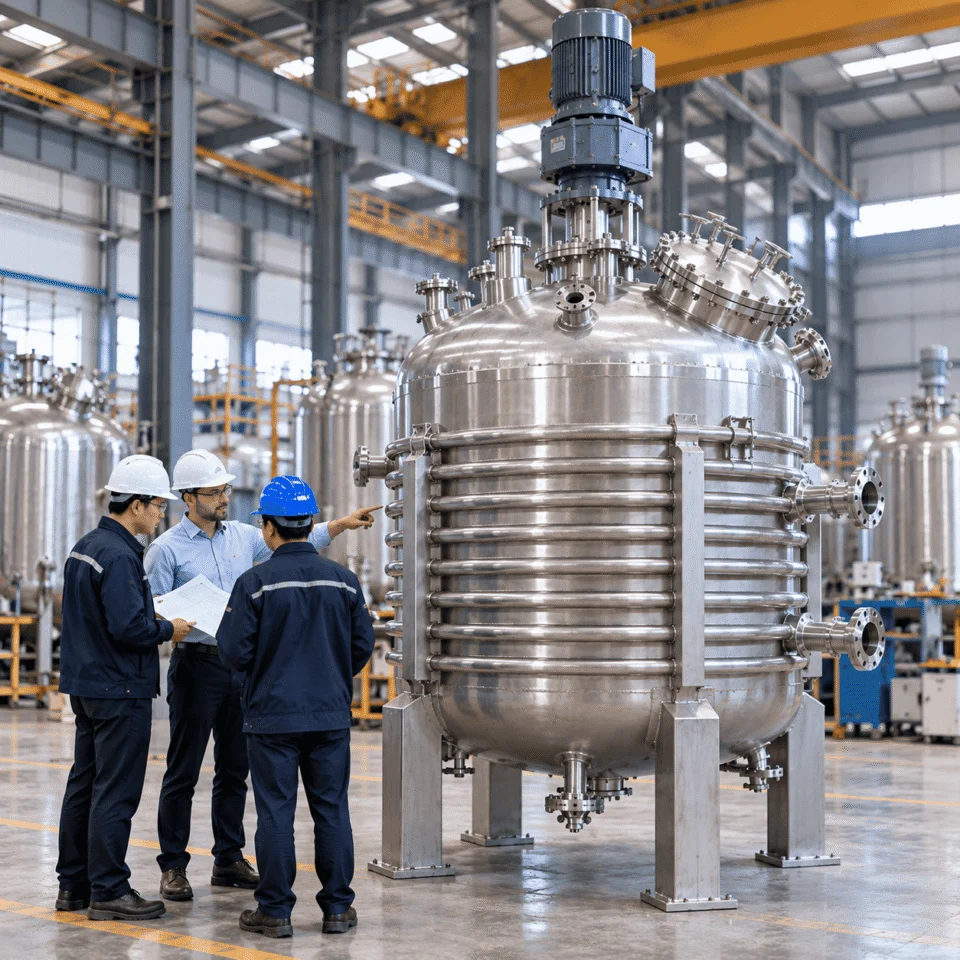
Engineers reviewing a vertical stainless steel half-pipe coil jacketed pressure vessel in the factory

Engineered for Your Process

Pressure • Temperature • Materials • Heat Transfer

Your Process
Our Expertise
Scroll to Top
DRAWING & FILE REVIEW

Send Your Drawings

Upload your drawings, datasheets or existing specifications. Our engineering team will review the files and respond with technical feedback.

Engineering Review

Drawings, specifications and process requirements

Confidential File Handling

Project files are used only for technical review and quotation

Faster Technical Feedback

Clearer inputs help us respond more accurately and efficiently

DRAWING & FILE REVIEW

Send Your Drawings

Upload your drawings, datasheets or specifications. Our engineering team will review your files and provide technical feedback.

Contact Form Demo (#3)
Project Protected NDA available
12h Response
ASME / PED
AFTER SUBMISSION
01 Review
→
02 Confirm
→
03 Quote
TECHNICAL QUOTATION

Get a
Technical Quote

Tell us what you need. Our engineering team will review your requirements and respond within 12 hours.

Engineered for Your Application

From concept to certified manufacturing

Global Compliance

ASME, PED and other international standards

Expert Support

Direct access to our engineering team

TECHNICAL QUOTATION

Get a Technical Quote

Tell us what you need. Our engineering team will review your requirements and respond within 12 hours.

Contact Form Demo
Project Protected NDA available
12h Response
ASME / PED
AFTER SUBMISSION
01 Review
→
02 Confirm
→
03 Quote