Jacketed Reactors Engineered Around Your Heating, Cooling and Mixing Requirements
Custom jacketed reactor vessels for chemical processing, pharmaceuticals, food production, cosmetics, resins and other batch processes requiring controlled heating, cooling, mixing, pressure or vacuum.
Temperature Control Starts With the Process
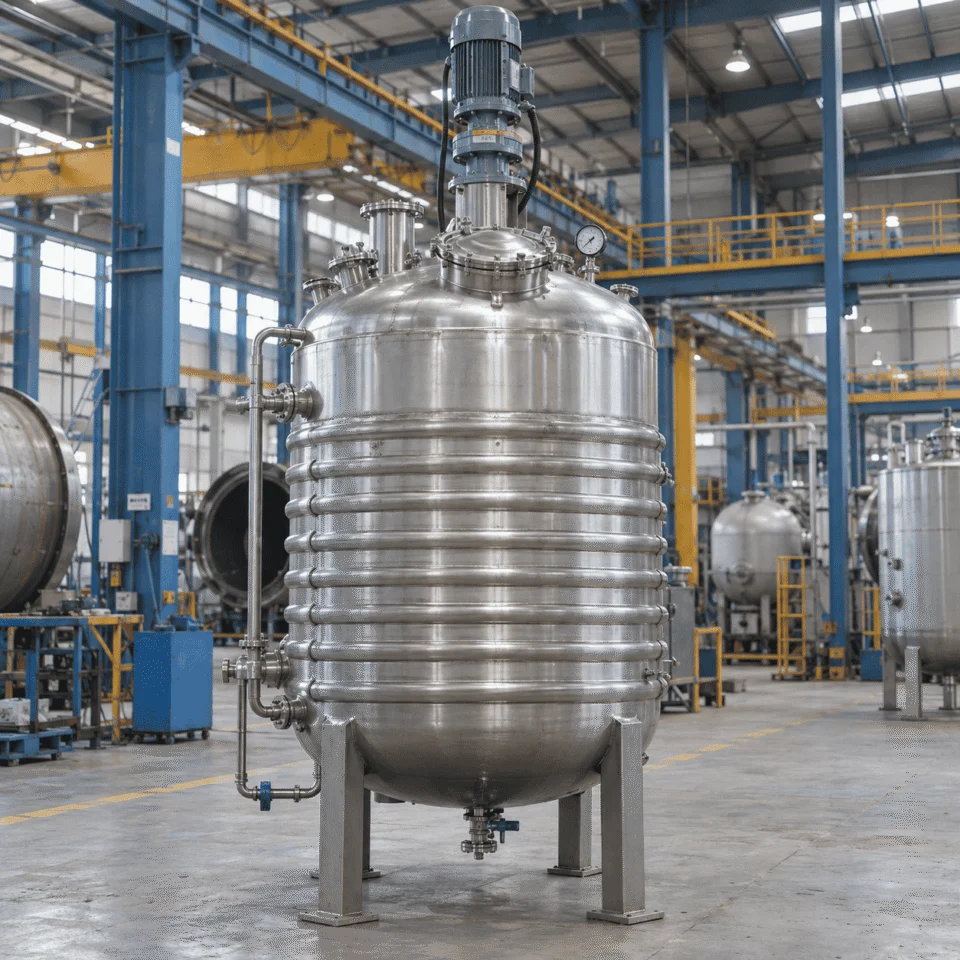
A jacketed reactor is not just a vessel with an outer heating or cooling chamber. Its thermal performance depends on how the utility, jacket, vessel wall, product and agitator work together as one system.
Heating or Cooling Medium
Steam, hot water, thermal oil, cooling water, chilled water or glycol provides the thermal driving force.
Jacket Geometry and Flow Path
Jacket type, channel geometry, circulation rate and pressure drop determine how effectively the utility reaches the vessel wall.
Vessel Wall
Wall material, thickness, fouling and thermal conductivity all affect heat transfer into or out of the batch.
Product + Agitation
The agitator must continuously move product across the heated or cooled wall. High viscosity can limit temperature uniformity even when jacket area is large.
Heating and Cooling Duty Comes Before Jacket Selection
Selecting a jacket only by reactor volume can lead to poor temperature-control performance. The first question should be how much heat must be added or removed, and how quickly.
Defines the total sensible heat required to move the batch from its starting temperature to the target temperature.
Converts the total batch energy requirement into the heating or cooling duty required to meet the target batch time.
Connects the required duty to heat-transfer area, temperature driving force and overall heat-transfer performance.
“1,000 L reactor with a steam jacket” is not enough information for reliable thermal design. Batch conditions, target heating or cooling time and utility data should be defined before the jacket is finalized.
Choose the Jacket Around the Process Conditions
There is no single jacket design that is ideal for every reactor. Utility pressure, circulation rate, required heat-transfer area, vessel size and process duty all influence the final configuration.
Full Jacket
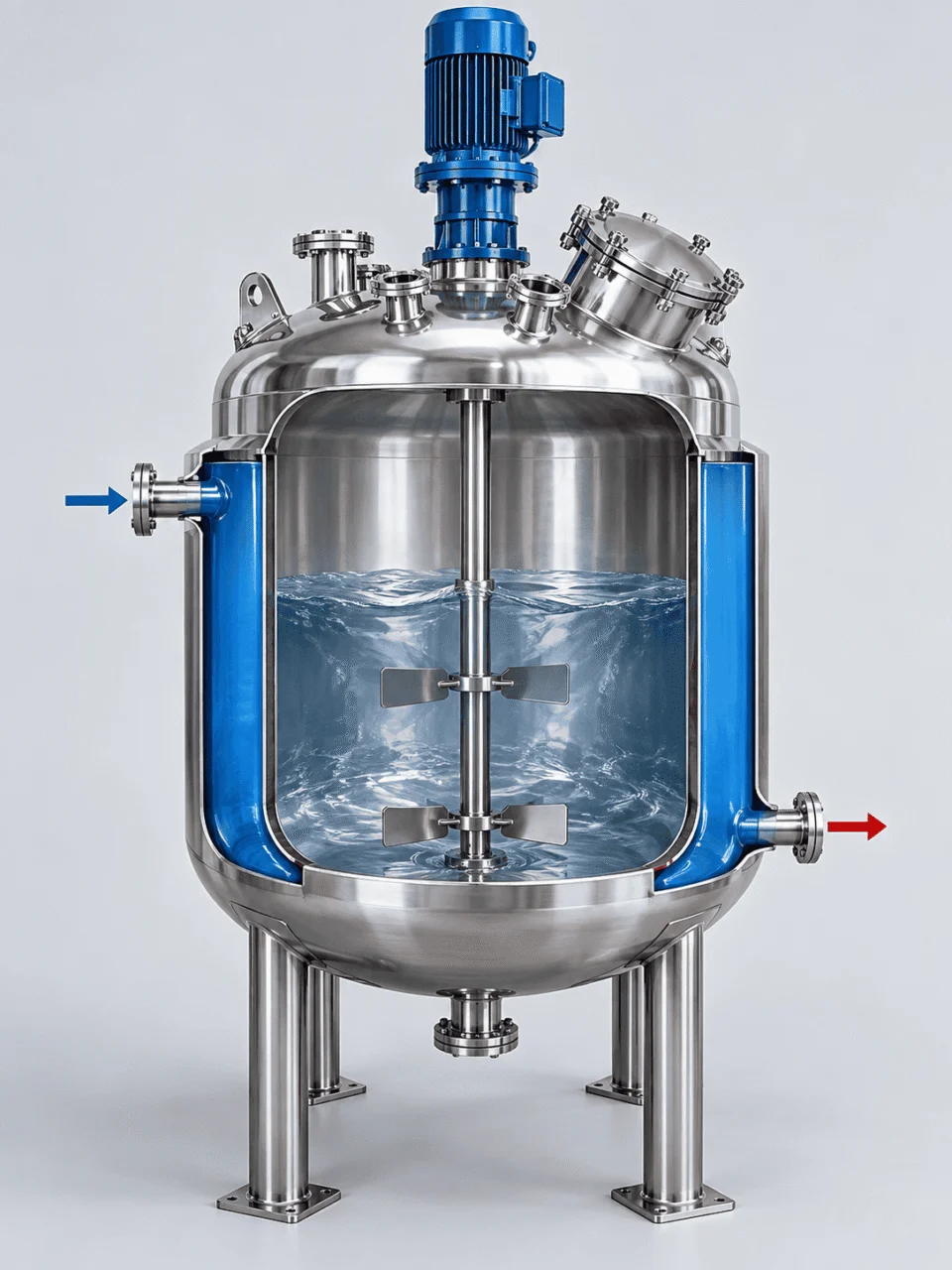
An outer shell creates a larger jacket chamber around the reactor body. It can suit many general-purpose heating and cooling duties using steam, water or thermal fluid.

Lower Jacket Volume
The outer jacket is welded to the vessel at multiple points, creating a compact flow space that can provide good heat-transfer area with relatively low jacket volume.

Controlled Flow Path
Formed channels are welded around the reactor shell to create a defined thermal-fluid path. This arrangement can support higher jacket-side pressure and stronger circulation velocity.
Additional Heat-Transfer Area
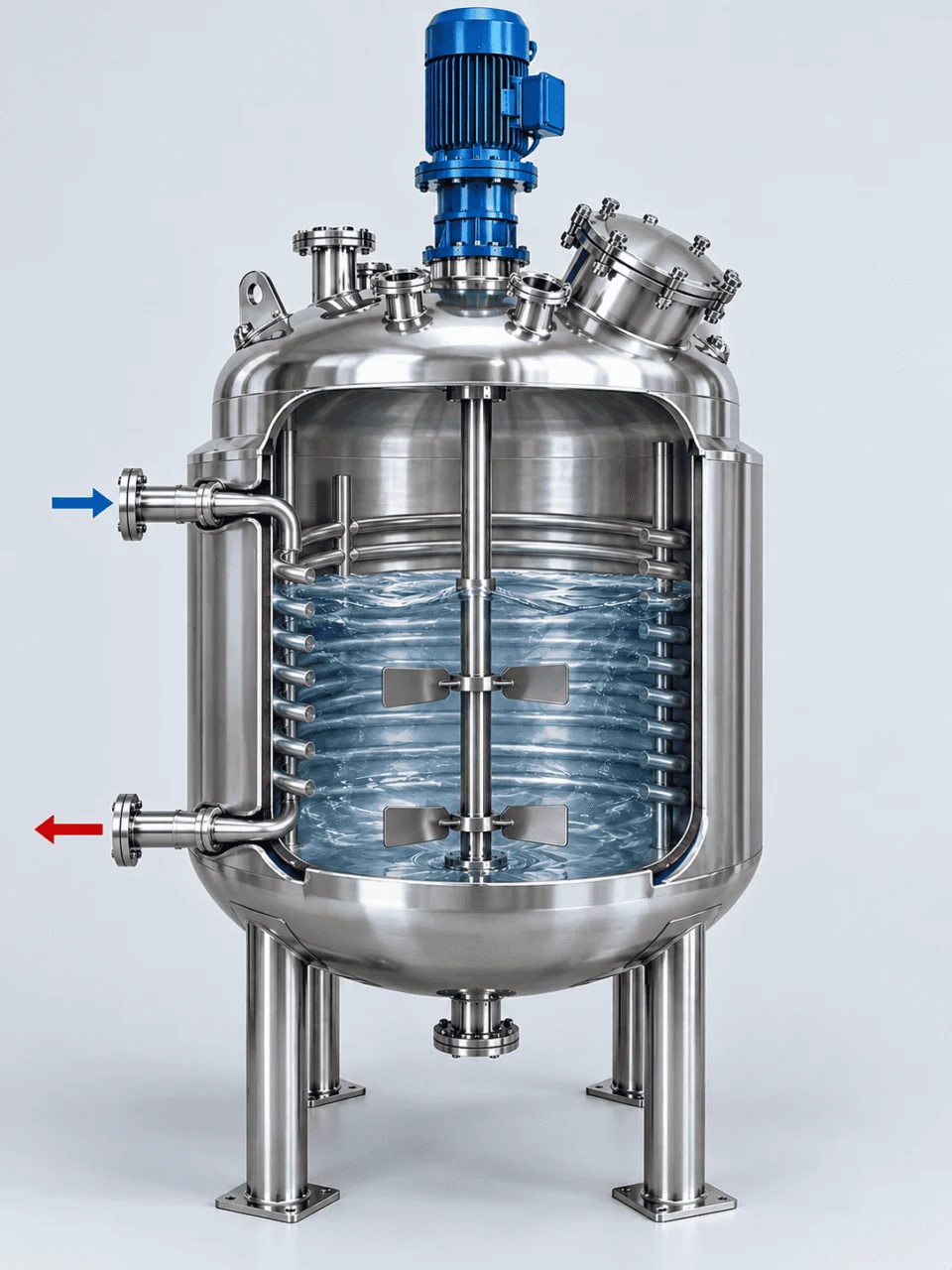
Internal coils, bottom-head jackets or combined thermal surfaces can be considered when an external shell jacket alone does not provide enough heat-transfer capacity.
The Jacket and Agitator Must Work Together
A large heat-transfer surface does not guarantee fast or uniform temperature control. Heat transferred through the vessel wall still needs to be distributed through the batch by effective mixing.

Jacket performance depends on the product-side boundary layer.
Steam, thermal oil, cooling water or glycol can deliver strong utility-side performance, but heat still has to cross the vessel wall and move into the process fluid.
Mixing continually replaces fluid near the heat-transfer surface.
Effective circulation reduces stagnant zones and helps move heated or cooled product away from the wall, replacing it with material from the bulk of the batch.
Viscosity and impeller selection directly affect thermal response.
As viscosity rises, product-side circulation becomes more difficult. In these services, jacket area and agitator design should be reviewed together rather than as separate equipment decisions.
Propeller / Turbine
Useful where stronger bulk circulation and higher fluid movement are required.
Paddle
Can suit a wide range of moderate-viscosity blending and temperature-control duties.
Anchor / Frame
Close-clearance designs can improve circulation near the vessel wall for viscous products.
Multiple Impellers
Multiple impeller levels may be used to maintain circulation throughout the full batch height.
Agitator type, speed, motor power, shaft, seal, impeller geometry and jacket performance should be evaluated as one reactor system.
Single-Zone or Multi-Zone Jacket Design
Larger reactors do not always perform best with one jacket inlet and one outlet. Dividing the heat-transfer surface into separate circuits can improve utility distribution, reduce excessive flow-path length and provide more control over changing batch conditions.
Multi-zone construction should solve a process problem, not just add complexity.
Long utility paths can create pressure-drop and flow-distribution issues.
Different zones can remain active or inactive depending on actual batch level.
Separate circuits can help maintain stronger circulation through the required heat-transfer area.
Bottom heating or cooling may need to be controlled independently from the cylindrical shell.
The vessel is relatively compact, the utility circuit is short, batch level is consistent and one flow path can meet the required heat-transfer duty without excessive pressure drop.
Jacketed Reactor Technical Configurations
Final specifications are developed around the process rather than selected from a fixed catalog. Capacity, jacket type, agitation, pressure conditions, controls and auxiliary equipment can all be configured together.
The table describes configurable manufacturing options. Final capacity, material, pressure, temperature, jacket design, agitation and control scope are confirmed from the actual process conditions.
Materials and Construction Details Matter
Reactor material should be selected from the actual process medium, concentration, operating temperature, pressure, cleaning chemistry and contamination limits—not from vessel type alone.
Choose the material from the service conditions.
SS304
Suitable for many general processing duties where corrosion conditions are relatively mild.
SS316L
Commonly selected for more demanding chemical, hygienic, pharmaceutical and food-contact service.
Carbon Steel
Can be suitable for non-corrosive industrial processes where stainless construction is unnecessary.
SS321 & Other Materials
Available where temperature, corrosion or process conditions require a different material basis.
Product chemistry, concentration, operating temperature and cleaning media should all be reviewed before the material is finalized.
Small mechanical details can strongly affect operation, cleaning and maintenance.
Access points are positioned around filling, inspection, maintenance and cleaning requirements.
Connection size and orientation should follow the P&ID, process sequence and maintenance access.
Seal selection depends on pressure, temperature, shaft speed, leakage risk and product containment needs.
Outlet geometry can be adjusted for free-flowing liquids, viscous products or low-residual-volume discharge.
Insulation can reduce heat loss, improve temperature stability and protect personnel from hot surfaces.
Cleanability requirements should be defined before fabrication so geometry and fittings can be coordinated properly.
Why Jacketed Reactor Temperature Control Can Underperform
Slow heating or cooling does not automatically mean the jacket is too small. Reactor performance can be limited by utility conditions, mixing, viscosity, fouling, flow-path design or the available temperature difference.

Verify steam or thermal-fluid condition, circulation rate, actual jacket flow path, agitator performance and the product-side heat-transfer resistance.
Compare the actual cooling-medium inlet temperature and flow with the design basis, then review heat-transfer area and any exothermic load remaining in the batch.
Review circulation pattern, impeller diameter, impeller level, shaft speed and temperature-probe position instead of assuming one local reading represents the entire reactor.
Review channel geometry, circuit length and whether a multi-zone jacket would provide a shorter, more controllable utility path.
As product temperature approaches utility temperature, the driving force decreases. Target temperature, target time and utility temperature must therefore be reviewed together.
A larger jacket is not automatically the correct fix.
Before changing vessel size or adding heat-transfer area, check the complete thermal system: utility supply, jacket circulation, vessel wall, agitator performance, product viscosity and actual process duty.
Designed From Your Process Data
A useful reactor inquiry should describe the process, not only the vessel capacity. The more clearly the operating conditions are defined, the more accurately the jacket, agitator, pressure boundary and control system can be configured.
Start with the process conditions you already know.
Capacity, process medium, operating temperature, operating pressure, heating or cooling medium, approximate viscosity and preferred material.
One set of process inputs drives multiple reactor decisions.
If your process specification is incomplete, we can review the available information and identify which additional inputs are still needed before the reactor configuration is finalized.
From Process Requirement to Fabricated Reactor
A jacketed reactor should move through a defined engineering sequence before fabrication begins. Thermal duty, pressure boundary, agitation, nozzles and auxiliary systems need to be coordinated before the design is released to manufacturing.
Define the operating conditions
Capacity, product properties, pressure, vacuum, temperature, heating and cooling targets, utilities and mixing requirements are reviewed first.
Establish heating and cooling duty
Required heat-transfer rate, utility conditions, jacket area, flow path and possible zoning are developed from the batch thermal requirement.
Develop the pressure boundary
Vessel geometry, wall thickness, heads, nozzles, supports, jacket pressure, agitation loads and thermal effects are coordinated.
Add the equipment around the vessel
Agitator, seal, condenser, receiver, vacuum system, instruments, control panel and plant interfaces are integrated with the reactor.
Freeze the design before fabrication
Drawings, material scope, inspection requirements, testing and documentation are confirmed before the manufacturing package is released.
The goal is not to manufacture a tank with a mixer and a jacket.
The goal is to deliver a reactor where the pressure boundary, heat-transfer system, agitation system and process connections function together under the actual operating conditions.
Fabrication, Inspection and Testing
A jacketed reactor contains multiple welded assemblies, pressure boundaries and rotating components. Fabrication quality therefore needs to be controlled from material preparation through final testing and documentation.
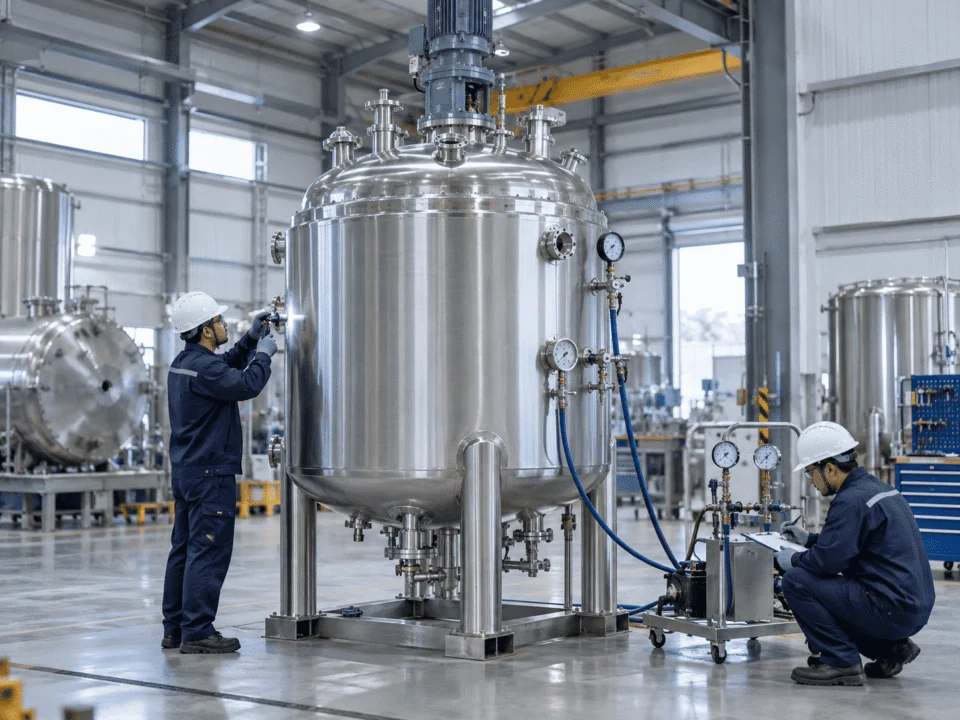
Material grade, thickness, cutting, forming and component preparation are checked against the approved manufacturing scope.
Shell seams, heads, jacket welds, nozzles, supports and agitator interfaces are assembled according to the approved fabrication drawings.
Visual examination and additional NDE can be applied where required by the design specification, inspection plan or project documentation.
The vessel and jacket can be pressure or leak tested according to the agreed design basis, test procedure and project requirements.
Agitator rotation, drive condition, installed instruments, valves and agreed auxiliary functions can be checked before shipment.
Final dimensions, equipment condition, agreed documentation and shipment scope are reviewed before the reactor is released.
Inspection scope is easier to control when it is agreed before manufacturing starts.
Jacketed Reactors Across Different Process Industries
The industry only tells part of the story. Product chemistry, viscosity, reaction heat, cleanliness, pressure and batch sequence determine how the reactor should actually be configured.

Synthesis, neutralization and polymerization
Reaction heat, corrosion, pressure or vacuum and changing viscosity can all affect the same batch.
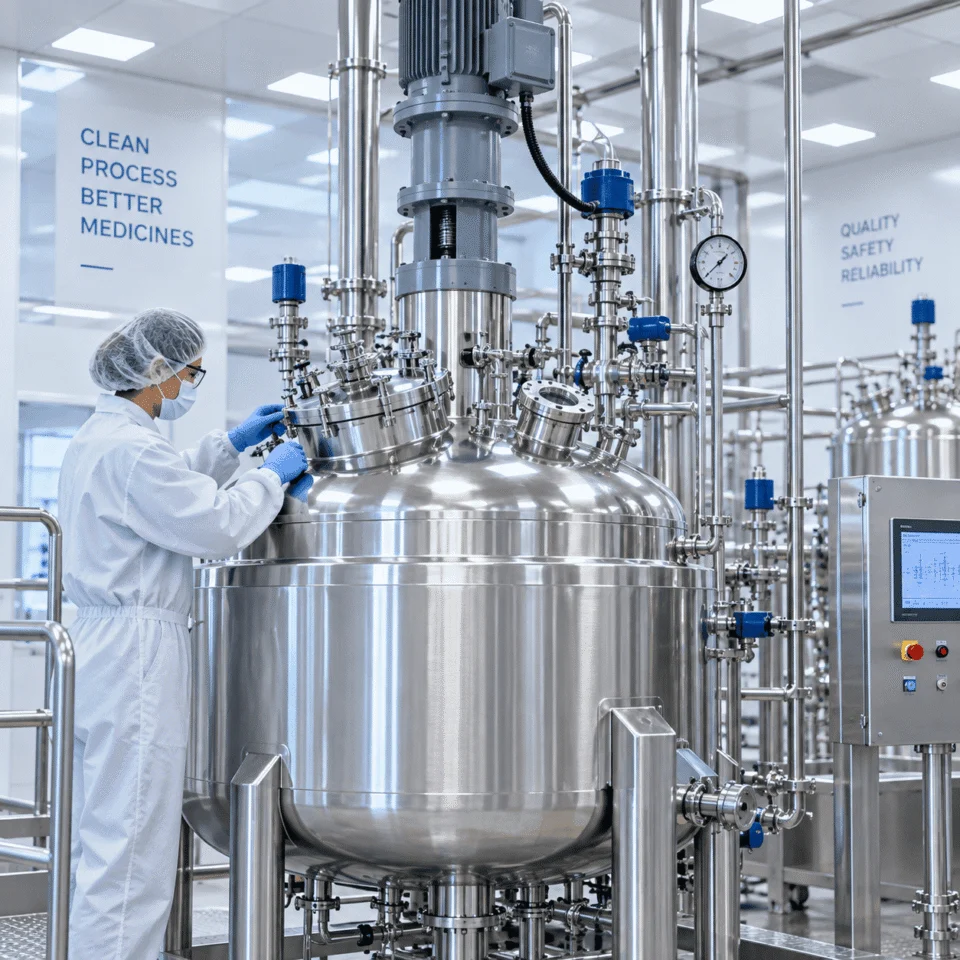
Controlled hygienic batch processing
Thermal performance must work together with cleanability, contamination control and repeatable process conditions.
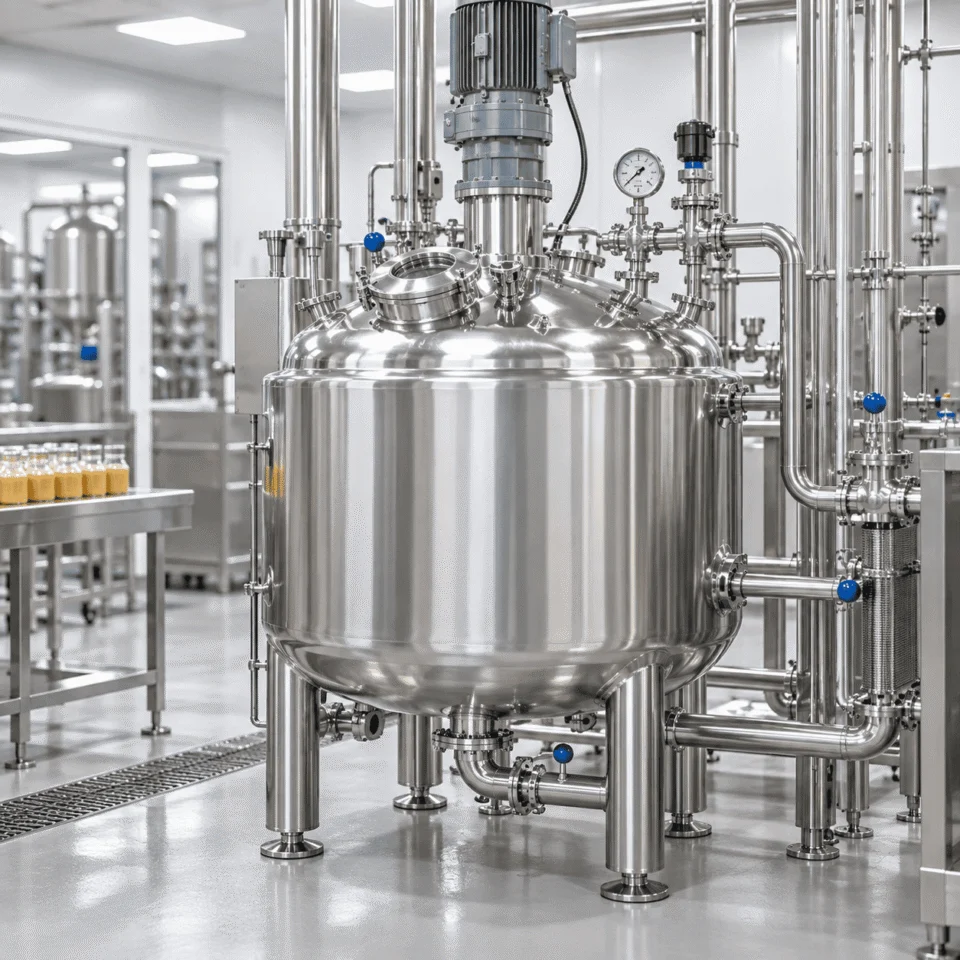
Heating, cooling and blending
Product quality can depend on gentle mixing, uniform temperature, hygienic geometry and complete drainage.
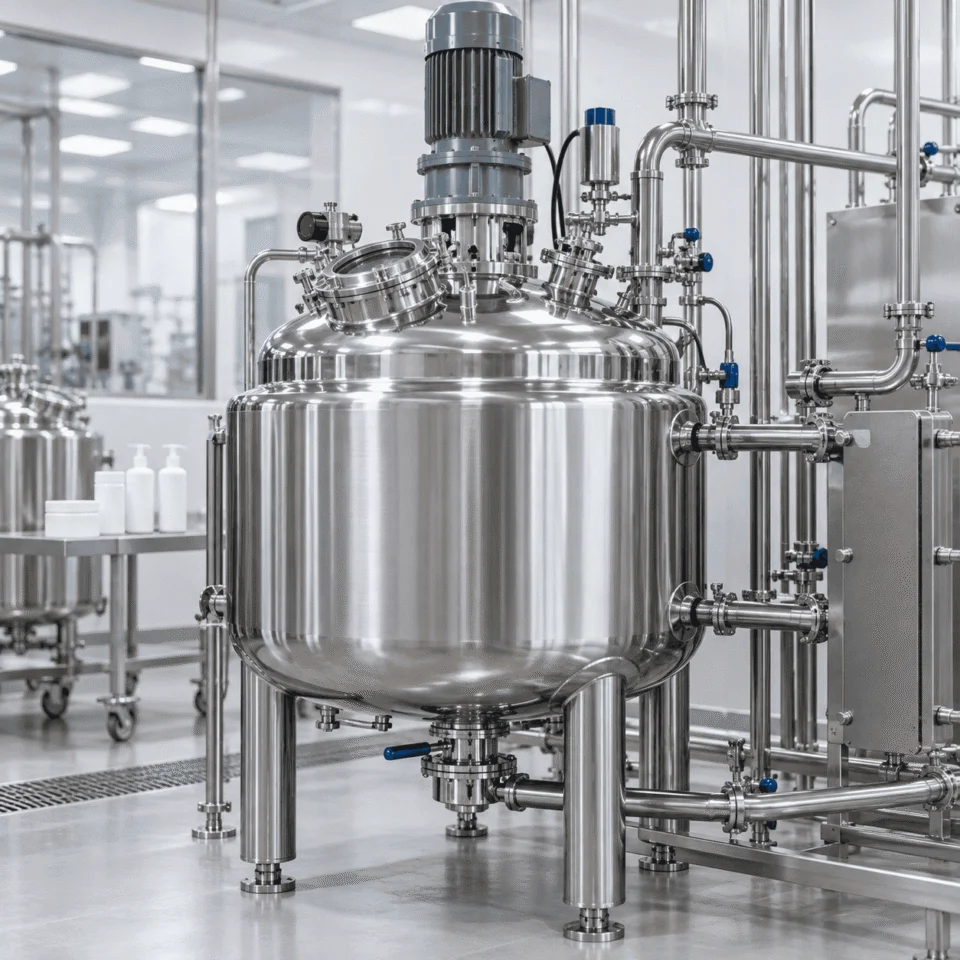
Creams, gels, lotions and shampoos
Viscosity can rise significantly during cooling, making wall-side circulation and discharge increasingly important.

High-viscosity reaction service
Higher viscosity increases torque demand and can make heat removal, mixing uniformity and final discharge more difficult.
Controlled biological processing
Stable temperature, sanitary construction, instrumentation and automated cleaning can all be required together.
Frequently Asked Questions About Jacketed Reactors
These questions cover the issues that most often affect jacket selection, heating and cooling performance, pressure or vacuum operation, materials and controls.
Which jacket type is best for a reactor?
There is no universally best jacket. The appropriate configuration depends on vessel size, required heating or cooling duty, utility pressure, utility flow, allowable pressure drop, temperature range and fabrication requirements. A conventional jacket may suit one process, while another may benefit from a dimple or half-pipe configuration.
Can a jacketed reactor operate under vacuum?
Yes. A reactor can be engineered for vacuum operation when required by the process. Vacuum design affects the shell, heads, nozzles, supports and other structural details, so the vacuum condition should be defined during the design stage.
Can the same jacket be used for heating and cooling?
In many systems, the same jacket circuit can be used with different thermal media at different stages of the batch. The operating sequence, media compatibility, pressure, temperature, drainage and control strategy still need to be reviewed. Some processes may benefit from separate circuits or zones.
Can steam and chilled water be used in the same reactor?
Yes, depending on the system design. The transition between heating and cooling media should consider pressure, drainage, thermal shock and control requirements.
How do you determine the required jacket area?
Required heat-transfer area depends on thermal duty, available temperature difference and the overall heat-transfer coefficient. Actual design also considers viscosity, mixing, fouling, jacket geometry, utility flow and vessel-wall construction. Capacity alone is not enough to determine jacket area.
Does a larger jacket always provide faster heating?
No. Increasing heat-transfer area can help, but performance may still be limited by utility flow, utility temperature, product viscosity, agitation, fouling or heat transfer through the vessel wall. The complete thermal system should be reviewed.
Can you build a reactor for high-viscosity material?
Yes. High-viscosity applications require particular attention to agitator geometry, motor torque, shaft design, wall clearance, heat transfer and discharge. Anchor, frame or other low-speed, high-torque mixing arrangements may be considered according to the product.
What materials are available?
Common options include SS304, SS316L and carbon steel. SS321 and other materials can also be considered where process conditions require them. Final material selection should be based on the actual chemical medium, concentration, temperature and corrosion conditions.
Can you manufacture from our existing drawing?
Yes. ChannelVessel can review customer drawings, datasheets and process requirements and manufacture customized reactor equipment accordingly. Where necessary, the design can also be revised to suit process, fabrication or project conditions.
Can you provide PLC controls?
Yes. Depending on the project, the reactor can be supplied with manual controls, PID temperature control, PLC + HMI control or provisions for integration with the customer's plant control system. Instrumentation and automation scope can be customized.
How is a jacketed reactor tested before shipment?
Testing depends on the equipment design and project specification. Typical inspection can include dimensional checks, pressure or leak testing, agitator trial operation, functional checks and documentation review. Additional inspection requirements can be agreed before fabrication.
Build the Reactor Around the Process — Not the Other Way Around
Send ChannelVessel your process data, equipment specification or existing drawing. We can review the required capacity, heating and cooling duty, jacket configuration, agitation system, pressure conditions, materials and auxiliary equipment before the final reactor configuration is developed.