
Stripping Towers for Air & Steam Service
ChannelVessel supplies custom stripping towers for transferring target compounds from liquid streams into a gas or vapor phase. Discuss air stripping, steam stripping, packed or trayed construction, and the equipment scope required for your process.
Start with the feed composition, required outlet concentration and available utilities. We coordinate the tower configuration and fabrication scope around the agreed project basis—not a one-size-fits-all removal claim.
Share your process conditions, equipment datasheet or existing tower drawing.

What Are You Trying to Remove?
Specify the separation task before selecting the tower. A groundwater VOC duty, an ammonia-bearing wastewater and a solvent-recovery stream should not share a generic performance specification.
Volatile Organic Compounds
Provide the individual compounds, inlet concentrations and required outlet limits.
Ammonia Removal or Recovery
Define the ammonia reporting basis, pH, temperature and complete water analysis.
Solvent Removal
State solvent composition, water content and whether recovery is part of the objective.
Dissolved-Gas Removal
Identify the gas, dissolved concentration and downstream handling requirements.
Sour-Water Treatment
Provide ammonia, hydrogen sulfide, hydrocarbons, solids and pretreatment information.
Stripping is not a substitute for every treatment step. Free oil, solids and scale-forming constituents may require pretreatment, while nonvolatile dissolved contaminants need separate evaluation rather than an assumed stripping guarantee.
Air Stripping or Steam Stripping?
Air stripping uses an air stream to carry volatile compounds away from the liquid. Steam stripping uses steam or generated process vapor and normally requires a closer review of heat supply, overhead handling and liquid composition.

Air Stripping
Steam Stripping
Neither route is universally better. Compare both against the same feed envelope, outlet targets and supply boundary. Atmospheric, vacuum and pressurized operation describe pressure conditions and should be specified separately from the choice of stripping medium.
Can Your Target Compound Be Effectively Stripped?
“VOC” is a category, not a complete design input. Identify each target compound and evaluate its equilibrium behavior at the intended temperature and liquid composition before selecting the tower.
Reference Henry Constants at 25°C
Historical screening values from the U.S. EPA Air Stripper Design Manual. Use validated property data for the actual process conditions.
This shows why two compounds in the same broad “VOC” category can require very different gas rates, transfer area and operating conditions. It does not mean one tower needs exactly 220 times more air or packing.
Use the correct property basis
Henry constants appear in several conventions and units. Do not compare reciprocal or dimensionless forms directly with Hpc values. Concentrated solvents, reactive systems and ammonia also require a suitable thermodynamic or chemical-speciation basis.
How Stripping Works—and Where the Removed Compounds Go
In a countercurrent tower, liquid descends through the contacting section while gas or vapor rises. Internals provide contact between the phases. Treated liquid leaves the bottom, while transferred compounds leave with the overhead stream.

Overhead treatment is selected by vapor composition, concentration and recovery objective. The routes shown are alternatives, not a universal configuration.
Air-Stripping Route
Steam-Stripping Route
Transferred does not mean destroyed. A stripping tower changes where the target compound is carried. The project must also define how the overhead stream, condensate and treated liquid are handled.
Specify Outlet Concentration, Not Just Removal Efficiency
A headline removal percentage does not tell a buyer whether the treated liquid meets the required concentration. State both inlet and outlet values, with units and a defined sampling basis.
Illustrative Performance Target
A “99% removal” claim would still leave 10 mg/L in this example and therefore miss the specified 5 mg/L outlet target.
When inlet and outlet liquid flows differ, use a component mass balance. Dilution alone can lower concentration without removing the same proportion of contaminant mass.
The example demonstrates how to define an acceptance target. Actual stripping performance depends on the feed, physical properties, operating conditions, internals and system design.
What Determines Tower Diameter and Height?
Liquid throughput alone does not determine tower dimensions. The required flow area and contacting height are set by the separation task, gas and liquid loads, hydraulic limits and the selected internals.

Diameter: Provide Enough Flow Area
Tower diameter is selected through hydraulic evaluation of gas and liquid loading, pressure drop and flooding limits. A higher stripping-gas demand can increase the required diameter even when liquid throughput stays the same.
Packing Height: Provide Enough Transfer Duty
For a packed-column calculation using a consistent transfer-unit basis, active packing height depends on the height of a transfer unit and the number of transfer units required by the separation.
Overall Height Is More Than Active Packing
Allow additional space for liquid distributors, collectors, inlet zones, disengagement, liquid inventory, manways and maintenance access. A quotation for 6 m of active packing is not automatically a 6 m overall vessel.
Do not size the tower from flow alone. The final geometry should be checked against the complete process and mechanical design basis, including the selected internals and operating envelope.
Balance Gas/Liquid Ratio, Pressure Drop and Flooding
Increasing stripping gas can improve mass-transfer driving force, but it also raises vapor velocity, pressure drop and utility demand. The operating point must stay inside the hydraulic range of the selected internals.
More Gas Is Not a Free Performance Gain
Higher gas flow changes the gas-to-liquid operating ratio.
The driving force can improve, but the benefit depends on equilibrium and internals.
Gas velocity and resistance through the contacting section increase.
Approaching flooding reduces stable countercurrent operation and available capacity margin.
Check minimum, normal and maximum gas and liquid loads. High-load capacity, pressure drop and low-load wetting all matter when selecting the internals and tower diameter.
Gas/Liquid Ratio Example
For an illustrative volumetric gas-to-liquid ratio of 50:1 and a liquid flow of 20 m³/h:
State whether the gas flow is actual or normalized, together with reference temperature, pressure and wet/dry basis.
Why Pressure Drop Affects Blower Power
Using an illustrative actual gas flow of 1,000 m³/h and blower efficiency of 65%:
These are simplified shaft-power calculations, not motor selections. Total system resistance also includes connected equipment and ducting.
Flooding is a hydraulic limit, not an operating target. Keep adequate capacity margin and verify the selected packing or trays against the actual gas and liquid properties.
Packed or Trayed? There Is No Universal Winner
Internal selection should follow the process duty, fouling tendency, pressure-drop allowance, turndown requirement and maintenance strategy—not a generic preference for one tower type.
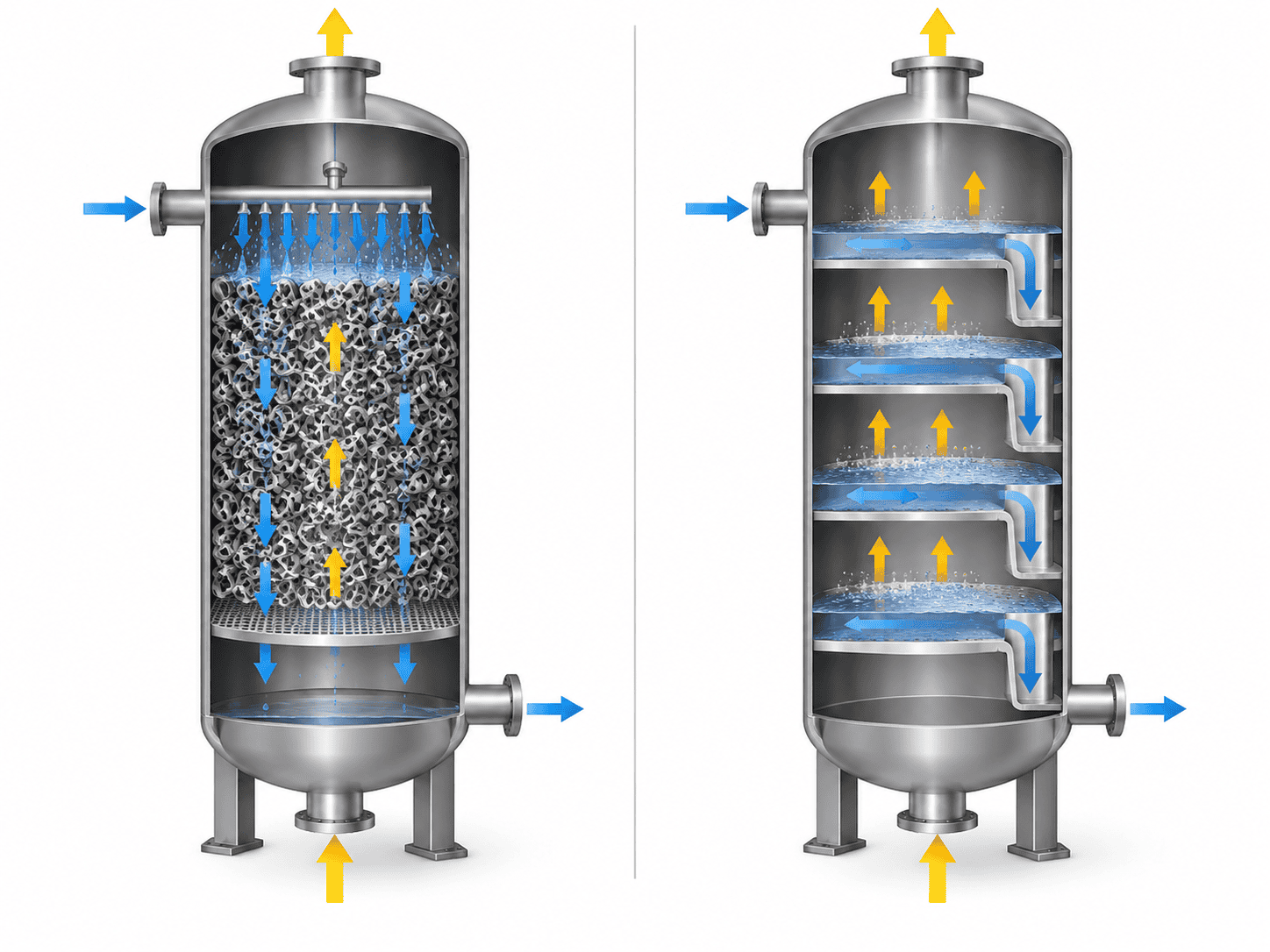
Packed Stripping Tower
Trayed Stripping Tower
Internals are part of the process design basis. Distributors, support grids, collecting devices, trays and access provisions should be defined together with the feed conditions and expected maintenance strategy.
Ammonia, VOC and Solvent Duties Need Different Design Bases
A single “stripping efficiency” does not describe every service. Chemistry, equilibrium behavior, temperature, reporting basis and downstream handling can all change what the tower must do.
Define pH, Temperature and Reporting Basis
Ammonia stripping depends on the balance between dissolved ammonium and free ammonia. Specify whether the laboratory value is reported as nitrogen, NH₃ or another basis, together with pH and seasonal temperature.
Specify Individual Compounds and Limits
A combined “total VOC” number can hide the component that actually controls tower design. Provide each regulated or process-critical compound, inlet concentration and required outlet concentration.
Define What Happens After Stripping
For solvent recovery, specify acceptable water content and downstream use. For sour water, identify ammonia, hydrogen sulfide, hydrocarbons and the intended overhead-treatment route.
Ammonia removal is not the same as total-nitrogen removal. Other nitrogen species require separate evaluation and may need additional treatment steps.
Plan for Fouling Before Performance Starts to Fall
Suspended solids, free oil, mineral deposits and biological growth can affect pressure drop, liquid distribution and stripping performance. Include fouling tendency in the original design discussion—not only after problems appear.

A higher outlet concentration or rising pressure drop can have several causes. Compare actual operating data with a clean baseline before changing internals or increasing utility demand.
Record flow, temperature, pressure drop, utility conditions and outlet concentration after commissioning or cleaning so later changes can be interpreted against known conditions.
Maintenance access belongs in the purchase specification. Define how distributors, packing supports, trays and other internals will be inspected or removed before fabrication is released.
Stripping Tower Configurations and Fabrication Scope
ChannelVessel can coordinate the tower shell, internals, access, supports and documentation around an approved equipment datasheet. Dimensional ranges describe a reference fabrication envelope—not a fixed stripping-tower model.
Reference Configuration and Fabrication Data
Final limits depend on material, pressure, temperature, internals, transport and the agreed design basis. Upper limits are not assumed to apply simultaneously.
Define the Manufacturing Basis Before Release
Requested design-code compliance, certification, marking and third-party inspection should be identified explicitly in the quotation and purchase specification.
Compare Utility Demand, Not Only Tower Price
A stripping tower is only one part of the operating-cost picture. Compare quotations on the same basis for feed temperature, production schedule, utility conditions, overhead handling and heat-recovery scope.

Air-Stripping Utility Scope
Review the complete connected system rather than only the tower shell.
Blower power depends on actual gas flow and the total system pressure rise, including packing, connected equipment and ducting.
Steam-Stripping Heat Duty
Feed heating, steam or reboiler duty, cooling and overhead condensation can dominate operating cost.
Assumes 20 m³/h water heated from 40°C to 100°C, density 1,000 kg/m³ and heat capacity 4.18 kJ/(kg·K).
The example excludes vaporization, heat losses and other process duties, and it does not deduct recovered heat.
Heat recovery should be evaluated on the actual temperature program. A feed–bottoms exchanger can reduce external heating demand when the process temperatures, allowable approach and fouling conditions make recovery practical.