Industrial Condensers for Steam & Solvent Recovery
ChannelVessel supplies custom shell-and-tube condensers for steam condensation, solvent recovery, distillation overheads and vacuum processes. Specify your vapor conditions, available cooling utilities and required outlet performance so the condenser can be engineered around the duty—not selected by surface area alone.
Share a process datasheet, existing drawing or application summary. Unknown technical fields can be marked “To be confirmed.”
Explore Heat Exchangers
Match the Condenser to Your Process Duty
The application name is only the starting point. The required liquid output, remaining vapor and available utilities define the actual condenser duty.
Steam Condensation
Utility & Process SteamDefine
Steam flow, pressure, inlet condition and required condensate outlet temperature.
Design Focus
Condensing duty, any desuperheating or subcooling, cooling-water demand and allowable pressure drop.
Solvent Recovery
Recovery DutyDefine
Target components, inlet composition, vapor load and the required recovery or outlet condition.
Design Focus
Component recovery, co-condensation, coolant temperature and the vapor load remaining after condensation.
Distillation Overheads
Column ServiceDefine
Total or partial condensation, reflux requirement, overhead composition and product conditions.
Design Focus
Condensation profile, pressure drop, reflux and product split, and the receiver interface.
Vacuum Processes
Low-Pressure ServiceDefine
Absolute pressure, vapor composition, non-condensable load and downstream vacuum conditions.
Design Focus
Low-pressure operation, pressure-drop budget, gas removal and reliable condensate drainage.
These duties can overlap. A condenser serving a distillation column may also recover solvent and operate under vacuum. For batch processes, provide peak vapor generation and composition changes rather than a daily average alone.
Total Condensation or Partial Condensation?
Decide what should leave the condenser before deciding how large it should be. The required outlet phases, temperatures and compositions belong in the design basis.

Target the Intended Condensable Stream
The intended condensable process stream is converted to liquid at the specified outlet condition. In distillation service, the collected liquid may then be divided between reflux and product downstream.
Non-condensable gases still require an appropriate removal route. “Total condensation” does not mean every real process has zero gas discharge.
Define Both Liquid and Vapor Outputs
Only part of the vapor is condensed, leaving both liquid and vapor outlets. For mixtures, the two phases can have different compositions.
Define the required phase split and product conditions rather than specifying only an outlet temperature.
Include All Required Thermal Zones
A duty may include cooling superheated vapor, condensing it, and then subcooling the liquid. Mixtures can also condense over a temperature range.
What Data Determines Condenser Size?
A useful condenser specification separates process inputs, engineered results and mechanical requirements. It also keeps shell-side and tube-side conditions distinct instead of reducing the enquiry to “custom size” or “custom material.”
What You Provide
Process InputsVapor composition
Components, mass or mole fractions, moisture, contaminants and non-condensable gases.
Vapor flow
Minimum, normal and maximum flow in kg/h, including peak conditions for batch operation.
Operating conditions
Inlet temperature, absolute operating pressure and all operating cases that must be satisfied.
Outlet requirement
Total or partial condensation, liquid temperature, recovery target and remaining vapor condition.
Cooling utility
Cooling-water, chilled-water or other utility composition, available flow, inlet temperature and pressure.
Hydraulic limits
Allowable process-side and coolant-side pressure drops with clear equipment boundaries.
Maintenance basis
Fouling risks, preferred cleaning method, inspection access and available bundle-removal space.
What We Engineer
Design OutputsThermal duty
Required heat removal for desuperheating, condensation and any specified liquid subcooling.
Heat-transfer surface
Required area based on the selected fluids, temperature driving force, fouling basis and design method.
Tube-side arrangement
Tube diameter, wall thickness, length, tube count, material and number of passes.
Shell-side arrangement
Shell diameter, flow distribution, baffle arrangement, venting and condensate-drainage provisions.
Pressure drop
Calculated losses on both sides checked against the allowable hydraulic limits.
Mechanical construction
Orientation, construction type, nozzle sizes, material combination and project-specific design conditions.
Project deliverables
Drawings, design data, material requirements and the agreed inspection and documentation scope.
Custom Condenser Options
The equipment is configured around the agreed process duty. Available options are reviewed as a system rather than treated as independent menu selections.
Specification structure can be aligned with applicable exchanger data-sheet requirements. See TEMA standards.
What Does 1,000 kg/h of Steam Require?
A simple energy balance helps explain why vapor load and cooling-water conditions matter before surface area is discussed. The example below is for illustration only, not a ChannelVessel product rating.
Assume 1,000 kg/h of dry saturated steam condenses at approximately 100°C and 1.013 bar(a) and leaves as saturated liquid at the same temperature. Using latent heat of approximately 2,257 kJ/kg:
Q = (1,000 × 2,257) ÷ 3,600
Approximately 627 kW of condensing duty before adding any desuperheating, liquid subcooling, non-condensable load or heat loss.
Cooling-Water Circulation
Using water heat capacity of 4.19 kJ/(kg·K) and approximate density of 1,000 kg/m³:
Steam-property reference: Spirax Sarco.
Vacuum Service, Non-Condensables and Drainage
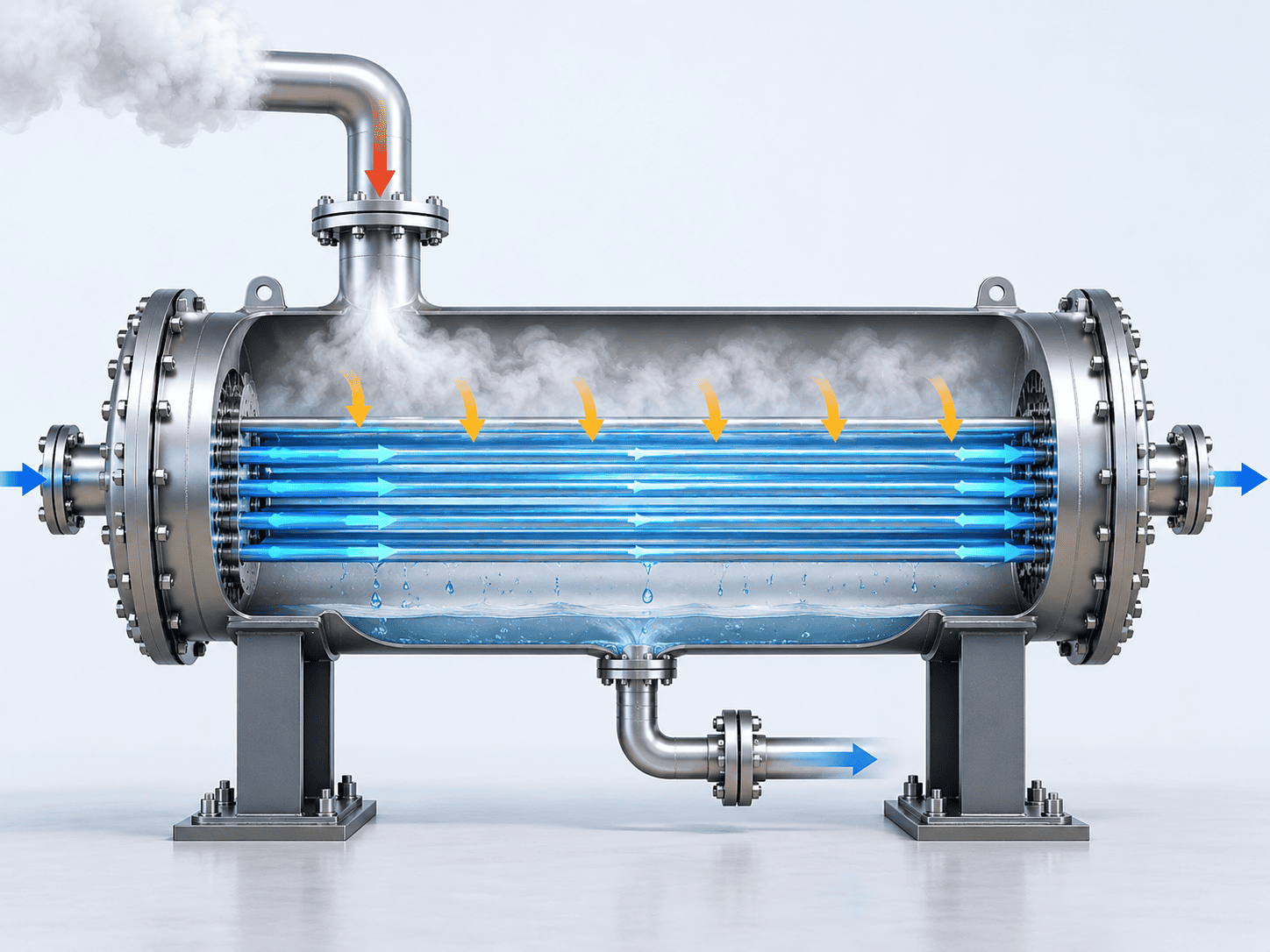
A vacuum condenser operates as part of a system. Condensation, remaining gas removal and liquid discharge need to be reviewed together rather than treated as three unrelated connections.

Use Absolute Pressure
Specify the actual operating pressure at the relevant inlet and outlet locations. For mixtures, total pressure alone does not define the condensation condition.
Protect the Pressure-Drop Budget
Include condenser losses and connecting-line losses in the vacuum-system review. A pressure loss that appears small in pressurized service can materially affect low-pressure operation.
Define the Remaining Gas Load
State the expected non-condensable flow and any residual process vapor at the condenser outlet instead of assuming downstream vacuum equipment handles only air.
Design the Liquid Route Separately
Confirm receiver pressure, elevation, level control and the liquid-discharge arrangement so condensate does not accumulate where it interferes with vapor flow or system stability.
A conceptual arrangement may include the condenser, receiver, vacuum equipment, off-gas treatment, piping and controls. The actual supply boundary should be stated explicitly in the quotation.
Choose a Condenser Configuration You Can Maintain
The best construction is not simply the one with the lowest first cost. Start with where deposits are likely to form, how the unit will be cleaned and whether the plant has enough space to remove the parts that are meant to be removable.
Start With Maintenance, Not Just Geometry
Condenser configuration should be evaluated together with fouling tendency, cleaning method, differential expansion and the available maintenance envelope.
Fixed Tubesheet
Simple ConstructionStraight-tube internal access can be provided, but the tube bundle is normally not removable. Shell-side mechanical access is therefore limited and differential expansion must be checked.
Is the shell side clean enough, or is there a practical cleaning method that does not require bundle removal?
U-Tube
Expansion FriendlyA removable bundle can improve shell-side access and accommodate differential expansion. Straight-through mechanical rodding cannot pass around the U-bend.
Is the chosen tube-side cleaning and inspection method suitable for the return bends and the expected deposits?
Floating Head
Maximum AccessA removable straight-tube bundle can support access on both sides and accommodate differential expansion, depending on the detailed head arrangement.
Do the cleaning and inspection benefits justify the additional joints, space requirement and mechanical complexity?
Materials Must Work on Both Sides
The process vapor is only one part of the materials decision. Cooling-water chemistry, local temperatures, cleaning chemicals and shutdown conditions can be just as important as the process-side fluid.

Process-Side Review
Vapor / CondensateProvide vapor and condensate composition, concentration changes, impurities, operating temperature range and known deposit risks. Identify the cleaning chemicals the plant expects to use.
Cooling-Side Review
Utility WaterProvide the cooling-water source, chloride level, treatment chemicals, suspended solids and relevant temperature range. A stainless grade selected for the process side is not automatically suitable for the cooling-water side.
Specify Materials by Component
Different parts of the condenser can face different fluids, temperatures and fabrication constraints.
Compare Condenser Quotations on the Same Design Basis
A lower price or a smaller heat-transfer area means little if the suppliers used different vapor loads, cooling-water temperatures, fouling assumptions or outlet targets.
A Smaller Condenser Is Not Automatically a Better Design
A smaller quoted area may come from a more favorable cooling-water temperature, a higher assumed heat-transfer coefficient, a lower fouling allowance, a larger permitted pressure drop or omitted non-condensable load.
A larger area is not automatically better either. Compare the complete duty, pressure drop, materials, maintainability and supply scope before deciding which proposal is technically stronger.
Custom Heat ExchangersDefine Performance, Inspection and Acceptance Before Ordering
Turn the approved design basis into a clear acceptance plan. Thermal performance, mechanical verification and certification are related, but they are not the same deliverable and should not be treated as interchangeable proof.
Thermal Performance Basis
Process AcceptanceAgree which operating case will be used to judge the condenser and how any off-design test condition will be corrected or interpreted.
Mechanical Inspection & Documentation
Fabrication EvidenceSpecify the material records, welding documentation, dimensional checks, applicable non-destructive examinations, pressure or leakage testing and release documents required for the project.
Codes, Marking and Certification
Project RequirementsState the applicable code, edition, any TEMA requirements, third-party involvement, marking and documentation scope in the purchase specification. A reference to a standard is not itself proof of certification.
Certification reference: ASME Boiler and Pressure Vessel Certification.

Check the Operating Data Before Replacing the Condenser
Poor performance can come from changed process conditions, warmer utilities, fouling, instrumentation problems or a genuine equipment limitation. Compare current readings with the original design basis before concluding that more area is required.
Higher Vapor Outlet Temperature
Actual vapor load, operating pressure, coolant inlet temperature, coolant flow and outlet conditions.
Changed duty, warmer utilities, insufficient coolant flow, fouling or reduced heat-transfer performance.
Higher Cooling-Side Pressure Drop
Cooling flow, inlet/outlet pressures, recent cleaning history and any utility-system changes.
Fouling, blockage, higher-than-design flow, valve position or instrument accuracy.
Larger Cooling-Water Temperature Rise
Measured cooling-water flow, inlet and outlet temperatures, and the actual vapor load.
Reduced utility flow, increased heat load or a change in operating duty relative to the original design case.
Higher Process-Side Pressure Drop
Vapor flow, composition, pressure readings, cooling condition and any known deposit history.
Incomplete condensation, changed loading, fouling, flow maldistribution or an altered downstream system condition.
Send More Than the Old Drawing
A dimensional match does not automatically provide a thermal match. If the process or utility conditions have changed, the existing envelope should be checked against the current duty.