Stainless Steel Reactors Engineered Around Your Process
Custom reactor vessels engineered for chemical reactions, mixing, heating, cooling, pressure and vacuum processing. We design around your medium, viscosity, temperature, pressure and heat-transfer duty—not just tank capacity.
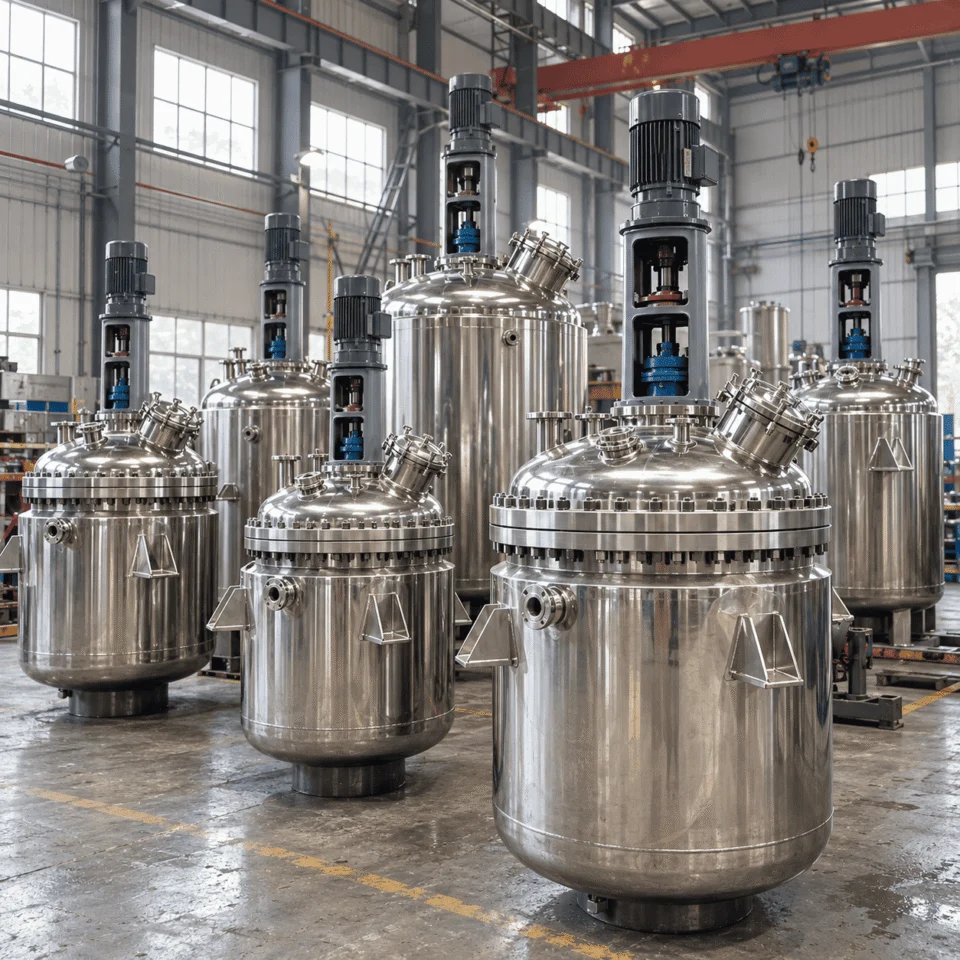
Choose the Reactor Structure Around the Process Duty
The vessel shell, heat-transfer surface, pressure boundary and agitation system should work as one engineered package. Different reaction duties need different reactor structures.

The Agitator Is Selected for the Process — Not From a Standard List
Reactor volume alone cannot determine the impeller. Viscosity, solids loading, heat-transfer duty, gas dispersion, circulation pattern and the required process result all change the agitation system.
The same 2,000 L vessel can require a completely different agitator depending on whether the process is low-viscosity blending, solids suspension, high-viscosity circulation or heat-transfer control.
High-speed dispersion and high-shear systems are engineered separately. Typical drive configurations may range from approximately 1.1–11 kW and above depending on vessel size and process duty.
Anchor + high-shear mixer, turbine + propeller or other combinations can be engineered when one impeller cannot achieve the required process result.

Shaft length, torque, gearbox weight, dynamic loads, nozzle reinforcement and support design are reviewed together.
Heating & Cooling Around the Reaction
Reactor temperature control is not simply a matter of adding a jacket. The thermal system should be engineered around heat-up time, reaction heat, cooling duty, utility conditions, product viscosity and available heat-transfer area.
Heat transfer + agitation + process conditions
A versatile solution for many batch processes using steam, hot water, thermal oil, chilled water or glycol.
A compact jacket structure that can provide useful heat-transfer area while keeping the vessel exterior relatively clean.
Creates a defined utility flow path around the shell and can be applied where higher utility-side pressure or demanding thermal duty is involved.
Adds heat-transfer area inside the vessel when the available external jacket area alone cannot satisfy the process requirement.

The vessel chamber and the heating/cooling circuit may operate at completely different temperatures and pressures.
How quickly must the batch reach the target temperature?
Exothermic reactions may require rapid heat removal, not just temperature holding.
Larger vessel volume does not automatically provide enough transfer surface.
Steam pressure, oil temperature, coolant temperature and flow rate all affect duty.
High-viscosity products can reduce wall-side heat transfer if circulation is weak.
Good circulation helps reduce local temperature gradients and improves wall-side transfer.
Select Stainless Steel From the Process Chemistry
Stainless steel grade should be selected from the actual process medium, temperature, chloride level, cleaning chemistry, contamination sensitivity and fabrication requirements—not simply from a standard material list.

Material selection is reviewed together with welding, pressure boundary, surface finishing and process compatibility.
A widely used stainless steel grade for many industrial processes with moderate corrosion requirements.
Selected where the process environment is more demanding and improved resistance is required.
Frequently selected where corrosion resistance, welding performance and high-quality internal surfaces are important.
Duplex stainless steel, titanium, Hastelloy and other alloys can be evaluated when standard stainless steels are not suitable.
Pickling, passivation and project-specific weld treatment.
Improved internal cleanability for hygienic processing duties.
For demanding hygienic or high-purity applications.
Available where enhanced surface quality is specified.
Pressure, Vacuum & Mechanical Loads Must Be Reviewed Together
A reactor can experience internal pressure, full vacuum, jacket pressure, agitator torque, piping loads and thermal expansion during the same operating cycle. The vessel must be engineered as one mechanical system.
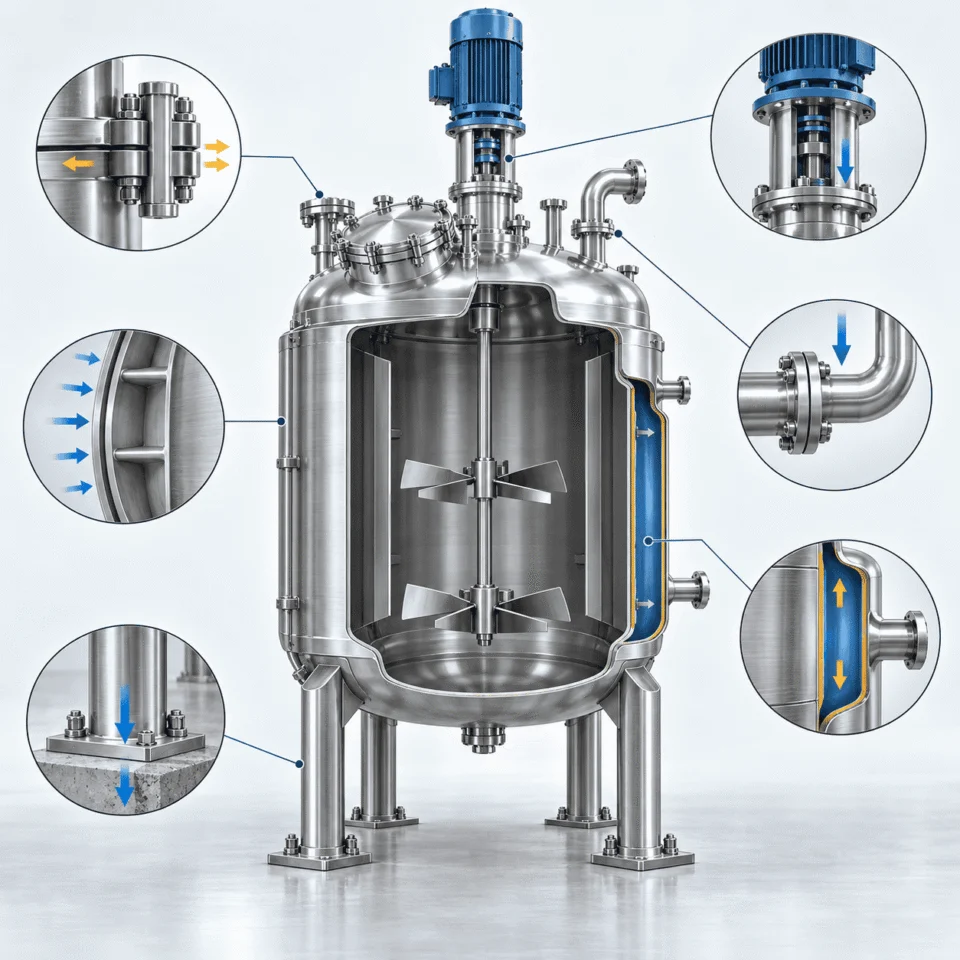
Pressure affects shell and head thickness, flanges, nozzles, reinforcement, agitator sealing, bolting and support design. Typical stainless steel reactor projects can be engineered up to approximately 1.0 MPa, with higher-pressure configurations reviewed separately.
Full vacuum down to approximately -0.1 MPa gauge requires review of shell geometry, unsupported length, wall thickness, roundness, stiffening and repeated vacuum cycles.
The process chamber and heating or cooling jacket can operate at different pressure and temperature combinations. Each boundary is checked independently.
Charging, reaction, distillation, transfer, cooling and cleaning can expose the vessel to very different mechanical conditions. The full operating sequence should be defined before fabrication.
The agitator drive introduces static and dynamic loads into the vessel roof and support structure.
Large connected piping can introduce loads that must be considered at the nozzle-to-shell connection.
Support type depends on vessel geometry, operating weight, agitator loads and installation conditions.
Heating and cooling cycles can create differential movement that should be considered before layout is finalized.
Build the Reactor Around the Process Connections
A reactor is rarely an isolated vessel. Agitation, feeding, instrumentation, cleaning, sampling, discharge and utility connections should be coordinated before fabrication so the final layout works as one process system.
Drive position is coordinated with vessel geometry, torque, maintenance access and process requirements.
Selected according to pressure, vacuum, leakage control and media compatibility.
Size and position are arranged for cleaning, internal inspection and maintenance.
Multiple feed nozzles can be integrated around the process sequence and piping layout.
Cleaning connections can be arranged for hygienic or repeatable internal cleaning duties.

Sensor position is selected to represent actual process temperature rather than simply vessel-wall temperature.
Pressure connections can be integrated according to operating and safety requirements.
Inspection windows can be added where product behavior and operating conditions allow.
Sampling arrangement is selected according to cleanliness, pressure and operator access.
Flush-bottom and low-hold-up configurations can be evaluated where complete discharge is important.
Utility connections are arranged around the selected jacket or coil flow path.
Applied for thermal retention, cooling stability or personnel protection.
Variable-speed control can be integrated where mixing duty changes during the batch.
Temperature, pressure, speed and process signals can be integrated into the control scope.
Electrical configuration can be specified for project and installation requirements.
Engineering Continues Through Fabrication
A good reactor design still depends on controlled manufacturing. Material identity, forming, welding, inspection, testing, surface treatment and final documentation all affect the finished vessel.
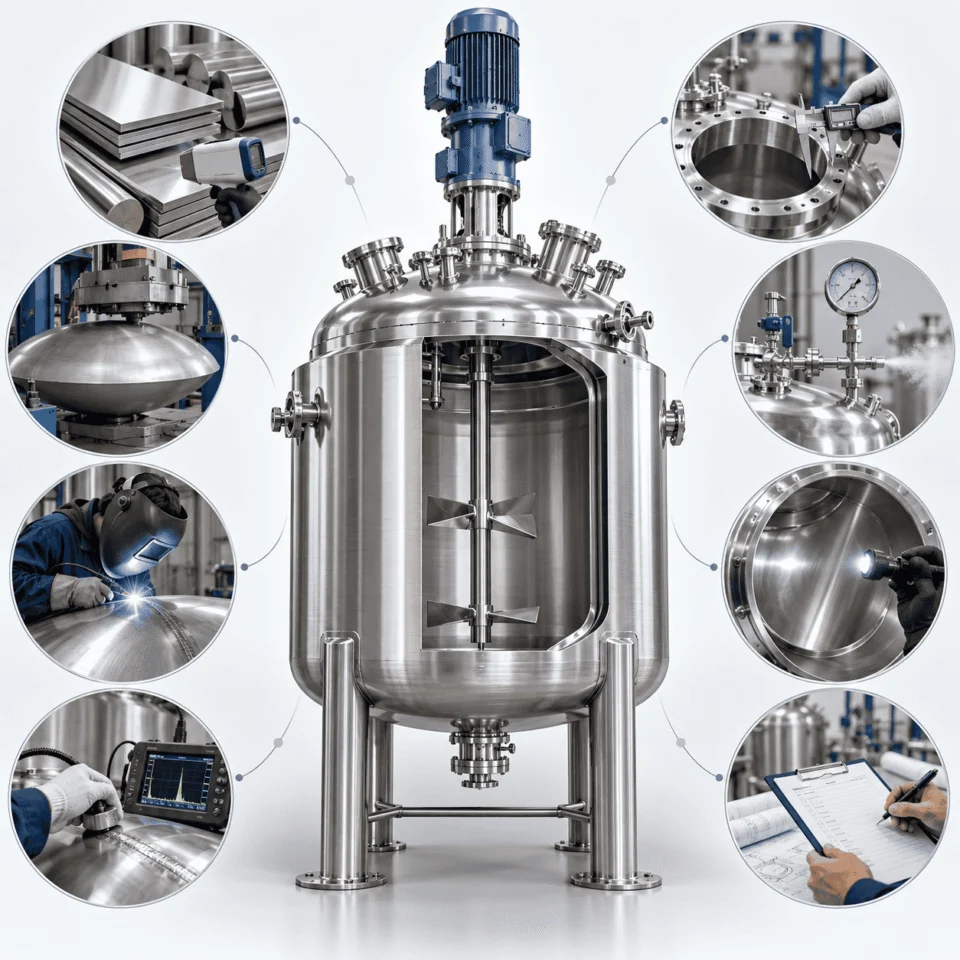
Material, welds, nozzle locations and test results are easier to verify when quality checks are built into the fabrication sequence.
Material identity and supporting documentation are reviewed before fabrication begins.
Shell seams, head joints, nozzles, jackets, coils, supports and agitator mounting areas receive process-specific attention.
Examination scope and method are selected according to the pressure boundary, applicable standard and project criticality.
Key dimensions are checked before shipment so the vessel can connect correctly to piping, platforms and surrounding equipment.
Testing can include hydrostatic, pneumatic where appropriate, jacket, leak and vacuum tests according to the design and purchase specification.
Mechanical polishing, pickling, passivation, electropolishing and project-specific external finishing can be incorporated.