Jacketed Mixing Tanks for Heating & Cooling
ChannelVessel designs and manufactures stainless steel jacketed mixing tanks around your working batch, product properties and temperature-control requirements. Combine conventional, dimple or half-pipe jackets with the agitation, instrumentation and utility connections your process needs.
Whether you are blending liquids, dissolving ingredients or heating and cooling a viscous batch, start with the result you need—not just a tank capacity. We use your process conditions to define the vessel, jacket, mixing arrangement and supply scope.

Illustrative configuration. Final specifications are defined for each project.
Jacketed Mixing Tank Specifications & Options
Discuss custom jacketed mixing vessel requirements from 50 to 30,000 L, with the usable batch range and configuration established for your process. Capacity reference points include 100, 300, 500, 1,000, 2,000, 3,000, 5,000 and 10,000 L.
These are inquiry starting points, not stock model numbers. State whether your requested capacity means total vessel volume or the quantity you need to process in one batch.
| Specification | Configuration options | What defines the selection |
|---|---|---|
| Batch capacity | Custom sizing around the requested batch range | Normal, minimum and maximum working batches; required freeboard |
| Product-contact material | SS304, SS316L or a project-specified material | Ingredients, concentration, temperature and cleaning chemistry |
| Jacket construction | Conventional, dimple or half-pipe; coverage and zones as designed | Heat-transfer duty, utility conditions and pressure ratings |
| Main agitator | Axial-flow, paddle, anchor, frame or scraper arrangement | Circulation, viscosity changes, solids and shear sensitivity |
| Additional mixing | Separately specified disperser or rotor-stator homogenizer | Dispersion or emulsification objective and required product result |
| Heating and cooling | Steam, hot water, thermal fluid, cooling water or chilled-fluid circuits | Available supply temperature, pressure, flow and return conditions |
| Temperature controls | Product sensors, PID controller or PLC with operator interface; recording options | Control sequence, monitoring and acceptance requirements |
| Surface finish | Industrial finish or agreed hygienic finish, including Ra targets | Product-contact requirements and inspection method |
| Vessel and jacket ratings | Separate design pressures and temperatures; vacuum where specified | Actual operating combinations and the applicable design basis |
| Connections and layout | Feed, discharge, sampling, cleaning and utility connections | Plant interfaces, maintenance access and installation space |
Selection note: Final dimensions, jacket area, drive power, operating speed and rated conditions are stated in the project specification. A larger capacity does not automatically define a particular motor or heating system.
For other vessel arrangements, explore our mixing tank configurations.
Choose a Configuration for Your Mixing Process
Use the process task to choose a starting arrangement. The following options describe configurable equipment—not fixed recipes or universal performance packages.
Liquid Blending & Dissolution
For liquid ingredient preparation, blending and dissolution, define the required circulation, addition sequence and acceptable shear. This can include compatible food ingredients, personal care formulations and industrial liquid blends.
A starting arrangement may combine a circulation-focused agitator, the required feed connections and a jacket serving the temperature step. Tell us whether ingredients arrive as liquids or powders and how you judge the finished batch.
Batch size, density, viscosity at the relevant temperature, ingredient addition sequence, foaming tendency and required mixing result.
Viscous Heating & Cooling
For products that become thick during processing, review the entire temperature cycle rather than only the warm, easy-to-mix condition. Anchor, frame or scraper-assisted arrangements can be evaluated alongside the jacket and drive system.
Include the most demanding mixing condition, such as a cooled batch or restart after a pause. The design review should address both bulk movement and product renewal near the heat-transfer wall.
Viscosity at more than one temperature, available rheology data, normal and minimum batches, startup condition, product sensitivity and discharge requirements.
Dispersion & Emulsification
When the task includes dispersing solids or forming an emulsion, specify the target product result separately from the need to heat or cool the batch. Bulk agitation and a high-shear workhead perform different duties and may be combined.
A jacketed tank with an agitator is not automatically a homogenizing system. Vacuum processing, where required, also needs its own vessel, sealing and system specification.
Formulation type, solids content, required fineness or emulsion characteristics, addition sequence, temperature stages and air-removal requirements.
Conventional, Dimple or Half-Pipe Jacket?
A jacket transfers heat through the vessel wall while keeping the product separate from the utility medium. The useful comparison is not simply which construction has the highest quoted pressure: it is which arrangement suits your thermal duty, flow conditions and batch range.
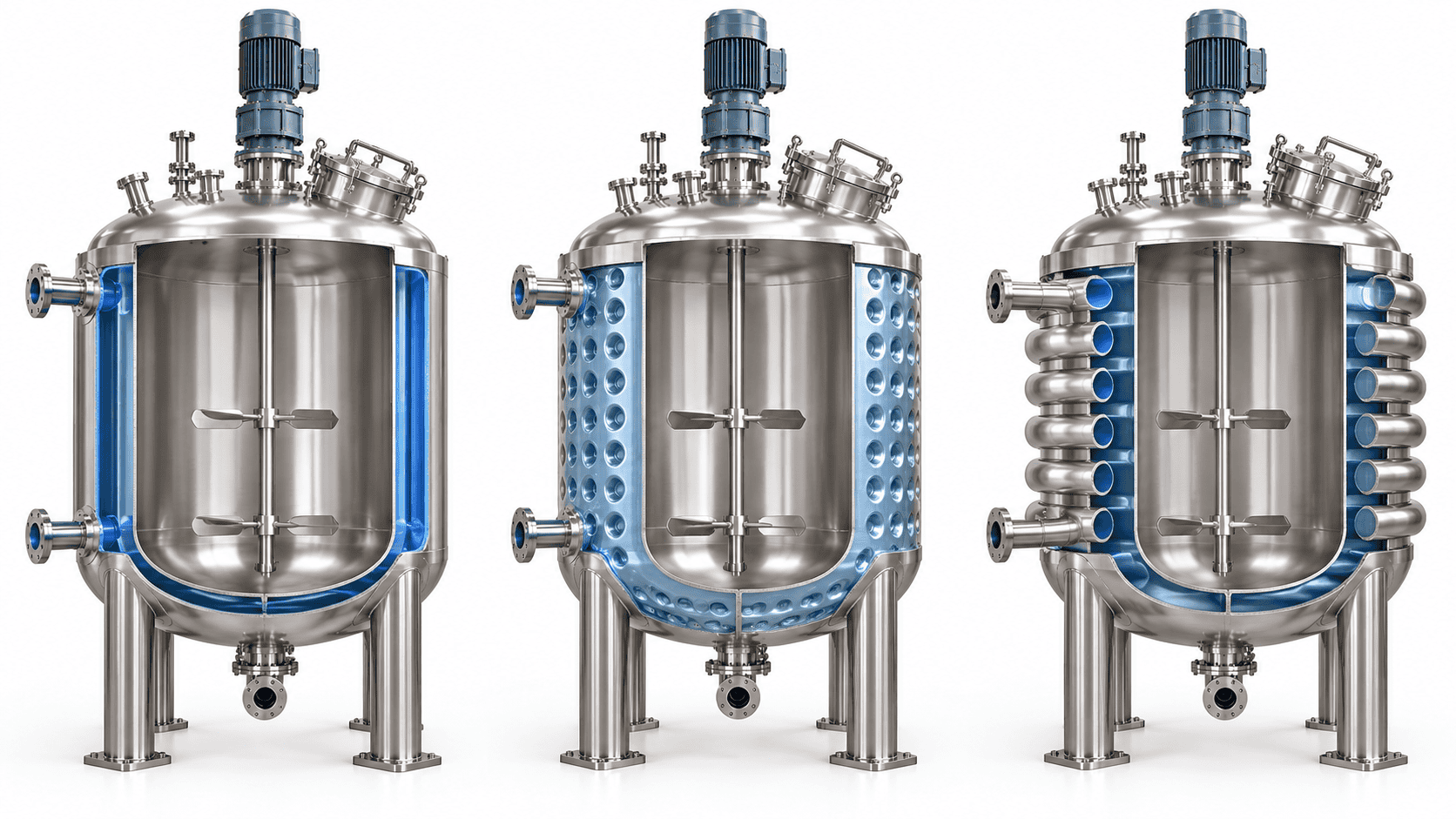
| Jacket type | Construction | Questions to resolve before selection |
|---|---|---|
| Conventional jacket | An outer shell creates an annular space; internal baffles may direct utility flow. | Which surfaces need coverage? How will the medium circulate or drain? What ratings apply to both spaces? |
| Dimple jacket | A patterned, attached stainless steel layer forms heat-transfer passages. | Which pattern and coverage are proposed? What flow, pressure drop and design conditions have been established? |
| Half-pipe coil jacket | Formed half-pipe sections welded to the vessel create defined external flow paths. | What circuit length, zoning and pressure drop suit the duty? How are temperature cycling and utility limits addressed? |
A half-pipe mixing vessel may be considered for demanding liquid heat-transfer duties, but the jacket type alone does not establish heating time, cooling time or a universal pressure rating.
Heating & Cooling Media: Match Your Available Utilities
The jacket is the heat-transfer interface. The source serving it may already exist at your plant or may need to be included in the equipment package.
Heating Connections
Identify the actual medium and its available conditions at the vessel, not only the boiler or heater nameplate.
- Hot water
- Provide the available supply temperature, expected return conditions, flow and pressure at the tank connection. Include any limits on the product’s exposure to a hot wall.
- Steam
- Specify the available pressure, supply conditions and condensate return arrangement. Control, condensate removal and the jacket’s approved operating conditions need to be coordinated.
- Thermal fluid
- Identify the fluid, operating temperature range, circulation conditions and compatibility requirements. The selected medium and equipment must suit the intended cycle.
- Electric heating
- Define whether electricity heats a circulating medium or another specified heating arrangement. Electric heating describes an energy source, not a fourth jacket construction.
Cooling Connections
For cooling water, chilled water or a glycol solution, provide the supply temperature, available flow, pressure and permitted return temperature.
Identify coolant composition where relevant and any variation in plant supply conditions.
Specify cooling conditions at the vessel connection, not only the chiller’s nameplate capacity. The circulation loop, piping and return arrangement belong in the same review.
Utility data to send
- Heating and cooling medium
- Available supply and expected return temperatures
- Available flow and pressure at the vessel
- Utility connection limits and plant operating variation
A system can be designed for heating followed by cooling, but different utilities must not be treated as interchangeable without an appropriate circuit and switching design.
Already have a boiler, chiller or temperature-control unit? Send its datasheet and the conditions available at the proposed tank location.
Heating & Cooling Duty: A Worked Example
Before selecting heating or cooling equipment, separate the energy needed by the product from the rate at which the system must transfer it.
One Batch, Two Different Duties
The following calculation uses a 1,000 kg water-like batch and a constant specific heat capacity of 4.18 kJ/(kg·K). It assumes no phase change or reaction and excludes vessel, accessory and circulating-fluid heat capacity, environmental heat exchange and agitator heat input.
| Batch task | Product sensible heat | Target time | Required average effective transfer rate |
|---|---|---|---|
| Heat from 20°C to 80°C | 69.67 kWh added | 60 minutes | 69.67 kW into the product |
| Cool from 80°C to 30°C | 58.06 kWh removed | 45 minutes | 77.41 kW out of the product |
Illustrative calculation only: this is not a ChannelVessel equipment test or a direct heater/chiller selection. It describes the product-only energy balance under the stated assumptions.
Calculate Product Heat Load
Product sensible heat, kWh = mass (kg) × specific heat [kJ/(kg·K)] × absolute temperature change (K) ÷ 3,600.
Average effective transfer rate, kW = product sensible heat (kWh) ÷ target time (hours).
Use the magnitude of the temperature change for either heating or cooling. If the batch is specified in liters, convert volume to mass using the product’s density rather than assuming every liter weighs one kilogram.
Why Nameplate Power Is Not Enough
Actual performance also depends on the effective jacket area, overall heat-transfer coefficient, circulation and available temperature difference. The temperature difference changes as the batch approaches its target.
A heater rating alone does not establish how much heat reaches the product throughout the cycle. Likewise, an average cooling load does not establish the chiller capacity available at the required fluid temperatures.
Batch Thermal Duty Estimator
Enter known batch conditions to estimate sensible heat and the required average effective rate.
Heating · product sensible heat
These results do not select a tank, heater or chiller, or predict the actual temperature curve.
Reference: How Product Properties Affect Heat Transfer View coefficient ranges
Spirax Sarco gives the following overall heat-transfer coefficient ranges for steam jackets with stainless steel walls and moderate agitation without close-clearance wall mixing. Values are condition-specific references, not ChannelVessel results or defaults for chilled-water, thermal-oil or scraper-assisted service.
| Product category | Reference U, W/(m²·K) |
|---|---|
| Water | 850–1,700 |
| Aqueous solution | 450–1,140 |
| Organics | 285–850 |
| Light oil | 340–910 |
| Heavy oil | 57–285 |
Technical reference: Spirax Sarco — Heating with Coils and Jackets.
Have a required heating or cooling time? Send the batch data and available utility conditions for review.
Agitators That Support Mixing and Heat Transfer
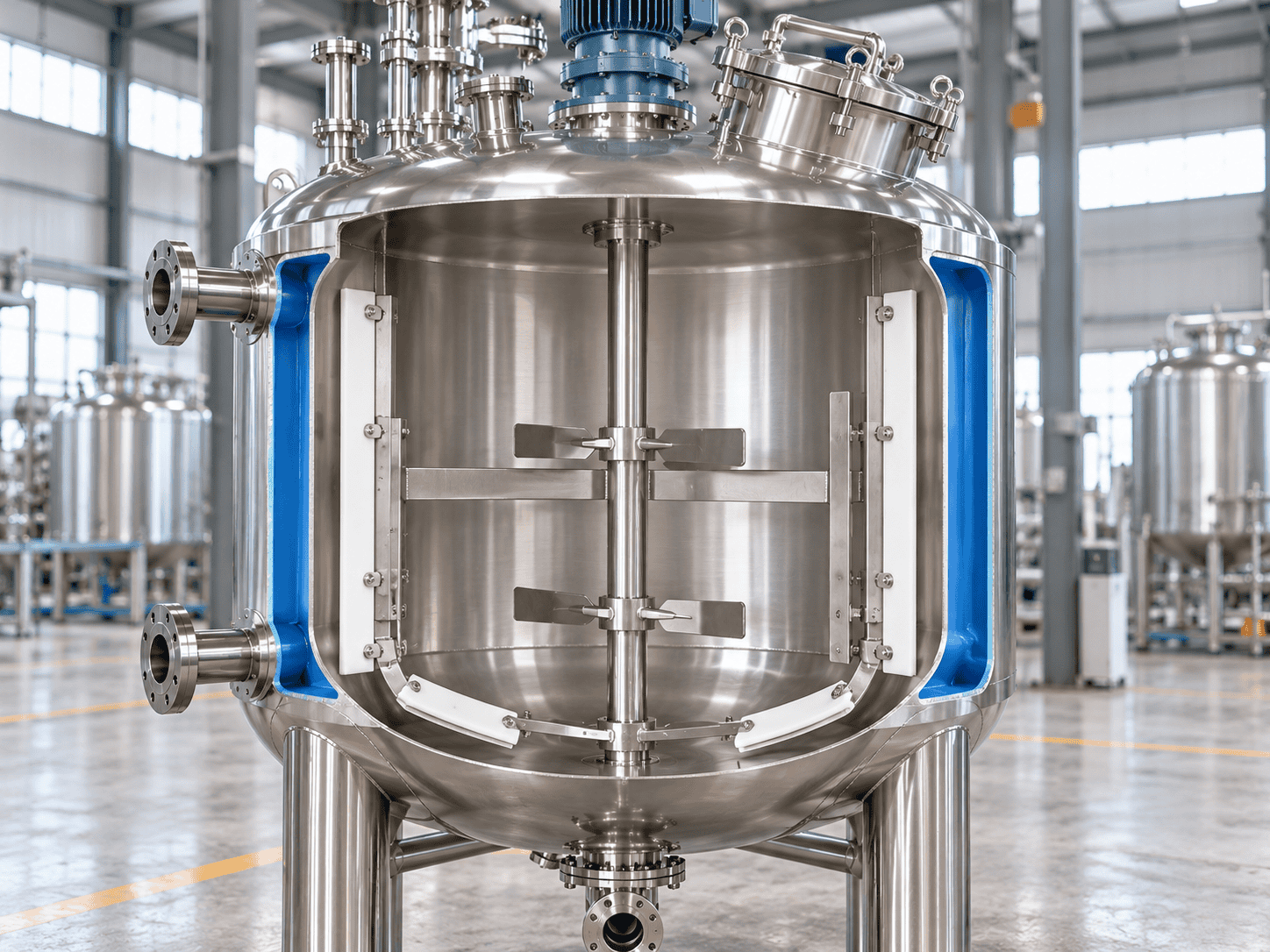
Selecting a jacketed mixing tank with an agitator involves more than choosing a motor power. Define how the product should move, how its viscosity changes and whether the process needs gentle circulation, wall renewal or additional shear.
Choose the Mixing Function First
Axial-flow or paddle arrangements
Can be evaluated for bulk circulation and blending. Impeller geometry, tank proportions, liquid level and product behavior define the arrangement.
Anchor or frame arrangements
Can be evaluated for viscous-product movement. Specify startup conditions and output torque as well as the operating speed range.
Scraper-assisted arrangements
Add a wall-contact function. Scraper material, mounting, contact, wear and cleaning access need to suit the product and temperature cycle.
High-shear mixing
Is a separate dispersion or emulsification function. It should not be added solely because a batch is viscous, or used as a substitute for specifying whole-vessel circulation.
Why Can Cooling Take Longer Than Expected?
For a product that thickens as it cools, material near the colder wall may become more resistant to movement. Review wall renewal, bulk circulation and coolant conditions together before assuming that a larger chiller is the only answer.
For your quotation, specify main-agitator and homogenizer duties separately. Include drive power, working speed range, output torque, gearbox, shaft and impeller arrangement, and seal requirements in the equipment review.
Working Volume, Minimum Batch & Jacket Coverage
Three volume descriptions belong in the specification. They answer different questions and should not be replaced by one nominal tank size.
- Total Vessel Volume
- The geometric internal volume of the vessel. It is not automatically the quantity available for production after allowing for the required operating space and process conditions.
- Normal Working Volume
- The batch quantity the equipment is intended to process during normal operation, with the required mixing and temperature-control functions.
- Minimum Working Batch
- The lowest agreed batch quantity for those functions. Check impeller and sensor immersion, circulation and effective heat-transfer coverage at this level—not just whether the liquid fits inside the tank.
Check the Jacket Against the Batch Range
Review sidewall and bottom coverage, active zones and liquid levels on the arrangement drawing. A large vessel does not automatically perform the same way at a much smaller fill level.
Tank proportions also affect how the batch, impellers, connections and heat-transfer surfaces fit together. Our guide to vessel geometry and design inputs provides further design context; the mixing and thermal requirements still need their own project review.
Vessel Pressure and Jacket Pressure Are Separate Ratings
A pressurized jacket does not mean the product vessel is rated for pressure or vacuum. The product chamber and the utility jacket are separate spaces with separate design conditions.
Product Vessel
Specify whether the product chamber operates at atmospheric pressure, positive pressure or vacuum. Identify its design pressure, design temperature, normal operating range and any required vacuum rating.
State the pressure basis clearly, such as gauge or absolute pressure. Avoid an unqualified number labeled only “working pressure.”
Heat-Transfer Jacket
Specify the jacket’s design pressure and temperature separately from the supply conditions used during normal operation. Identify the approved utility medium and the conditions expected during heating, cooling and changeover.
The allowable jacket conditions should not be inferred from a similarly named tank or a different jacket construction.
Review the Combined Conditions
The design review should consider the operating combinations, not two unrelated maximum numbers. A pressurized jacket around a vessel under vacuum is one example that needs explicit evaluation.
Confirm the mechanical design basis, sealing arrangement and required protective provisions before operation. Product temperature, utility supply temperature and equipment design temperature should remain separate fields.
For projects requiring pressure-rated equipment, review our jacketed pressure vessel design information alongside the mixing specification.
Temperature Control: Define What You Will Measure
A useful temperature requirement states what is being measured, where it is measured and under which batch conditions.
Four Different Performance Requirements
Measurement accuracy
Sensor specification, complete measurement loop and calibration method.
Holding stability
Permitted variation at a defined measurement location over an agreed holding period.
Temperature uniformity
Permitted difference between agreed locations within the batch.
Dynamic response
Heating/cooling target, overshoot and recovery under defined operating conditions.
A Pt100 Sensor Is Not a Whole-Tank Accuracy Guarantee
JUMO describes a Class A Pt100 tolerance of ±(0.15 + 0.002 × |t|)°C. At 80°C, this corresponds to ±0.31°C for that sensor tolerance calculation.
That number does not describe the total installed measurement error, temperature differences throughout the batch or the controller’s ability to hold a setpoint. Wiring, installation and the remainder of the measurement chain must also be considered.
Technical reference: JUMO — Pt100 Accuracy Classes.
Specify the Control Functions You Need
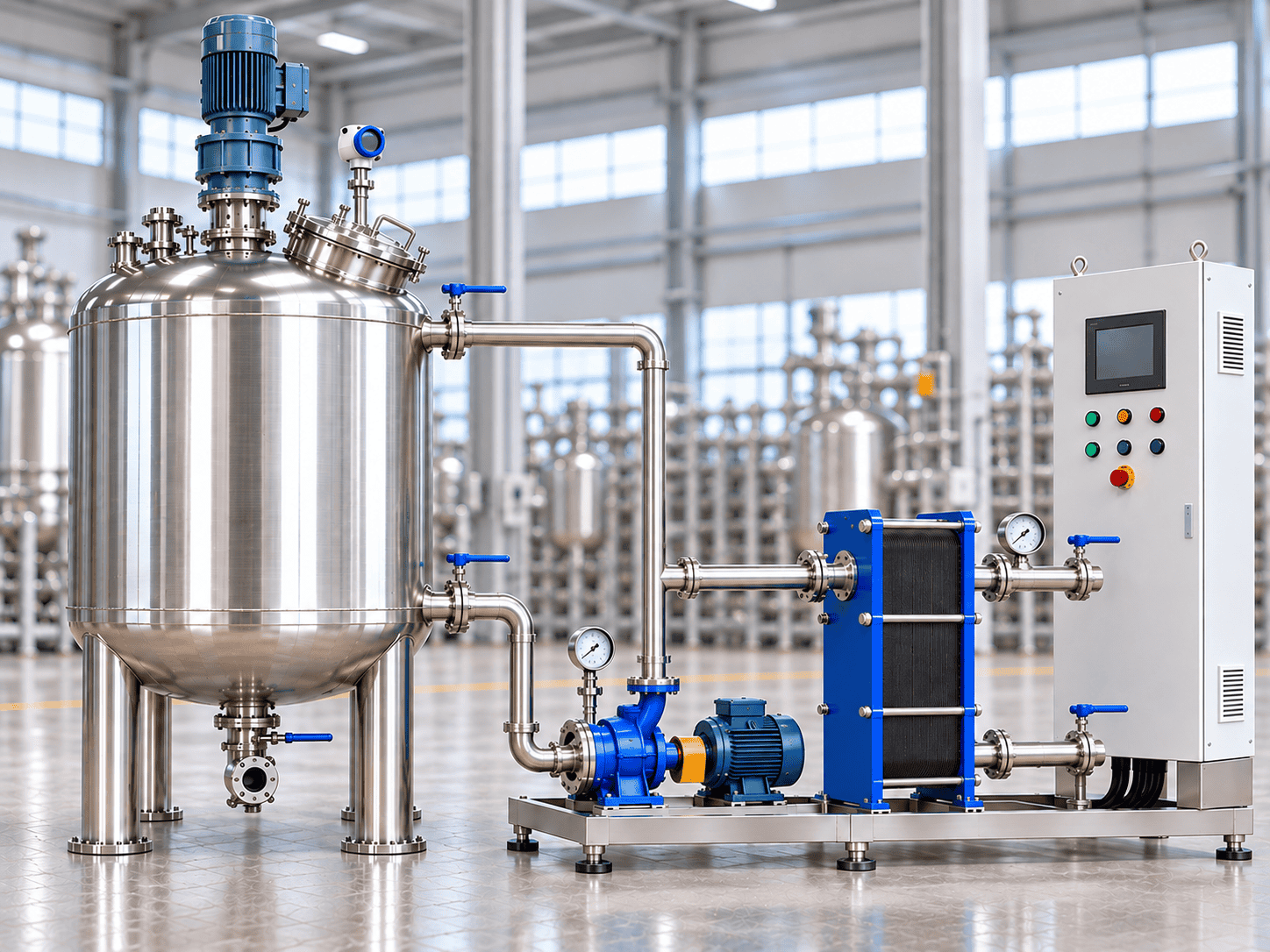
Options can include product-temperature measurement, jacket supply and return monitoring, PID control, a PLC with operator display and batch data recording. Define recipe steps and integration with existing plant controls where required.
Protective functions—such as overtemperature response, sensor-fault handling and flow, level or agitator interlocks—are established through the project review. They should not be assumed from the presence of a control panel.
Hygienic Design, Surface Finish & Cleaning Access
Specify the complete product-contact arrangement, not only the tank shell. Include the shaft, impellers, fittings, outlet valve, seals and cleaning connections.
Match Materials and Finish to the Process
SS304 and SS316L are product-contact options to assess against the ingredients and cleaning conditions. State concentrations, temperatures and cleaning chemicals so the review covers the operating cycle.
Hygienic finish targets can include Ra ≤0.8 μm, or Ra ≤0.4 μm where specified. Define the surfaces covered, agreed measurement locations and records required. A roughness value or polished appearance does not establish hygienic certification.
For a deeper comparison, see our stainless steel mixing tank materials and finishes guidance.
Design for Cleaning and Inspection
Cleaning requirements should be considered alongside the impeller, seals, outlet and jacketed-vessel geometry.
Review weld finishing, seal access, drain geometry and the ability to inspect product-contact parts. Include the outlet and areas around internal equipment rather than considering only the open wall surface.
For cleaning-in-place, match the cleaning device and its placement to the internal arrangement, available cleaning-fluid supply and required cleaning task. Agitators and other internals can create areas that need particular attention.
Installing a spray ball or rotary device does not, by itself, verify the cleaning result. Define the procedure and acceptance method separately, together with any parts that need removal.
The project specification should connect each hygiene requirement to a design detail or an agreed inspection record.
What Is Included in Your Jacketed Mixing Tank Quote?
Compare the complete supply scope, not only the vessel capacity. A jacketed tank and a complete temperature-controlled mixing package are different purchase scopes.
Define the Supply Responsibility
Ask for each item to be marked Included, Optional or By Others in the quotation.
| Supply item | What the quotation should clarify |
|---|---|
| Vessel, jacket and outer construction | Tank arrangement, jacket coverage, insulation and cladding scope |
| Mixing equipment | Main agitator, additional workheads, drives, seals and speed control |
| Instruments and controls | Sensors, control panel, records, alarms and agreed interfaces |
| Heating source | Connection to an existing source or a separately supplied heating package |
| Cooling source | Plant cooling connection or a separately supplied cooling package |
| Circulation equipment | Pumps, valves, expansion provisions and required utility-side components |
| Piping and connection boundaries | What is assembled with the equipment and what connects on site |
| Electrical and site work | Power connections, field wiring, installation and commissioning responsibilities |
| Documentation and acceptance | Agreed drawings, inspection records, manuals and test scope |
Compare Like-for-Like Offers
Included means supplied within the quoted package. Optional means offered as an additional item. By Others identifies equipment or work supplied by the customer or another contractor.
The final price depends on the specified batch range, material, design conditions, jacket, agitation, finish and system scope. Define these before comparing quotations for tanks with the same nominal capacity.
Engineering Review, Inspection & Project Documents
Agree the design inputs and acceptance requirements before fabrication. This turns general expectations such as “easy to clean” or “fast cooling” into items that can be checked against the project specification.
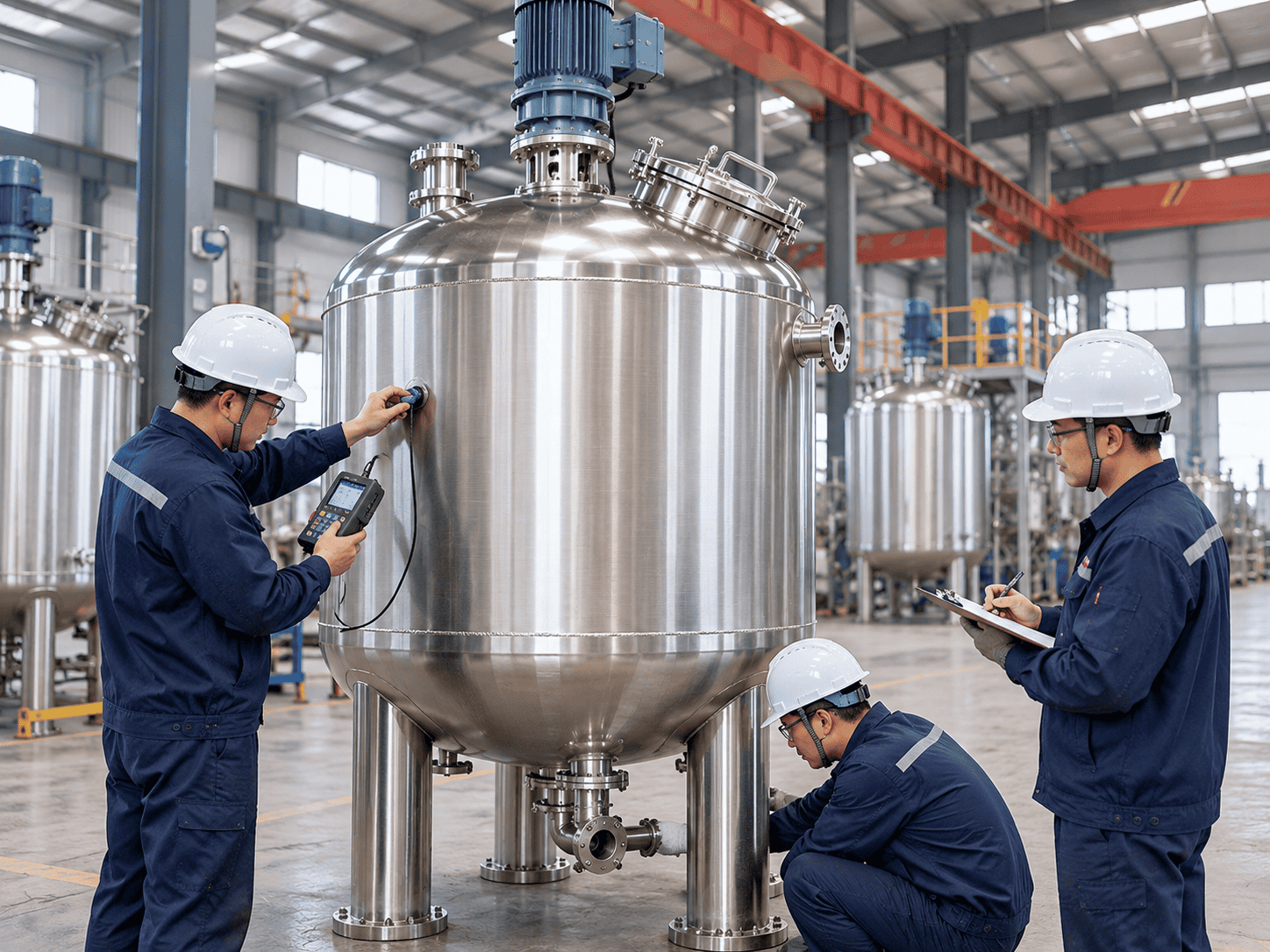
Design Review
Define total and working volumes, the minimum batch, jacket coverage and zones, agitation, connection positions, site clearances and the separate vessel and jacket design conditions.
Confirm the boundary between the tank, utilities, circulation package and plant controls. The agreed equipment datasheet and general arrangement drawing provide the basis for the supplied configuration.
Manufacturing and Functional Checks
Establish an inspection plan covering the relevant materials, fabrication, dimensions, surfaces, pressure-containing spaces and seals. Functional checks can address agitator direction, agreed speed range, instrumentation and specified control functions.
Test procedures and acceptance criteria follow the approved project documents. The test medium and conditions should be recorded rather than summarized as a generic “tested” claim.
Documents and Performance Acceptance
Agree the required drawing set, material records, inspection and test records, control information and operating or maintenance documents with the order.
Where thermal performance testing is included, define the medium, batch size, mixing condition, utility supply and measurement method. A water test should not be treated as a direct performance guarantee for an unrelated viscous product.
See our inspection and testing requirements guidance for document planning. The applicable checks depend on the project; pressure-vessel requirements should not be applied indiscriminately to every atmospheric mixing tank.
Jacketed Mixing Tank FAQs
Get clear answers about jacket construction, batch size, heating and cooling, pressure ratings, and what to provide when requesting a custom tank.
What is the difference between a jacketed mixing tank and a heated mixing tank?
“Jacketed” describes the construction used to transfer heat through the vessel wall. “Heated” describes a function and may involve a jacket or another heating arrangement. A jacketed mixing tank can also be configured for cooling when the vessel, utility circuit and control system are specified for that duty.
Does the tank include a heater, chiller or circulation unit?
Not automatically. A tank can connect to existing plant utilities or form part of a package that includes additional heating, cooling and circulation equipment. The quotation should identify each item as Included, Optional or By Others, including connecting pipework and site responsibilities.
Can the same tank heat and cool a batch?
Yes, when both duties are part of the design. Provide the complete temperature sequence and the available utilities. The jacket, seals, piping, changeover arrangement and controls need to suit that sequence; one circuit should not be assumed suitable for arbitrary utility changes.
Can the product vessel operate under pressure or vacuum?
Pressure or vacuum capability must be specified for the product chamber. A pressurized jacket does not establish either capability. State the required operating and design conditions for both spaces, including the pressure basis and any combinations of jacket pressure and product-side vacuum.
What minimum batch size can the tank process?
The minimum batch depends on the vessel geometry, impeller and sensor positions, product behavior and effective jacket coverage. It is not a fixed percentage of the nominal capacity. Provide your smallest batch and the mixing and temperature-control tasks that must still be achieved at that level.
Does a viscous product always need a scraper or homogenizer?
No. Scrapers help address wall-contact and heat-transfer needs in suitable arrangements; homogenizers address additional shear, dispersion or emulsification. They perform different functions. Selection depends on the formulation, viscosity changes, bulk circulation, temperature cycle and required final product characteristics.
Can heating time, cooling time and temperature uniformity be specified for acceptance?
Yes. These can be agreed as project-specific criteria after the process and utilities have been reviewed. Define the product or representative test medium, batch size, initial conditions, mixing state, measurement locations and available utility supply. An agreed test result applies to its stated conditions.
Can ChannelVessel manufacture to my drawing and site utility conditions?
Yes. Send the drawing, equipment specification or process and instrumentation diagram, together with batch requirements and site conditions. We can review the proposed configuration, connections, jacket, agitation and supply scope before the manufacturing specification is finalized.
Get a Quote for Your Jacketed Mixing Tank
Send your product, normal working batch, starting and target temperatures, required heating or cooling time, and available utilities to begin the equipment review.
Where available, include the smallest batch, viscosity at the relevant temperature, pressure or vacuum requirements, cleaning expectations, installation dimensions and destination country. Site voltage, frequency and connection standards help define the supplied arrangement.
You do not need every technical field completed before making an inquiry. Share the information already available and identify the items that still need to be established.
Already have a drawing or specification? Send it with your operating conditions so we can review the jacket, agitation, thermal requirements and supply boundaries together.
